Off-Plan Sales in Saudi Arabia: How the System Works and Where the Real Opportunities Are

Off-plan sales in Saudi Arabia have evolved from a speculative financing tool into a structured, regulated mechanism that underpins large-scale real estate development across the Kingdom. What used to be associated with emerging market risk is now increasingly framed as a controlled entry point into one of the fastest-growing property markets in the Middle East.
This shift is not accidental. It is the result of two parallel forces: a government-led transformation of the real estate sector under Vision 2030 and the introduction of a formal regulatory environment that defines how developers can launch, market and sell projects before completion.
For investors, this combination creates a market that behaves differently from both Dubai’s high-liquidity cycles and less regulated emerging markets. Understanding how off-plan sales actually function in Saudi Arabia is critical before evaluating specific opportunities.
Table of Contents

Unlike loosely regulated markets where off-plan sales often rely on developer credibility alone, Saudi Arabia operates within a defined legal structure that governs every stage of the process.
At the core of this system is mandatory project licensing. A developer cannot legally market or sell off-plan units without obtaining approval from the relevant authorities. This approval is not symbolic — it requires submission of project documentation, financial planning and construction timelines.
A central component of the framework is the escrow account mechanism. Buyer payments are not transferred directly to the developer’s operational accounts. Instead, they are held in regulated accounts linked to the specific project and released in phases tied to construction progress. This introduces financial discipline and significantly reduces the risk of fund misallocation.
Equally important is the restriction on land disposal once a project is registered. The underlying land cannot be freely sold or transferred in a way that would compromise buyer rights. In parallel, authorities retain the power to suspend or revoke licenses if developers fail to meet obligations or if project timelines are materially disrupted.
In cases where construction is halted for extended periods, regulatory bodies can intervene to protect buyers — including restructuring or reassigning project execution. While this does not eliminate risk, it changes its nature: from uncontrolled developer risk to monitored execution risk.
Today, these processes are operationalized through centralized systems such as Wafi, which standardize licensing, registration and compliance across off-plan developments in the Kingdom.
From a developer’s perspective, off-plan sales are not just about early revenue — they are embedded in how projects are structured and delivered.
Saudi Arabia is currently undergoing one of the largest real estate expansion cycles globally. Master-planned communities, giga-projects and urban redevelopment zones require capital efficiency at scale. Pre-sales allow developers to:
validate demand before full capital deployment
sequence construction phases based on real absorption
reduce dependency on external financing
But the more important shift is operational. Off-plan sales in Saudi Arabia are increasingly data-driven. Developers are not just selling units early — they are actively managing inventory release, pricing curves and buyer segmentation across different project stages.
This is where the market begins to resemble more mature ecosystems: sales operations, not just construction, become a core competency.
The appeal of off-plan property is straightforward: early entry typically comes with pricing incentives. Developers offer lower launch prices, flexible payment plans and staged increases as the project progresses.
In Saudi Arabia, this model is reinforced by the scale of development. Entire districts are being built from the ground up, which creates long-term appreciation potential tied not just to individual buildings but to infrastructure, connectivity and urban planning.
However, the risk profile is often misunderstood.
The primary risk is no longer fraud or capital mismanagement — those are largely mitigated by escrow structures and licensing. The real variables are:
delivery timelines in large-scale developments
supply concentration in emerging districts
long-term positioning of the project within the broader urban plan
Liquidity is another factor. Unlike completed properties, off-plan units may be harder to exit before handover, especially in segments with high upcoming supply.
In practice, this means that off-plan investments in Saudi Arabia are better aligned with medium- to long-term strategies rather than short-term flipping.
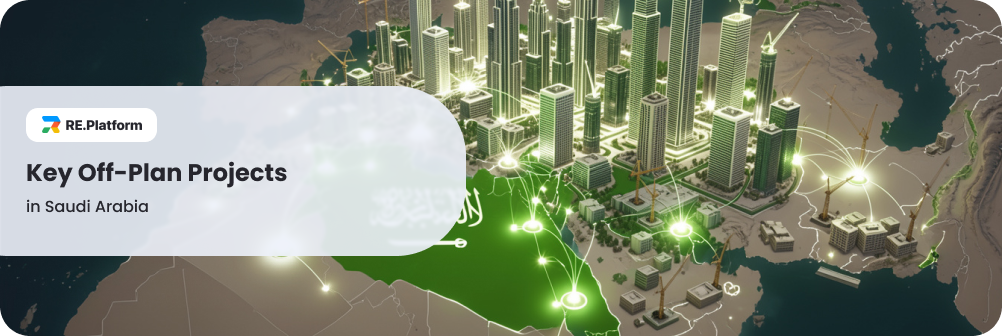
The Saudi off-plan market is not defined by volume alone, but by the type of developments being launched. Recent projects reflect a clear shift toward branded residences, large-scale mixed-use districts and government-backed transformation zones.
Instead of fragmented construction, developers are increasingly building fully integrated environments — combining residential units with hospitality, retail and infrastructure.
| Project | City | Segment | Positioning |
|---|---|---|---|
| Trump Tower Jeddah | Jeddah | Luxury residential | Branded high-rise, waterfront location |
| Four Seasons Residences | Jeddah / Riyadh | Ultra-luxury | Hospitality-driven branded living |
| Neptune Interiors (Sedra) | Riyadh | Luxury villas | Designer-led residential community |
| RAYANA by DarGlobal | Diriyah (Riyadh) | Ultra-luxury estates | Low-density heritage-integrated living |
Trump Tower Jeddah represents one of the most visible examples of branded real estate entering the Saudi market. Positioned along the Jeddah Corniche, the project is designed as a high-rise residential tower targeting high-net-worth buyers. Its investment appeal is not limited to location — it is tied to brand recognition, which often plays a critical role in resale value and international demand. At the same time, the long development horizon means that this is a capital appreciation play rather than a short-term yield asset.
The Four Seasons Residences in Jeddah and Riyadh follow a slightly different model. Here, the focus is on integrating residential ownership with hospitality standards. Buyers are not just purchasing property — they are entering an ecosystem defined by service, management and global brand positioning. Historically, such projects demonstrate stronger resilience in volatile markets due to consistent demand from international investors and premium tenants.
In Riyadh, developments within Sedra — including Neptune Interiors by Mouawad — illustrate how the domestic market is evolving. These are not speculative luxury towers but structured residential communities with a strong emphasis on design and livability. The inclusion of branded interior concepts signals a shift toward product differentiation even in villa segments, which traditionally relied more on location than on design identity.
RAYANA by DarGlobal in Diriyah operates at an entirely different level of scarcity. Located within the Wadi Safar area, this project is part of a broader government-backed cultural and lifestyle transformation zone. Large plot sizes, limited supply and proximity to heritage landmarks create a unique positioning where value is driven not just by real estate fundamentals, but by the strategic importance of the location itself. For investors, this translates into a longer-term horizon with potential for significant upside tied to district-level development.

The trajectory of off-plan sales in Saudi Arabia suggests continued expansion, but with increasing selectivity.
Developers are no longer competing purely on price or location. The focus is shifting toward:
integrated communities rather than standalone buildings
branded and differentiated products
operational efficiency in sales and delivery
At the same time, regulatory oversight is becoming more structured, which may gradually increase barriers to entry for smaller or less organized developers.
For investors, this means that project selection will matter more than market timing. The gap between high-quality, well-positioned developments and average inventory is likely to widen.
Is off-plan property in Saudi Arabia safe today?
It is significantly more structured than in many emerging markets due to escrow systems and licensing requirements. However, execution risk at the project level still exists.
What role does escrow play in protecting buyers?
Funds are released in stages based on construction progress, which limits misuse of capital and aligns developer incentives with delivery.
Are branded residences a better investment?
They often carry price premiums but can offer stronger resale value and international demand, depending on location and operator.
Can off-plan units be resold before completion?
In some cases yes, but liquidity depends heavily on project demand and market conditions.
Which cities dominate off-plan activity?
Riyadh leads in terms of volume and strategic importance, while Jeddah remains key for coastal and lifestyle-driven developments.
Off-plan sales in Saudi Arabia are no longer defined by risk alone — they are defined by structure.
The Kingdom has built a system where early-stage investment is tied to regulated processes, institutional-scale development and long-term urban planning. At the same time, the market is becoming more complex, with clear segmentation between mass housing, branded luxury and government-backed mega-projects.
For investors and market observers alike, the key shift is this: off-plan in Saudi Arabia is not just about buying early — it is about understanding how each project fits into a much larger transformation of the country’s real estate landscape.