Where to Find Property in Saudi Arabia and the UAE: A Guide to Modern Real Estate Search

Over the past decade, Saudi Arabia and the UAE have transformed into two of the most active real estate markets in the GCC. What was once a region dominated by local demand has evolved into a landscape shaped by international investors, large-scale development strategies and long-term economic reforms.
In Saudi Arabia, Vision 2030 has fundamentally changed how cities grow. Entire districts are being built from the ground up, and new residential formats are emerging across Riyadh, Jeddah and other urban centers. This has led to a surge in real estate projects in Saudi Arabia, with both government-backed and private developers expanding supply.
The UAE, and Dubai in particular, represents a more mature but still highly dynamic environment. The market here is characterized by transparency, international accessibility and a constant pipeline of new developments in Dubai, including a strong focus on off-plan real estate.
Across the wider GCC, these trends are converging. Investors are no longer looking at single cities — they are comparing opportunities across countries, evaluating where capital can be deployed most efficiently.
Table of Contents
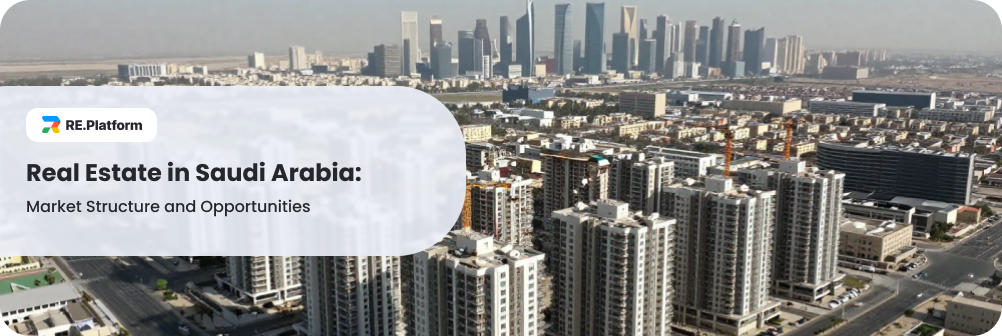
The Saudi market is still in a phase of structural expansion. Unlike more mature markets, it is not yet fully centralized or standardized, which creates both challenges and opportunities.
Buyers exploring property in Saudi Arabia are entering a landscape where supply is growing rapidly but information remains fragmented. A significant portion of inventory is tied to new developments, many of which are released in phases rather than through fully transparent listing systems.
This is especially visible in major cities. In Riyadh, for example, demand is concentrated around newly developed districts, where infrastructure expansion and residential construction are happening simultaneously. As a result, new projects in Saudi Arabia often represent the primary entry point for both investors and end users.
Another defining characteristic is the increasing role of large developers. Companies such as ROSHN and Dar Al Arkan are shaping entire communities rather than individual buildings. This shifts the focus from single properties to integrated developments, where buyers evaluate not just a unit, but the surrounding environment and long-term growth potential.
In contrast, the UAE offers a more structured and accessible real estate ecosystem. Buyers searching for property in Dubai typically interact with a well-established network of listing platforms, brokers and developers.
The availability of data is significantly higher. Listings are standardized, pricing is more transparent and transaction processes are clearly defined. This makes the UAE one of the easiest entry points for international buyers looking at Dubai real estate for sale.
Another key feature is the dominance of the off-plan segment. A large share of transactions in Dubai is tied to projects that are still under development. Buyers are not just purchasing completed units, but investing in future supply through off-plan properties in Dubai, often with flexible payment structures.
At the same time, the market remains highly competitive. New launches are constant, and developers actively differentiate their projects through location, amenities and pricing strategies. This creates a dynamic environment where opportunities exist across multiple price segments.
Despite rapid growth, property search across the GCC is still far from unified. Unlike markets with centralized listing systems, Saudi Arabia and, to a lesser extent, the UAE operate through a combination of fragmented channels.
Buyers typically navigate between:
listing platforms
developer announcements
broker networks
direct project marketing
This fragmentation becomes even more visible when comparing opportunities across countries. Someone evaluating real estate projects in the GCC often has to switch between multiple sources just to build a basic understanding of available supply.
As a result, the process of finding property is not just about browsing listings — it is about assembling information from different layers of the market.
The way buyers approach property search differs significantly between the two markets.
In Saudi Arabia, discovery is often driven by projects rather than listings. Buyers look for developments, track new releases and evaluate opportunities at the community level. Access to information is less centralized, which makes local knowledge and developer visibility more important.
In Dubai, the process is more listing-driven. Buyers can filter properties based on price, location and type, often without direct interaction with developers at the early stage. The ecosystem is designed for accessibility and speed.
This difference has a direct impact on how opportunities are identified. In Saudi Arabia, early access to new real estate projects can be a competitive advantage. In Dubai, efficiency comes from comparing existing inventory across platforms.
| Factor | Saudi Arabia | Dubai |
|---|---|---|
| Search approach | Project-driven (focus on developments) | Listing-driven (focus on units) |
| Market structure | Fragmented, still evolving | Mature and well-structured |
| Data availability | Limited, less centralized | High, standardized across platforms |
| Main entry point | Developers and new projects | Portals and brokerage platforms |
| Off-plan role | Growing but not dominant | Core part of the market |
| Buyer behavior | Long-term, family-oriented | Investment-driven, flexible |
| Transparency | Medium | High |
| Speed of search | Slower, requires deeper research | Fast, filter-based search |
| Access to supply | Often indirect (via developers) | Direct and widely accessible |
There are several primary channels through which buyers search for property, each with its own limitations.
Real estate portals are the most obvious starting point. They provide a broad overview of available inventory and allow users to filter listings. However, they often focus on secondary market supply and may not fully capture newly launched developments.
Working directly with developers is another common approach, particularly in Saudi Arabia. This gives access to early-stage projects and off-plan opportunities, but requires awareness of which developers are active in the market.
Brokers and agencies act as intermediaries, helping buyers navigate options and handle transactions. Their effectiveness depends heavily on individual expertise and network coverage.
Finally, a newer category is emerging — platforms that aggregate projects rather than individual listings. These tools are designed to provide a structured overview of real estate developments across multiple cities, making it easier to compare opportunities at scale.
One of the most common mistakes is relying on a single source of information. Many buyers limit themselves to listing platforms, which can result in a narrow view of the market.
Another issue is focusing too heavily on price without considering the broader context. Location, developer reputation and project stage often have a greater impact on long-term value than initial pricing alone.
Buyers also tend to underestimate the importance of timing. Entering a project at an early stage can significantly affect both pricing and selection, particularly in markets driven by off-plan development.
Finally, there is a tendency to treat Saudi Arabia and the UAE as identical markets. In reality, they operate under different dynamics, and strategies that work in Dubai do not always translate directly to Saudi cities.