Why Property Listings Don’t Reflect Reality in Saudi Arabia


On the surface, the Saudi real estate market looks increasingly accessible. A growing number of platforms, listings and portals suggest that buyers now have visibility into available properties across Riyadh, Jeddah and beyond. For a first-time observer, it can feel comparable to mature markets — structured, searchable, and transparent.
But that impression doesn’t hold for long.
Spend a few days actively trying to find a property, and the gap becomes obvious. Units marked as “available” are already reserved. Prices shift between inquiry and follow-up. Entire projects appear fragmented across multiple platforms, each showing partial or outdated information. What initially looks like a broad selection often turns out to be a thin layer of visibility over a much more complex system.
The issue isn’t that platforms are poorly built. It’s that the listing model itself does not map well to how the Saudi market actually operates.
Table of Contents

In many Western markets, listings are the backbone of property discovery. Agents upload inventory, platforms aggregate it, and buyers browse a relatively accurate snapshot of what’s available. The system works because supply is distributed, and data flows are relatively standardized.
Saudi Arabia operates differently.
The market is fundamentally developer-driven, not broker-driven. Large-scale residential projects — often comprising hundreds or thousands of units — are managed internally by developers. Inventory, pricing and availability are controlled within proprietary systems that are rarely synchronized in real time with external platforms.
Listings, in this context, are not a source of truth. They are a derivative layer — often delayed, incomplete, and sometimes intentionally simplified for marketing purposes.
The discrepancy between listings and reality isn’t random. It follows a predictable pattern rooted in how information moves across the market.
At the project level, availability changes constantly. Units are reserved, released, repriced or bundled into offers as sales progress. Internally, this is tracked with precision — often down to individual units and buyer interactions.
Externally, however, that precision is lost.
Listings are typically updated manually or in batches. In some cases, they are not updated at all once published. Marketing teams prioritize visibility over accuracy, which leads to “starting from” prices and generalized availability labels that no longer reflect actual conditions.
The result is a time lag — sometimes measured in hours, often in days — between what is happening inside a developer’s system and what appears on public platforms.
One of the most common frustrations for buyers is the mismatch between listed availability and actual access to units.
A unit may appear available for several reasons:
This creates a recurring pattern where initial interest is built on inaccurate assumptions. By the time a buyer engages with a sales team, the options have already shifted.
A simplified comparison illustrates the gap:
| Stage | What the Listing Shows | What the Buyer Encounters |
|---|---|---|
| Discovery | Multiple available units | Limited or no matching units |
| Pricing | Broad “from” ranges | Specific units at different price points |
| Availability | Immediate purchase implied | Reservation queues or waiting lists |
| Comparison | Multiple projects side by side | Fragmented data across sources |
The friction doesn’t come from lack of supply. It comes from lack of synchronized visibility.
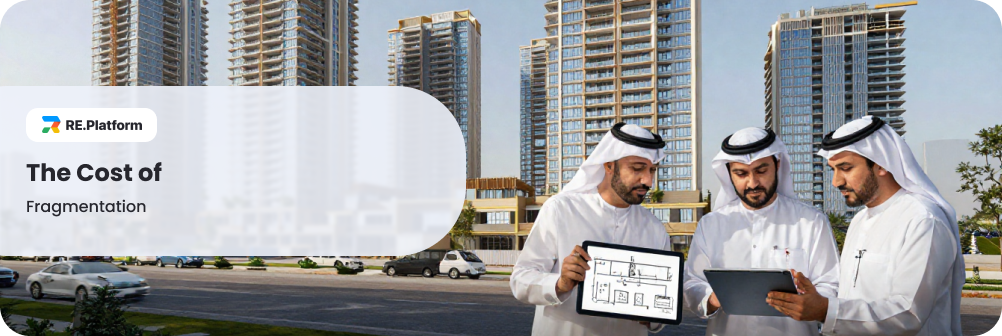
For buyers, this disconnect translates into more than inconvenience.
Time is the most immediate cost. What appears to be a structured search quickly becomes a series of conversations, follow-ups and manual comparisons. Instead of filtering options online, buyers reconstruct the market piece by piece.
More importantly, decision-making becomes less informed. Without consistent data, comparing projects on price, availability or delivery timelines becomes difficult. This often shifts control toward intermediaries — agents, brokers or sales representatives — who operate with access to more complete information.
From a market perspective, fragmentation introduces inefficiencies. Demand signals are harder to interpret. Pricing transparency decreases. And the overall experience becomes dependent on who you know rather than what you can see.
The reality of property search in Saudi Arabia is far more relationship-driven than platform-driven.
Serious buyers rarely rely on listings alone. They engage directly with developers, attend project launches, or work through networks that provide access to internal availability data. In many cases, the most relevant options are never fully visible online.
This creates a two-layer market:
The gap between these layers is where most of the friction sits.
For years, this structure was sustainable. The market was largely domestic, demand was predictable, and buyers were accustomed to navigating opaque systems.
That is changing.
The opening of the Saudi real estate market to foreign buyers, combined with increasing institutional interest, is putting pressure on the existing model. International investors expect a different level of transparency — not necessarily perfect, but structured and comparable.
At the same time, developers themselves are facing new operational challenges. Managing large inventories across multiple projects without real-time visibility creates inefficiencies not only for buyers, but internally.
These forces are converging toward a single requirement: better data structure.

The limitation of listings is not a technical flaw — it is a conceptual one. Listings focus on individual units, while the Saudi market operates at the level of projects.
A more accurate representation of the market starts with the project itself:
This shift — from unit-level listings to project-level discovery — changes how buyers interact with the market. Instead of chasing individual listings, they navigate structured datasets.
A simple comparison highlights the difference:
| Model | Listings-Based Search | Project-Based Search |
|---|---|---|
| Data structure | Fragmented | Centralized |
| Update frequency | Delayed | Near real-time |
| Comparison | Limited | Structured |
| Buyer experience | Reactive | Informed |
The distinction is subtle but fundamental. It aligns the discovery process with how the market actually functions.
The Saudi real estate market is not lacking in supply, demand or capital. What it is still developing is the infrastructure that connects them efficiently.
Listings were a necessary first step — a way to introduce visibility into a historically opaque system. But as the market grows in scale and complexity, that layer is no longer sufficient.
What replaces it will not be a better listing platform. It will be a different approach to how data is structured, shared and consumed.
And once that shift takes hold, the gap between what buyers see and what actually exists on the market will begin to close.