Geopolitics Meets Property: How the March 2026 Iran War Repriced Risk for Saudi Developers

On March 24, 2026, Saudi Arabia lost something more important than a conference. The World Economic Forum postponed its Global Collaboration and Growth Meeting in Jeddah — a flagship event designed to bring institutional investors, sovereign funds and international partners into direct contact with the Kingdom’s economic transformation agenda. Officially, the reason cited was “current regional developments.” In practice, it marked the moment when geopolitical tension began to interfere not with market sentiment alone, but with the infrastructure of capital formation itself.
Within days, financial markets began to reflect the same recalibration. On March 26, Gulf equities diverged sharply. Dubai’s main index dropped 3.2%, Abu Dhabi fell 1.8%, while Saudi Arabia edged up 0.1%. Four days later, on March 30, Saudi equities rose 0.8% despite continued fragility across neighboring markets. This was not resilience in the conventional sense. It was selectivity — a market beginning to distinguish between exposure, rather than exiting the region entirely.
For real estate developers, that distinction matters more than volatility itself. Property markets do not collapse on geopolitical headlines. They adjust through the behavior of capital, and capital, in March 2026, did not disappear. It hesitated.
Table of Contents
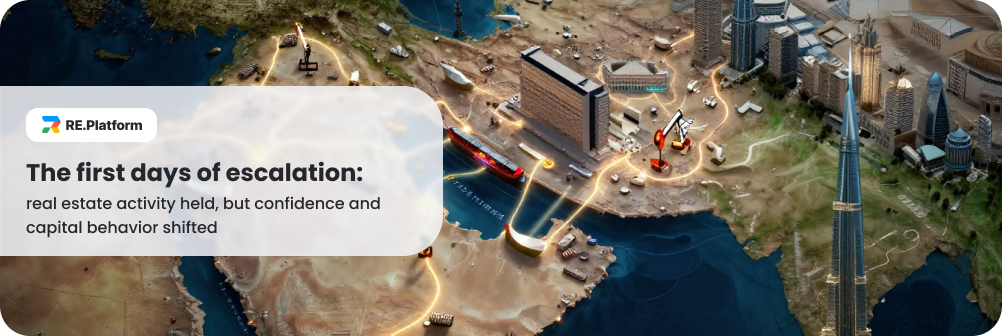
The opening phase of March 2026 did not produce any visible disruption in Saudi Arabia’s real estate development activity. Construction sites across Riyadh, Jeddah and emerging urban zones continued operating at full capacity, and there were no public announcements from major developers indicating halted projects, withdrawn launches or frozen pipelines.
At the level of physical execution, the system remained intact.
However, the surrounding environment changed almost immediately — and that is where the real signal emerged.
Between March 2 and March 10, the region experienced a sequence of escalation events that directly affected investor perception rather than construction itself. Attacks targeting energy infrastructure, including facilities linked to Saudi Aramco, combined with broader instability across the Gulf, triggered a sharp repricing of geopolitical risk. Oil markets reacted first, with Brent crude moving above $110 per barrel, briefly approaching the $115–119 range as concerns grew around potential disruption in the Strait of Hormuz — a corridor responsible for roughly 20% of global oil flows.
This macro shift fed directly into financial and operational conditions.
Institutional investors began reassessing regional exposure, not through immediate withdrawal, but through delayed commitments and stricter internal approval thresholds. International business travel softened, particularly among European and Asian capital allocators. Insurance premiums tied to logistics, construction and cross-border operations began to rise, while shipping costs reflected elevated risk in key maritime routes.
For developers, none of these factors stop projects already in motion. What they do instead is slow down the next layer of activity — transactions, partnerships, land acquisitions and new project launches.
By the end of the first week of March, the pattern was already visible across the market:
construction continued, but capital became slower, more cautious and more selective.
| Area | Pre-escalation behavior | First week of March | Real impact on developers |
|---|---|---|---|
| Construction activity | Stable, uninterrupted | No disruption | Projects continue as planned |
| Development pipeline | Active launches | No cancellations | Pipeline intact |
| Investor behavior | Aggressive / expansion-driven | Delayed decisions | Slower deal approvals |
| Oil prices | ~$80–90 range | $110–119 spike | Stronger macro support, higher volatility |
| Insurance & logistics | Normal conditions | Risk premiums increase | Higher operating costs |
| Capital deployment | Fast-moving | Selective / cautious | Fewer immediate commitments |
| Buyer sentiment | Momentum-driven | Wait-and-see mode | Longer sales cycles |
Expert commentary:
“In markets like Saudi Arabia, construction is the last thing to stop. What changes first is the speed of money — and in March, that speed dropped almost immediately.”
— GCC-based real estate investment advisor
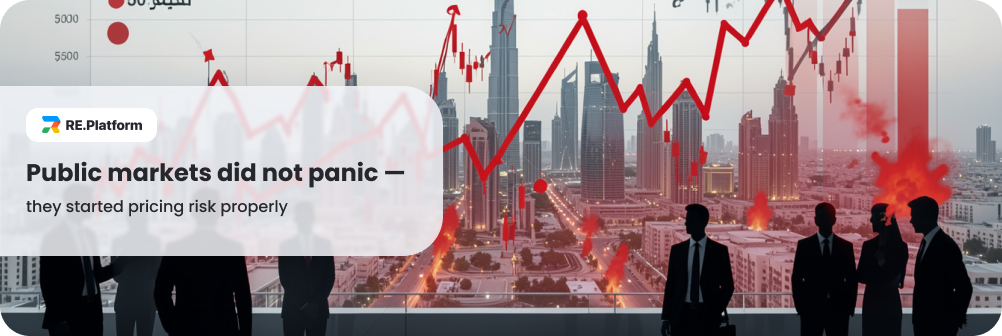
The clearest real-time signal of how the shock was absorbed did not come from construction activity or developer announcements. It came from listed equities.
Throughout March, Saudi real estate developers did not experience a sharp sell-off. Instead, they moved in tight, controlled ranges — but with visible sensitivity to geopolitical headlines. That distinction is important. Markets were not reacting with panic. They were adjusting exposure.
Dar Al Arkan spent most of the month fluctuating around the SAR 18 level, occasionally testing the 18.3–18.4 range before pulling back. Jabal Omar traded near SAR 16 with limited directional momentum, reflecting a market that lacked conviction rather than one under pressure. Retal moved within a narrower corridor between SAR 13.4 and 13.7, showing mild downward drift but no structural breakdown.
Emaar Economic City, however, provides a more precise view of how sentiment evolved day by day.
Between March 24 and March 30, the stock moved from SAR 10.03 down to 9.67, with intermediate fluctuations — 9.78 on March 25, a slight recovery to 9.80 on March 26, and then continued softness into month-end. This sequence does not indicate a collapse. It shows something more telling: the market recalibrating risk in response to incoming information, almost in real time.
To frame it more clearly:
| Company | Early March Range | Late March Range | Interpretation |
|---|---|---|---|
| Dar Al Arkan | ~18.3–18.4 | ~18.0–18.1 | Stable, low risk premium |
| Jabal Omar | ~16.1 | ~15.9–16.0 | Neutral positioning |
| Emaar EC | ~10.0 | ~9.6–9.7 | Sensitive to sentiment |
| Retal | ~13.7 | ~13.4 | Mild pressure |
What stands out is not the magnitude of the moves, but their consistency.
There was no broad-based exit from the sector. Instead, capital became more selective, adjusting positions incrementally rather than abandoning exposure altogether.
“What we saw in March wasn’t a sell-off of Saudi developers,” a GCC-focused equity analyst noted. “It was the market starting to price risk properly — and that means some names hold, while others start to drift.”
That distinction defines the entire period.
The market did not turn against real estate.
It began to differentiate within it.
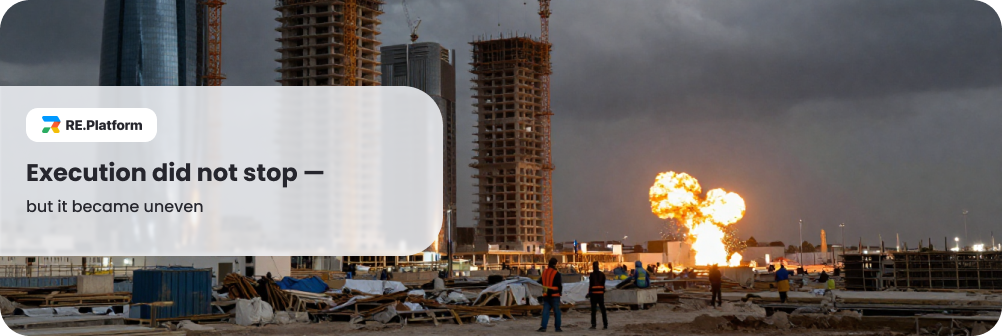
If capital markets reflected hesitation, developer activity itself revealed something more structural.
On March 2, at the very beginning of the escalation cycle, ROSHN announced land sale and development agreements in Riyadh’s WAREFA community valued at more than SAR 1.4 billion, covering over 223,000 square meters. The timing is important. This was not a post-shock adjustment. It was execution proceeding despite rising geopolitical tension.
The implication is clear.
The war did not freeze development activity. It exposed the hierarchy within it.
Developers backed by state capital or institutional structures continued to move forward with relative confidence. Those dependent on discretionary investment flows, pre-sales momentum or external capital became more cautious.
The market did not split visibly in terms of headlines. It split operationally — into those who could proceed regardless of sentiment, and those for whom sentiment became a constraint.

For most of the past several years, Saudi Arabia’s real estate market operated in an environment where capital moved faster than risk assessment. Large-scale projects were launched into a backdrop of strong demand, rising investor interest and consistent state-backed expansion. In that setup, speed itself became an advantage — developers could rely on momentum to absorb inefficiencies in structure, pricing or positioning.
March 2026 disrupted that dynamic.
Not by reducing demand in absolute terms, but by forcing capital to reassess how and where it commits. The shift was not visible in construction activity or headline project pipelines. It was visible in behavior: investment committees taking longer to approve deals, buyers delaying entry points, and developers adjusting expectations around absorption rates and sales velocity.
What had previously been a momentum-driven market began to behave like a capital-disciplined one.
The difference is material.
In a momentum environment, capital flows broadly across the sector. In a risk-adjusted environment, it concentrates. Projects backed by strong balance sheets, institutional partners or alignment with national development priorities continue to attract funding and maintain execution pace. At the same time, projects that depend on aggressive pre-sales, speculative positioning or weaker financial structures face friction — not necessarily rejection, but delay, repricing and reduced appetite.
This is not a contraction. It is a filtering mechanism.
“What changed in March wasn’t the size of the opportunity,” a Gulf-based fund manager noted. “It was the tolerance for ambiguity around it.”
That distinction defines the current phase of the market. Saudi Arabia’s real estate sector is not slowing in a traditional sense. It is becoming more discriminating — and in doing so, it is beginning to behave less like a growth story driven by expansion, and more like a market where access to capital is earned rather than assumed.
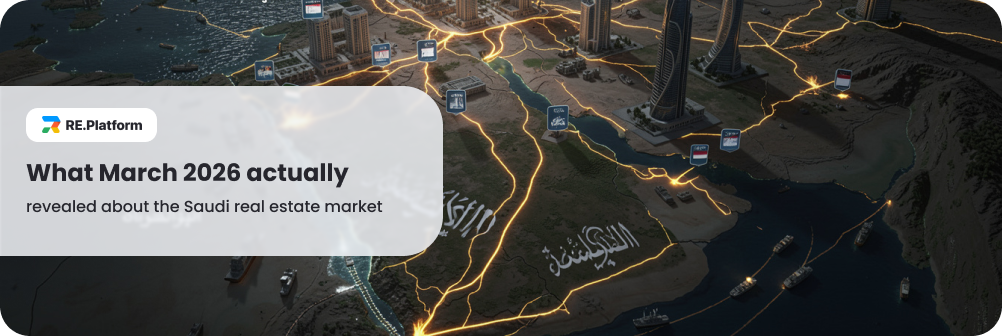
March did not break Saudi Arabia’s real estate sector. It clarified how it behaves under pressure.
At no point during the month was there evidence of systemic stress. Projects continued, large-scale developers kept executing, and the broader development pipeline remained intact. But beneath that stability, something more important shifted.
Capital stopped moving on momentum. Investors began to question timing, not just opportunity. Buyers delayed decisions rather than abandoning them. Equity markets adjusted positions gradually, not aggressively. Even at the institutional level, the postponement of high-profile events signaled a pause in commitment rather than a withdrawal of interest.
This is the difference between a market that is fragile and one that is evolving. Saudi real estate did not react like an overheated system under stress. It reacted like a market transitioning into a more disciplined phase, where access to capital depends less on narrative and more on structure. The implications are straightforward, but not trivial.
Developers with strong balance sheets, institutional backing and clearly defined project positioning continue to operate with relative stability. Those relying on speed, aggressive expansion or loosely structured demand are encountering friction — not because the market has weakened, but because it has become more selective.
“What changed in March wasn’t the direction of the market,” as one regional fund manager put it. “It was the threshold for confidence.” That threshold is now higher.
And that is likely to define the next phase of Saudi Arabia’s real estate cycle — not as a period of contraction, but as a phase where growth continues, only under tighter conditions and with clearer differentiation between those who can attract capital, and those who cannot.