Real Estate Sales Platform Benefits


For a long time, real estate sales were not designed to be efficient. They were designed to work. Leads came in through multiple channels, agents managed conversations across email and messaging apps, inventory was tracked in spreadsheets, and decisions were often made based on partial visibility. As long as demand remained strong, these inefficiencies did not fully surface. Sales happened despite the system, not because of it.
That model is no longer sustainable.
In 2026, real estate development operates in a different environment. Projects are larger, buyer journeys are longer, and acquisition costs have increased significantly. At the same time, buyers expect immediate responses, transparency and consistency across every interaction.
The result is simple: what used to be “manageable chaos” is now a direct limitation on growth. This is the point where real estate sales platforms begin to matter.
Table of Contents
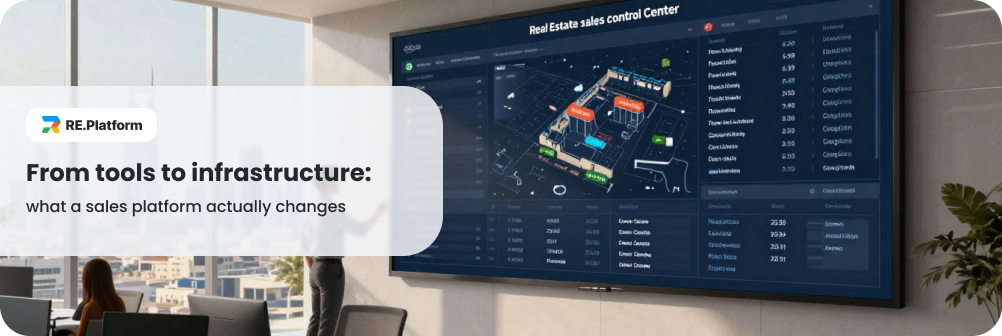
A real estate sales platform is often described as a combination of CRM, listing system and internal management tool. In practice, it is something more structural.
It replaces fragmentation with continuity. Instead of multiple disconnected processes — lead capture, communication, inventory tracking and reporting — the platform creates a single operational layer where all sales activity is structured, visible and measurable.
The difference is not technological. It is operational. Without a platform, each stage of the sales process exists independently. With a platform, those stages become part of a system.
The impact of a real estate sales platform becomes clear when looking at how sales actually happen inside a development company.
A lead arrives through a website or advertising campaign. It is forwarded to a manager, often manually. The manager responds, sometimes immediately, sometimes hours later. The client asks about availability. The manager checks a spreadsheet, which may or may not be up to date. Communication continues across multiple channels. At some point, the deal is either closed or lost — often without clear visibility into why.
Nothing in this process is technically broken. But everything in it is inefficient. What a platform does is not “add features” to this workflow. It restructures it. Lead capture becomes automatic. Distribution is immediate. Inventory is synchronized in real time. Every interaction is recorded. Every stage of the deal is visible.
The process does not become more complex. It becomes predictable.

One of the most commonly cited real estate sales platform benefits is efficiency. In practice, efficiency is often misunderstood as speed.
Speed is only one part of the equation. The more important change is the removal of friction across the sales process.
Repetitive tasks — follow-ups, reminders, document preparation — are automated. Internal approvals move faster because information is centralized. Teams spend less time coordinating and more time acting.
This does not just accelerate individual deals. It changes the capacity of the entire organization. A developer that previously handled 100 leads with difficulty can handle 300 without increasing team size — not because the team works harder, but because the system supports them.
Inventory is one of the most critical — and most underestimated — elements of real estate sales.
In many development companies, unit availability is still tracked in spreadsheets that require constant manual updates. This creates a gap between what is shown to clients and what is actually available.
The consequences are predictable:
A sales platform eliminates this gap by turning inventory into a live system rather than a static file.
Units, prices and availability are updated in real time. Managers no longer need to verify data manually. Clients receive accurate information instantly. The risk of errors decreases significantly.
What changes is not just accuracy. It is confidence — both internally and externally.
Real estate marketing has become increasingly digital, but in many cases it remains disconnected from actual sales processes.
Leads are generated through advertising campaigns, landing pages or aggregators, but once they enter the system, they are not always tracked effectively. The connection between marketing spend and closed deals is often unclear.
A real estate sales platform closes this gap.
Every lead is captured, tracked and linked to its source. Performance can be measured not only in terms of clicks or inquiries, but in actual sales outcomes. Campaigns can be adjusted based on real data rather than assumptions.
This is where the benefits of a real estate sales platform extend beyond operations and into strategy. Marketing becomes accountable. Decisions become data-driven.
One of the less obvious advantages of a structured sales platform is its effect on transaction timelines.
In a fragmented system, delays accumulate at every stage:
Individually, these delays may seem minor. Collectively, they extend the time required to close a deal.
A platform reduces this accumulation. Responses are faster because leads are assigned immediately. Information is available because inventory is centralized. Follow-ups are consistent because they are automated. The result is not just faster sales, but more predictable sales cycles.
From the client’s perspective, the sales process should appear simple: clear information, quick responses and transparent communication. In reality, client experience is determined by internal systems.
If a developer operates with fragmented tools, the client experiences inconsistency. Different managers provide different information. Responses vary in timing and quality. Trust is harder to establish.
A structured platform aligns internal processes, which in turn creates a more consistent external experience. Communication becomes traceable. Information is standardized. Interactions are recorded and accessible.
Trust is no longer dependent on individual managers. It is supported by the system.
Data exists in most real estate companies. The issue is not availability — it is usability.
Without a centralized system, data is scattered across spreadsheets, emails and individual tools. Reports are generated manually, often with delays, and are used more for retrospective analysis than for real-time decision-making. A sales platform changes how data functions within the organization.
Metrics such as lead conversion rates, sales velocity, pricing performance and team efficiency become visible in real time. This allows developers to identify bottlenecks, adjust strategies and allocate resources more effectively.
The shift is subtle but important. Data moves from being descriptive to being operational.
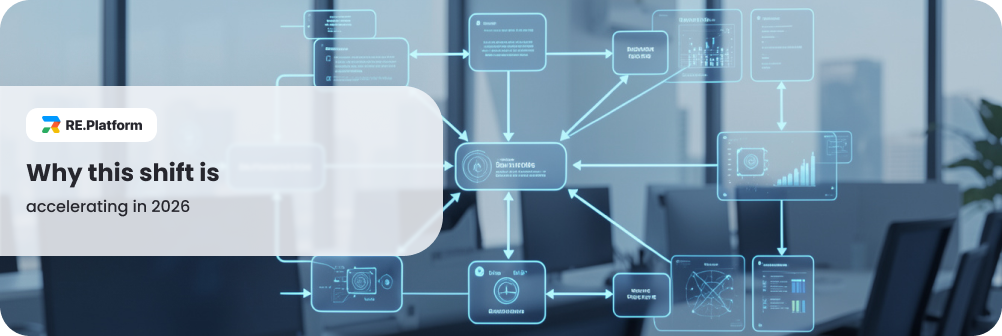
The adoption of real estate sales platforms is not happening in isolation. It is part of a broader shift in how real estate markets operate.
As markets become more competitive and more transparent, the margin for inefficiency decreases. Developers can no longer rely solely on demand or location advantages. Execution becomes a differentiating factor.
At the same time, the increasing role of digital channels in lead generation makes structured systems essential. Without them, the volume of incoming data becomes unmanageable.
The direction is clear. Real estate is moving toward a model where sales are not just driven by projects, but by how effectively those projects are managed.
Platforms are not replacing traditional elements of real estate sales. They are connecting them. They integrate marketing, sales, inventory and communication into a single system. They provide visibility across the entire lifecycle of a deal, from the first inquiry to the final transaction. In doing so, they reduce fragmentation — which remains one of the primary constraints in real estate operations.
This is where platforms like RE.Platform become relevant. By structuring project data, organizing inventory and aligning sales processes within a unified interface, they allow developers to move from disconnected workflows to a coherent system. The value is not in the technology itself. It is in how that technology reshapes operations.
The benefits of real estate sales platforms are often described in terms of features: automation, analytics, communication tools.
In practice, the impact is broader.
Developers gain:
Most importantly, they gain the ability to operate with intention rather than reaction.

Real estate developers do not compete solely on projects anymore. They compete on how well they manage those projects, how effectively they convert demand into transactions, and how clearly they understand their own data.
In that environment, a real estate sales platform is not an optimization tool. It is part of the core infrastructure that defines how the business operates. And as the market continues to evolve, that distinction becomes increasingly difficult to ignore.