Apartment Prices in Riyadh (2026 Guide)

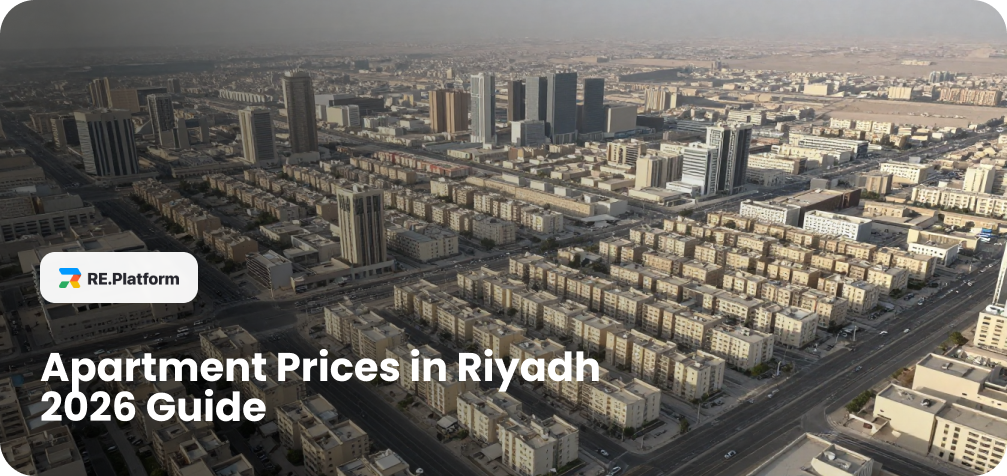
Riyadh has become one of the most closely watched real estate markets in the Middle East. As the capital continues to expand under Vision 2030, demand for residential property is rising across both local and international segments. For buyers and investors, one of the most common questions today is straightforward: how much does an apartment actually cost in Riyadh in 2026?
The answer is not uniform. Prices vary significantly depending on location, property type and development stage. However, current market data provides a clear benchmark for understanding the landscape.
As of early 2026, the average apartment price in Riyadh is around SAR 957,000, with a broad range that starts from approximately SAR 300,000 for smaller or peripheral units and exceeds SAR 2 million in premium northern districts. On a per-square-meter basis, prices are averaging close to SAR 3,800, reflecting both strong demand and the scale of ongoing development across the city.
Table of Contents
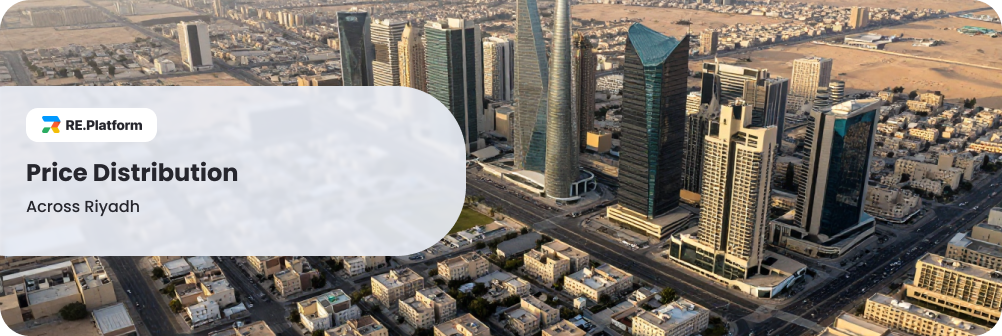
One of the defining characteristics of Riyadh’s property market is its geographic segmentation. The city is not priced as a single entity — it is effectively a collection of micro-markets, each with its own demand profile and pricing dynamics.
Northern districts such as Al Malqa, Al Narjis, Hittin and Al Sahafah represent the upper tier of the market. These areas have seen rapid development in recent years and are closely associated with new residential communities, modern infrastructure and proximity to business hubs.
In these locations, apartment prices typically start from around SAR 1.1 million and can exceed SAR 2 million, particularly for newer developments or furnished units. Demand here is driven not only by local buyers but increasingly by investors anticipating long-term appreciation.
More affordable options are concentrated in districts such as Al Janadriyah, Al Rimal and Al Dar Al Baida. These areas provide access to the market for first-time buyers or those seeking lower entry points.
Prices in these zones often begin at SAR 300,000–600,000, making them significantly more accessible compared to northern districts. While capital appreciation may be slower, these areas still benefit from the broader expansion of the city.
Central districts sit between these two extremes. Prices typically range from SAR 500,000 to over SAR 1.5 million, depending on unit size and building quality.
These locations often appeal to buyers prioritizing proximity to established infrastructure, business districts and existing urban density.
Interestingly, the Riyadh market does not show extreme variation in average prices across different apartment sizes, which reflects the way units are packaged and priced within developments.
| Apartment Type | Average Price (SAR) |
|---|---|
| Studio | ~992,000 |
| 1-Bedroom | ~983,000 |
| 2-Bedroom | ~947,000 |
| 3-Bedroom | ~954,000 |
This relatively narrow range suggests that pricing is influenced as much by location and project positioning as by unit size itself. In premium developments, even smaller units can command high prices due to branding, amenities and location.
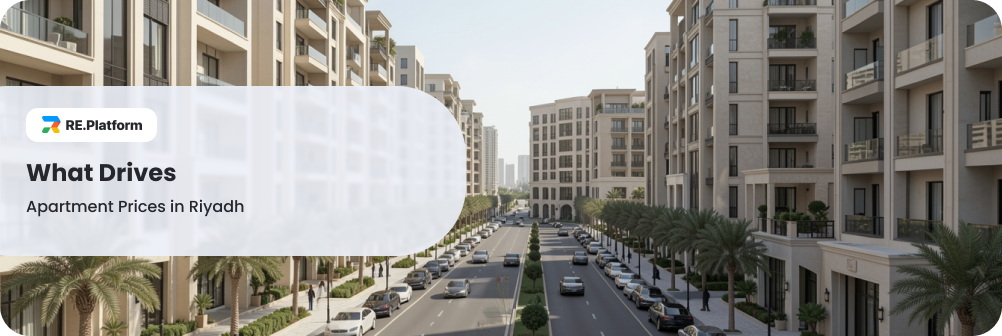
Understanding price levels requires looking beyond numbers. Several structural factors are shaping the market in 2026.
One of the primary drivers is the scale of development activity. Riyadh is expanding through large master-planned communities rather than isolated buildings, which creates concentrated zones of demand. As infrastructure and amenities develop around these areas, prices tend to follow.
Another factor is the increasing role of off-plan property. Many apartments are sold before completion, often at early-stage pricing. As projects progress, values typically adjust upward, contributing to overall market growth.
Regulatory changes also play a role. The introduction of foreign ownership in 2026 is expected to bring new capital into the market. While access may be limited to specific zones or conditions, the broader effect is increased demand and upward pressure on prices.
Finally, buyer expectations are evolving. Modern developments increasingly include integrated amenities, managed environments and digital infrastructure, which raises the baseline for pricing compared to older stock.
In Riyadh, the distinction between furnished and unfurnished properties can significantly impact price, especially in high-demand districts.
Furnished apartments in areas such as Al Malqa or Hittin often exceed SAR 1.5 million, particularly when positioned as ready-to-move-in units for professionals or investors. These properties typically include upgraded interiors, appliances and sometimes managed services.
Unfurnished units, while more flexible, are usually priced lower and attract buyers looking for customization or long-term use rather than immediate occupancy.
From an investment standpoint, Riyadh’s apartment market is transitioning from a locally driven environment to a more structured and internationally visible ecosystem.
Price growth is not uniform across the city, which makes location analysis critical. Northern expansion zones tend to attract capital due to perceived future value, while more affordable districts offer entry points with different risk-return profiles.
At the same time, the way investors approach the market is changing. Rather than focusing on individual listings, there is a growing shift toward analyzing entire developments and comparing projects at scale.
Platforms that aggregate real estate projects across Riyadh provide a clearer picture of where supply is concentrated and how different areas are evolving. This type of visibility allows investors to move from reactive decisions to more structured market analysis.
For buyers entering the market, price alone is not a sufficient metric. The same nominal value can represent very different assets depending on context.
A SAR 1 million apartment in a peripheral district is fundamentally different from a unit at the same price point in a high-demand northern development. Factors such as developer reputation, project scale, surrounding infrastructure and future growth plans all influence real value.
This is why comparing projects rather than isolated units has become increasingly important. Understanding how a development fits into the broader city expansion often provides more insight than focusing on individual listings.
Apartment prices in Riyadh reflect a market in transition. The city is expanding rapidly, new districts are emerging and demand is becoming more diverse. As a result, pricing is no longer defined by a single benchmark but by a combination of location, project positioning and future growth potential.
For buyers and investors, this creates both opportunity and complexity. Entry points still exist across different segments, but identifying the right opportunity increasingly depends on understanding the broader development landscape rather than isolated listings.
As Riyadh continues to evolve into a major real estate hub, the ability to navigate this landscape — and interpret where the market is heading — will become a key advantage.