Real Estate CRM in Saudi Arabia: Why Developers Move From Chaos to Control

Saudi Arabia’s real estate market has entered a fundamentally different growth phase. Developers are launching larger pipelines, running multiple off-plan phases in parallel, introducing complex installment schedules, and working with a buyer audience that expects speed, clarity, and digital convenience at every touchpoint. At the same time, internal sales operations often remain fragmented, relying on spreadsheets, WhatsApp conversations, static PDF price lists, and manual document workflows.
For sales leaders and commercial directors at development companies in KSA, the challenge is no longer about demand generation. Demand exists. The real issue is execution. Scaling sales volume without a dedicated real estate CRM does not increase efficiency — it accelerates operational chaos. Instead of improving velocity and margins, teams simply move existing inefficiencies faster and at a higher cost.
This article explains why a purpose-built real estate CRM in Saudi Arabia is now a core operational system for developers, what such a platform actually manages in practice, which supporting technologies must sit alongside it, and how RE.Platform provides a ready-to-use software platform that helps developers convert demand faster, with clearer forecasting and predictable unit economics.
Table of Contents
Across residential and mixed-use projects in Riyadh, Jeddah, and the Eastern Province, the same operational patterns repeat themselves. Inventory data is stored in spreadsheets or PDF files that become outdated almost immediately after a launch phase begins. Sales managers track deal status in private notes, chats, or personal task managers, which makes visibility dependent on individuals rather than systems.
Payment plans, broker commissions, and reservation status are often reconciled manually at the end of each week or month. Contract drafting becomes a copy-and-paste exercise inside Word documents, increasing both legal exposure and operational risk. Meanwhile, first-line buyer communication floods WhatsApp, phone calls, and social channels, leaving no structured way to qualify interest, route leads, or measure true demand.
The business impact is measurable. Sales teams spend more time on coordination and correction than on closing. Conversion rates decline even as lead volume grows. Cost of acquisition increases, while leadership is forced to make pricing and launch decisions based on incomplete or delayed data. This is not a future risk scenario — it directly affects cash flow, velocity, and margin today.
Result: managers chase administrative noise instead of qualified buyers; conversion falls, CAC rises, and leadership makes high-risk decisions without reliable data. This is not a future problem — it costs money today.
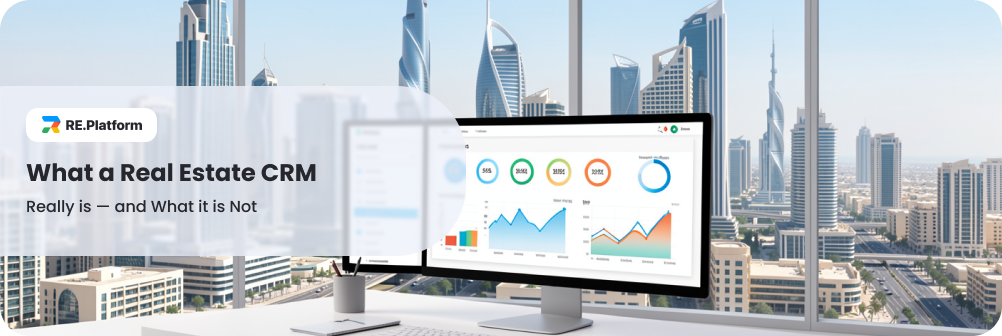
What is a CRM for Real Estate Developers? For developers, a CRM is often misunderstood as a simple contact or lead management tool. In reality, a real estate CRM for developers must operate as a full workflow and transaction engine that reflects how property sales actually function in Saudi Arabia.
A developer-grade CRM is not designed around individual agents. It is designed around units, phases, payment plans, broker networks, and long sales cycles. It connects demand generation to inventory availability, reservations, contracts, and post-sale management inside one environment.
A true real estate CRM includes centralized property inventory with live availability, unified deal pipelines from lead to handover, structured payment management, automated document generation, and reporting built specifically for unit-level economics. Generic sales software may store contacts, but without real estate logic it cannot support off-plan launches, installment schedules, or broker-driven distribution models common in KSA.
A Modern Real Estate CRM includes:
Centralized unit inventory with live availability and price tiers.
A unified deal pipeline (lead → reservation → contract → handover).
Payment orchestration for deposits, instalments and escrow flows.
Broker & partner management with automated commission logic.
Integrated document generation and e-signature.
Reporting and dashboards built for unit economics (absorption rate, velocity, conversion by channel).
If your “CRM” is a generic sales tool without these modules, it will not solve the real problems of a developer in KSA.
| Module | Business value |
|---|---|
| Interactive unit catalog | Real-time availability, pricing tiers, and filtering for buyers and brokers |
| Online booking and payment | Immediate reservation capture and reduced drop-off at peak intent |
| Developer CRM pipeline | Single source of truth for leads, deals, and sales stages |
| Automated documents and e-signature | Faster contract cycles, fewer errors, full audit trail |
| Sales analytics and dashboards | Data-driven pricing, launch timing, and absorption tracking |
| Conversational AI and chatbots | 24/7 lead qualification, scheduling, and first-line support |
| AI forecasting and lead scoring | Predictable sales velocity and smarter supply planning |
Each module addresses a specific operational bottleneck. Together, they form a connected system that replaces fragmented tools and manual coordination. And given that the sales market has expanded and opened up to foreign buyers, all of this becomes a minimum base for developers.

In Saudi Arabia’s current market environment, buyers and brokers expect immediate responses and digital convenience. Conversational AI plays a critical role in managing this expectation. Chatbots answer common questions, qualify intent, recommend available units based on preferences, and schedule viewings across web, messaging platforms, and social channels. This reduces response costs and ensures that only qualified interest enters the CRM pipeline.
Online booking and integrated payment rails are equally important. The buyer’s decision window is short. When commitment is delayed by manual follow-ups or offline reservations, deals are lost. A CRM connected to online reservation and payment software allows developers to lock demand instantly and reconcile transactions automatically.
Automated document generation and e-signature further reduce friction. Contracts built directly from CRM data eliminate inconsistencies, shorten approval cycles, and protect compliance. AI-based lead scoring and forecasting then allow management teams to prioritize resources based on probability rather than intuition, turning launches into predictable business processes instead of guesswork.
Chatbots & Conversational AI
Buyers and brokers expect instant answers. Conversational AI handles FAQs, qualifies intent, recommends units by parameters and schedules viewings — across website, WhatsApp and social channels. That reduces first-touch cost and feeds only warmed leads into the CRM.
Online booking & payment rails
The attention window is short. When a buyer is ready, friction kills the deal. Online reservation and deposit payment integrated with the CRM lock demand immediately and eliminate reconciliation delays.
Automated documents & e-sign
Manual contract assembly is slow and risky. Auto-generated contracts from CRM fields plus integrated e-signature reduce approval cycles from days to hours and protect legal compliance.
AI lead scoring & forecasting
Not all leads are equal. Machine learning that uses historical conversion patterns, channel behavior and payment readiness gives managers clear prioritization and makes launches predictable instead of guesswork.
These technologies work together: chatbots capture and qualify; CRM stores and routes; booking converts; AI optimizes. The stack is only as strong as its weakest link; a CRM built for developers is the glue.
Developers that deploy a real estate CRM typically see measurable results within the first quarter of use. Sales cycle time from lead to reservation decreases significantly, often by 20–40 percent. Operational cost per deal declines as manual steps are removed from booking, documentation, and reconciliation.
Contract errors decrease, broker engagement improves due to transparent commission tracking, and leadership gains near-real-time visibility into pipeline health and unit absorption. From a business perspective, this translates into clearer cash flow forecasting, stronger pricing discipline, and higher confidence during phased launches.
Faster conversion from lead to reservation (reductions of 20–40% in cycle time).
Reduced cost of sale due to automation and fewer manual touchpoints.
Fewer contract errors and shorter legal/compliance cycles.
Higher broker engagement and faster payout reconciliation.
Clear near-term forecasting and cleaner unit launch execution.
In practical terms: more predictable cash flow, better unit velocity management and measurable lift in margins.
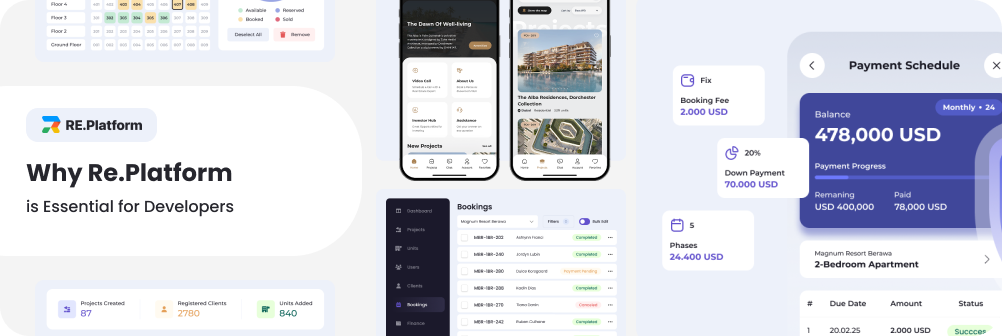
Building a custom CRM from scratch is expensive, slow, and risky. Most generic CRM software also requires heavy customization to fit real estate workflows. RE.Platform was designed specifically as a real estate CRM platform for Saudi Arabia, with developer sales models at its core.
The platform supports off-plan sales structures, staged payment plans, and broker-driven distribution. It integrates with regional payment gateways and includes interactive property catalogs, booking flows, CRM pipelines, AI lead scoring, and e-signature out of the box. Because the system is pre-configured for developer use cases, implementation takes weeks rather than months.
Equally important, RE.Platform is backed by local market experience. The platform reflects how real estate business is actually conducted in the Gulf, from channel management to regulatory expectations and buyer behavior.
You can build from scratch, or you can start with a platform designed for developers operating in Gulf markets. We offers a ready-to-deploy real estate CRM in Saudi Arabia that is:
Configured for off-plan sales and payment plan logic.
Integrated with regional payment gateways.
Includes interactive catalogs, booking flows and e-sign out of the box.
Deployable with minimal customization so you see results within a sales quarter.
Backed by local implementation experience — we already work with developers in the Gulf and understand local channel dynamics, broker models and regulatory expectations.

While CRM systems are often discussed as software tools, their real value appears only when they become part of a broader operational structure.
For real estate developers in Saudi Arabia, CRM platforms are closely connected with project management, sales operations, and the overall digital infrastructure used to manage large developments. As projects scale and sales pipelines grow, these systems start working together to bring transparency and control to complex operations.
If you want to explore how these processes work in practice, the following articles provide a deeper look at different aspects of real estate development management:
Real Estate Inventory Management for Developers
How development companies track unit availability across multiple projects, manage pricing and reservations, and use structured inventory systems to keep sales operations aligned with construction progress.
Managing 10,000+ Units: Real Estate Project Management for Developers at Scale
How large-scale real estate projects are structured and managed, from governance and planning to execution, when developers deliver thousands of residential units across multiple phases.
How Digital Transformation Is Reshaping the Real Estate Development Market in KSA
An overview of how technology, automation, and integrated digital platforms are transforming the way real estate developers manage projects and sales across Saudi Arabia.
Why Real Estate Developers Cannot Compete Without a Modern Digital Stack
An explanation of how CRM, project management systems, and data platforms form the technological backbone of modern development companies.
The Silent Inefficiency Crisis in Saudi Arabia’s Real Estate Industry
An industry perspective on operational inefficiencies and why developers are increasingly adopting structured digital workflows.
What Real Estate Developers Will Face After Opening Property Sales to Foreign Buyers
How opening Saudi Arabia’s property market to foreign buyers could reshape sales strategies, operational processes, and digital infrastructure for local real estate developers.
How CRM Helps Real Estate Developers and Simplifies Their Work
A practical look at how CRM systems help developers organize sales pipelines, manage leads across multiple projects, and bring structure to everyday development operations.
Developers can continue managing sales through spreadsheets, messaging apps, and disconnected software — or they can deploy an operational engine designed to convert demand consistently, reduce risk, and support long-term growth.
For development companies in Saudi Arabia that want a real estate CRM built for their market, RE.Platform delivers a unified system covering inventory, booking, sales management, AI-driven qualification, and analytics. The result is faster execution, clearer forecasting, and measurable improvement in sales performance within the same quarter.
If your team is ready to stop guessing and start scaling with control, a purpose-built real estate CRM is no longer a future upgrade. It is core business infrastructure.