How to Get a Real Estate Developer License in Saudi Arabia: What Foreign and Local Developers Need in 2026


For a real estate developer looking at Saudi Arabia in 2026, the first mistake is to assume that “getting licensed” is a single administrative step. It is not. In practice, market entry is a sequence of regulatory gates. A foreign or local developer may need to deal with investment registration, commercial registration, project-level approvals, developer qualification, marketing permissions, escrow controls, and off-plan licensing, depending on how the business model is structured. That is why many firms underestimate the process at the start: they look for one certificate, while the Saudi system is really asking whether the company is legally, financially, and operationally fit to develop and sell real estate in a regulated environment.
That distinction matters even more in Saudi Arabia than in many other markets. The Kingdom is not asking only whether a company exists. It is asking whether that company has the right legal vehicle, the right activity, the right project profile, the right documentation, and, if off-plan sales are involved, the right controls around buyer funds and project delivery. REGA’s own framework makes that clear: developer qualification for off-plan activity requires a compliant commercial registration, successful completion of an approved qualification program, audited financial statements, a credit clearance certificate, an organizational structure, labor and health-and-safety regulations, Saudization status, GOSI certificates, employee subscriber data, and a ZATCA certificate.
Table of Contents
A developer entering Saudi Arabia usually falls into one of two tracks. The first is a company that wants to establish or register an investment presence in the Kingdom and then develop property as part of that business. The second is a developer that specifically wants to sell units off-plan. Those are related, but not identical, regulatory paths.
For foreign developers, the entry point begins with investment registration through the Ministry of Investment. MISA’s 2025 Investor Guide states that a foreign investor must register for investment in Saudi Arabia under the Investment Law and its implementing regulations, and that the application requires, among other items, the foreign company’s commercial registration and last fiscal year financial statements, both authenticated by the Saudi embassy. The same guide states an estimated processing time of 10 working days for investment registration, while the registration fee is not published as a fixed public amount in the guide and is instead determined by the ministry upon approval of the application.
If the business model then includes acquiring or selling property in order to execute a real estate development project, MISA also has a separate approval track for real estate development activity. That service is available to establishments already registered with the ministry and practicing specialized real estate development activities. Here, the official guide becomes especially important because it answers the “how much money do I need?” question in a way that many commercial articles do not: the total project cost, including land and construction, must not be less than SAR 30 million. The guide also says the property must be located outside the boundaries of Makkah and Madinah, and that the land must be used for the stated purpose within five years. The required documents include an engineering-office report specifying total project cost and a copy of the title deed. MISA lists no fee for this approval service and gives an estimated processing time of five working days.
That SAR 30 million threshold is one of the most useful official numbers a prospective developer can work with. It does not mean that every developer license in Saudi Arabia costs SAR 30 million. It means that, for the MISA real-estate-development property ownership/sale approval route, the state is signaling what it considers a serious project scale for this type of activity. In other words, the regulatory system is already filtering out speculative or undercapitalized entrants at the property-approval stage.
Once a company is established or registered, the next issue is not branding or sales strategy. It is activity alignment. REGA’s developer qualification service explicitly requires that the commercial registration activity fall under real estate development for off-plan sales. That sounds technical, but in practice it is often where an application begins to weaken. A company may be active in construction, investment, brokerage, or holding activities, yet still not have the commercial registration framed in the way required for off-plan developer qualification.
This is one reason sophisticated entrants usually treat Saudi licensing as a sequencing exercise rather than a paperwork exercise. The legal entity, investment registration, commercial registration activity, internal governance, tax status, labor compliance, and financial reporting all have to align before the more visible commercial milestones become realistic. The Saudi system is designed to discourage improvisation. It rewards developers who are structured before they are public.
For developers planning to sell off-plan, qualification under REGA is where the market stops being a market study and becomes an executable plan. The authority’s developer-qualification service is not merely a database entry. It is an assessment of whether the company has the institutional capacity to act as an off-plan developer. REGA’s public requirements make that clear: the applicant needs a valid commercial register tied to the relevant activity, completion of the authority-accredited qualification program, audited financial statements, a clean or acceptable credit record, organizational structure, internal labor regulations, occupational health and safety regulations, Saudization compliance, GOSI certificates, a list of employed subscribers, and a ZATCA certificate.
The implementing regulations go even further. They establish a developer register and require a legal person to score at least 35 out of 100 points to register. For project licensing, the score threshold rises with project scale: a legal-person developer needs at least 35 points for projects under 15,000 square meters of built-up area, 45 points for projects under 25,000 square meters, and 55 points for projects exceeding 25,000 square meters. That matters because Saudi Arabia is not simply asking whether you are licensed; it is ranking whether your capabilities match the size of the project you want to deliver.
This is where many generic “how to get licensed” write-ups miss the real issue. In Saudi Arabia, the license is not just a right to operate. It is a threshold test of credibility. A smaller or less mature developer may be able to enter the market, but not on the same project scale, and not with the same freedom of execution, as a more established player. The regulations are deliberately structured to reflect that.
If the company intends to sell units before completion, Wafi becomes central. REGA’s official Wafi platform states that Wafi is the authority in charge of granting licenses for selling off-plan real estate units and issuing registration certificates to developers in the real estate developer registry. The implementing regulations then explain what that means operationally.
A developer can first apply for a real estate project marketing license before obtaining the full off-plan project license. To do that, the developer must submit the property registration deed number, any marketing contract with the broker, any development contract with the landowner, and the architectural and engineering layouts. REGA states that it will decide on the marketing license application within 10 working days. That marketing license can be valid for up to 180 days.
This pre-licensing stage is important because it allows a project to begin controlled market exposure before full project licensing. But the controls are strict. If a developer wants to collect reservation fees during that period, the regulations require disclosure of project status and future plans, cap reservation fees at 5% of the unit value, and require all reservation funds to be deposited into the designated escrow account. If the marketing license expires without the project obtaining the full project license, REGA must refund the escrowed reservation amounts to the rightful owners. That is not cosmetic regulation. It is a hard financial discipline imposed before the full launch of an off-plan project.
The full off-plan project license is where Saudi Arabia’s regulatory logic becomes most visible. Article 11 of the implementing regulations requires, among other things, a project feasibility study with estimated financial, construction, and marketing data, expected administrative and financial expenses, the unit-delivery schedule, and expected funding sources. The developer also needs a confirmation letter from Etmam or another competent authority verifying compliance with building permit, engineering layout, and architectural design requirements. If the project includes subdivided units, an approved subdivision report must be attached. Where applicable, the property owner must also consent to a notation on the title deed restricting disposal of the property until development works are completed.
In practical terms, this means the Saudi regulator wants to see more than a concept and a land parcel. It wants evidence that the project is technically buildable, financially reasoned, contractually structured, and legally protected against opportunistic changes. This is one reason Saudi Arabia is becoming more investable: the system asks difficult questions before the buyer is exposed, not after a problem appears.
The supporting ecosystem is also regulated. The consulting firm must meet approval criteria, including a valid commercial register, licensed status with the Saudi Council of Engineers, and, in larger projects, Balady classification criteria. The chartered accountant must have a valid commercial register, be licensed by the Saudi Organization for Certified Public Accountants, and meet REGA qualification requirements. These are not optional support providers. They are embedded into the licensing and monitoring model.
The most important difference between Saudi off-plan development and loosely regulated markets is that approval is only the beginning. The project then enters an ongoing compliance regime.
The regulations require buyer and tenant payments to be deposited into the escrow account. Each project must have its own separate escrow account in Saudi riyals, withdrawals must be limited to project purposes, and no ATM or credit cards may be issued against the account. Withdrawals require a developer request plus approval from the consulting firm and the chartered accountant. REGA may also require monthly or periodic progress reports depending on project size and location. In addition, REGA maintains a database for off-plan projects, and the developer must input implementation data, specifications, reports, completion certificates, and supplier and guarantee data. Some project information, including the developer’s name and rating, project details, progress reports, and the names of the consulting firm, accountant, bank, and marketer, is made public by REGA.
This is why the Saudi licensing conversation cannot be reduced to “How do I get the paper?” The paper is only the entry ticket. The real operating model is one of supervised execution. A developer that is weak on internal controls, reporting discipline, or project data management will usually feel that pressure after licensing, not before.
The most honest professional answer is that there is no single public “developer license price” that captures the real cost of entering this market. Official sources show three different cost realities.
First, MISA’s investment-registration fee is not listed as a fixed public amount in the Investor Guide; the ministry states that the fee is determined upon approval of the application, and payment must be made within 15 business days of notification. Second, REGA’s developer-qualification service page states that the service cost depends on the type of service rather than publishing one universal fee. Third, for MISA’s real-estate-development property-approval service, the guide expressly says no fees apply, but it also imposes the far more commercially significant condition that the total project cost must not be below SAR 30 million.
For a real entrant, that means budgeting should be built around the project model, not just around government filing fees. The serious cost centers are entity setup, legal structuring, authenticated corporate documents, tax and labor compliance, engineering reports, consultant and accountant appointments, escrow setup, project feasibility work, and the capital needed to support a project that can survive under milestone-based cash controls. The official framework tells you something important here: Saudi Arabia is not expensive because of one magical license fee. It is expensive because the system expects developers to arrive prepared.
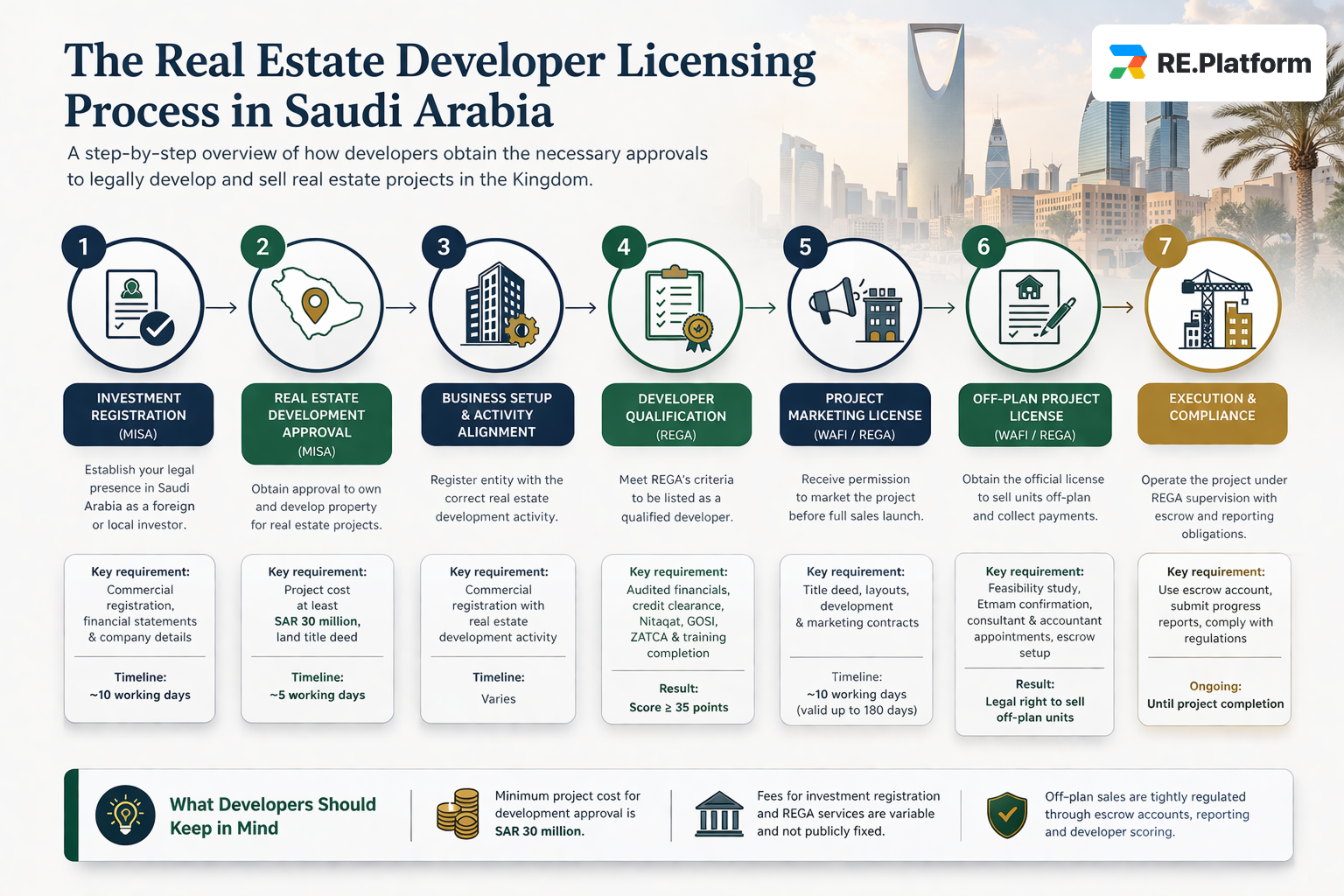
A developer approaching the Kingdom professionally should think in terms of order of operations. First comes legal entry through MISA if foreign investment is involved. Then comes commercial registration and activity alignment. Then comes developer qualification if off-plan work is contemplated. Then comes the project-specific layer: land position, engineering report, feasibility, permit confirmation, consultant/accountant appointments, marketing license if needed, escrow setup, and finally the off-plan project license. At each stage, the next step assumes the previous one was structured correctly. Saudi Arabia is very manageable for prepared companies and very frustrating for improvised ones.
| Stage | What You Do | Key Output | Timeline / Threshold |
|---|---|---|---|
| Market Entry | Register company / investor via MISA | Legal presence in KSA | ~10 working days |
| Development Approval | Apply for real estate development activity | Right to own/develop property | ≥ SAR 30M project |
| Business Setup | Align commercial registration with development activity | Eligible for developer status | Depends on setup |
| Developer Qualification | Pass REGA qualification | Approved developer profile | Score ≥ 35+ |
| Pre-Marketing | Obtain project marketing license | Ability to promote project | ~10 days / 180 days validity |
| Off-Plan License | Get full Wafi approval | Legal right to sell units | Full project package required |
| Execution | Operate via escrow + reporting | Controlled project execution | Ongoing compliance |
Saudi Arabia remains one of the most attractive real estate growth markets in the region, but it is not a shortcut market. The winning approach is not to ask how to get a certificate as quickly as possible. It is to understand which regulatory lane your company belongs in, how your project will be financed and sold, and what the authorities are really testing when they review your application.
For foreign developers in particular, the answer to “what do I need?” is broader than a license. You need an investment registration route, the right real estate activity, a commercially credible project, documentation that can survive scrutiny, and enough capital to meet both market expectations and formal thresholds. For off-plan developers, you also need to be ready for a system in which escrow, disclosure, reporting, and public project data are part of the business model itself. In Saudi Arabia, the firms that scale are rarely the ones that move fastest at the start. They are usually the ones that enter the market in the right order.