Real Estate Regulations for Developers in Saudi Arabia 2026 Guide

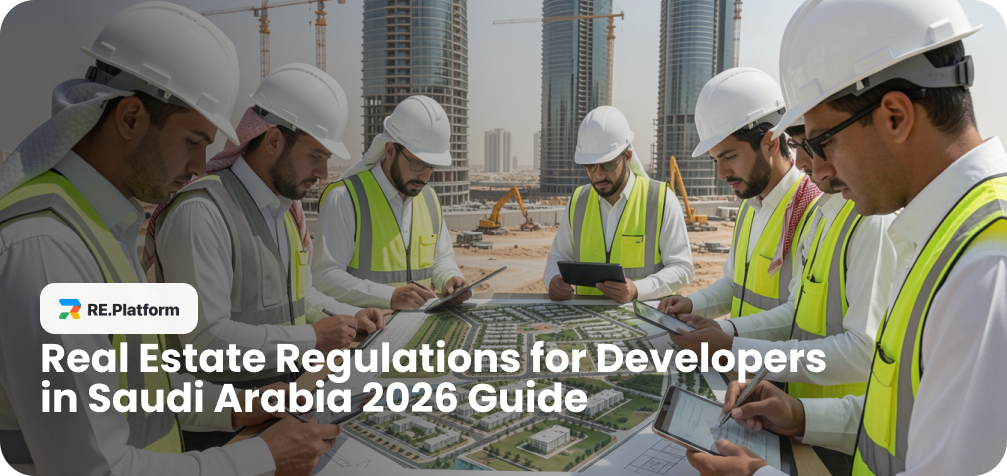
For developers entering Saudi Arabia, regulation is not a secondary layer of the market — it is the framework within which the market exists.
Unlike in less centralized environments, where compliance follows development, the Saudi system requires developers to align with regulatory structures before a project becomes commercially viable.
This is particularly relevant in 2026. The opening of the market to foreign ownership has increased demand, but it has also introduced stricter requirements around transparency, project validation and transaction control.
As a result, understanding regulation is not just about legal safety. It directly affects whether a project can be launched, marketed and sold at all.
Table of Contents
The Saudi real estate market is governed through a coordinated system led by the Real Estate General Authority (REGA), supported by municipal and investment bodies.
What makes this system distinctive is that regulation is embedded into operational processes. Developers do not interact with regulation only at the licensing stage — they encounter it throughout the entire lifecycle of a project.
From land approval to final sale, every stage is tied to specific frameworks:
This creates a market where compliance is continuous, not episodic.
Before any project can begin, a developer must obtain the appropriate authorization to operate.
This process is not limited to company registration. Authorities evaluate whether the developer is capable of executing a project within regulatory standards.
In practice, this includes:
A common scenario illustrates the challenge. An international developer with sufficient capital may still face delays if its structure does not align with local requirements. Licensing becomes not just a formality, but a gatekeeping mechanism that filters market participants.
One of the most important regulatory frameworks for developers is the system governing off-plan sales.
In Saudi Arabia, off-plan projects must be registered under WAFI, a government-controlled program designed to regulate pre-construction sales.
The logic behind WAFI is straightforward: protect buyers while ensuring project credibility.
A developer cannot simply begin selling units at the planning stage. Instead, the process requires:
This significantly alters how projects are financed.
In markets with minimal regulation, early sales are often used to fund construction. In Saudi Arabia, access to those funds is controlled, which reduces risk for buyers but increases pressure on developers to maintain structured financial planning.
Closely linked to WAFI is the escrow system.
All buyer payments for off-plan projects are placed into regulated accounts. Funds are not freely accessible — they are released based on verified construction milestones.
For developers, this introduces both discipline and constraint.
On one hand, it enhances market trust, making projects more attractive to investors.
On the other, it limits liquidity flexibility, requiring more robust upfront financial planning.
Another critical layer of regulation affects how properties are marketed and sold.
Saudi Arabia operates a centralized brokerage system known as FAL, which governs real estate transactions and licensing of agents.
This has direct implications for developers.
Sales cannot be executed through informal channels. Brokers must be licensed, transactions must be registered, and marketing must comply with regulatory standards.
In practice, this means that even the commercial side of a project is regulated.
A developer launching a marketing campaign without aligning with these requirements risks not only penalties, but also disruption of the sales process itself.
The 2026 reforms allowing foreign ownership introduced a new layer of regulatory complexity.
Ownership is not universally permitted. It is restricted to designated zones approved by authorities.
For developers, this transforms location into a regulatory variable.
A project built outside approved zones may still be valid for domestic buyers, but it will be excluded from international demand — which is increasingly a key driver of the market.
Two similar residential projects in Riyadh can have dramatically different outcomes:
The difference is not architectural or financial — it is regulatory.
Saudi Arabia is rapidly integrating digital infrastructure into its real estate ecosystem.
Developers are required to interact with centralized platforms for:
This digitalization reduces ambiguity but increases accountability.
Information about projects is no longer static or internal. It becomes part of a structured system where inconsistencies can directly affect approvals and sales.
As a result, developers must treat data management as part of compliance, not just operations.
While regulation is often perceived as a barrier, in Saudi Arabia it also functions as a filter that increases market quality.
Developers who successfully align with regulatory requirements gain:
Those who fail to do so face delays, limited demand and operational friction.
This creates a market dynamic where compliance is not only mandatory — it becomes a source of competitive differentiation.
Saudi Arabia’s real estate market in 2026 is defined by a clear principle:
development is inseparable from regulation.
For developers, success depends not only on identifying demand, but on navigating a system where:
Understanding this system is not optional. It is the foundation on which every successful project in the Kingdom is built.