What Is Off-Plan Property in Saudi Arabia

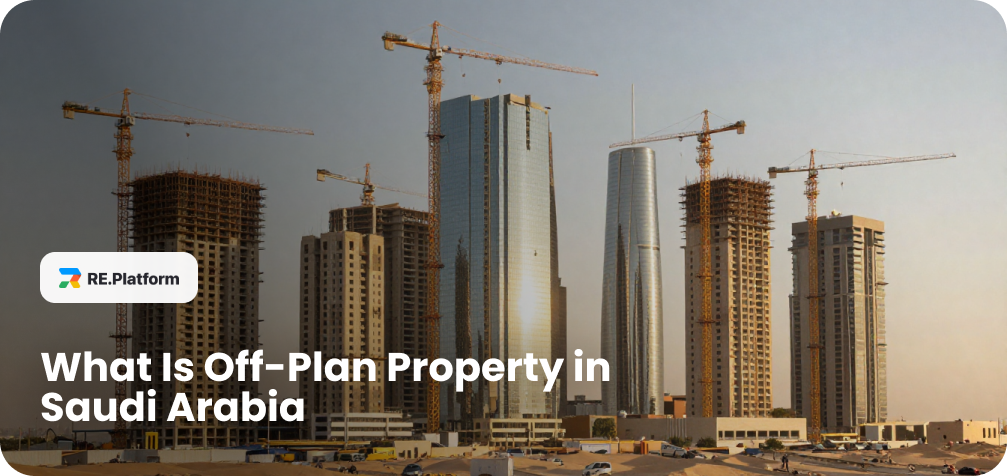
Saudi Arabia’s real estate market is entering a new phase. Large-scale developments, regulatory shifts and the gradual opening of the market to foreign buyers are reshaping how property is bought and sold. Within this transformation, one segment stands out for both investors and developers — off-plan property.
Unlike traditional real estate transactions, off-plan purchases are not about what exists today, but what will exist tomorrow. Buyers commit capital based on a project’s concept, timeline and the credibility of the developer behind it. In markets like Dubai, this model has long been standard. In Saudi Arabia, it is now moving into the mainstream — and becoming a defining feature of the next development cycle.
Table of Contents
Off-plan property refers to units sold before construction is completed, often at early development stages. In many cases, sales begin when a project is still in the design or initial construction phase. Buyers rely on architectural plans, masterplans and developer track records rather than a finished asset.
In the Saudi context, off-plan typically includes large residential communities, mixed-use developments and master-planned districts. These are not isolated buildings but integrated projects, often developed at scale and aligned with broader urban expansion strategies.
What makes this segment particularly relevant today is not just pricing, but access. Early buyers gain entry into projects that may later become central to new urban zones — especially in cities like Riyadh and Jeddah, where expansion is accelerating.
While the mechanics of off-plan transactions are familiar globally, the Saudi market is still standardizing processes. That said, the structure of a typical deal is becoming more consistent.
A buyer selects a unit within a project, usually based on availability grids, floor plans and pricing releases. A reservation secures the unit, followed by a Sale and Purchase Agreement (SPA). Payments are then distributed across the construction timeline, rather than paid upfront.
| Stage | Payment Range | Context |
|---|---|---|
| Reservation | 5–10% | Unit allocation and price lock |
| Construction Phase | 40–60% | Paid in tranches (milestones) |
| Handover | 30–50% | Final payment upon completion |
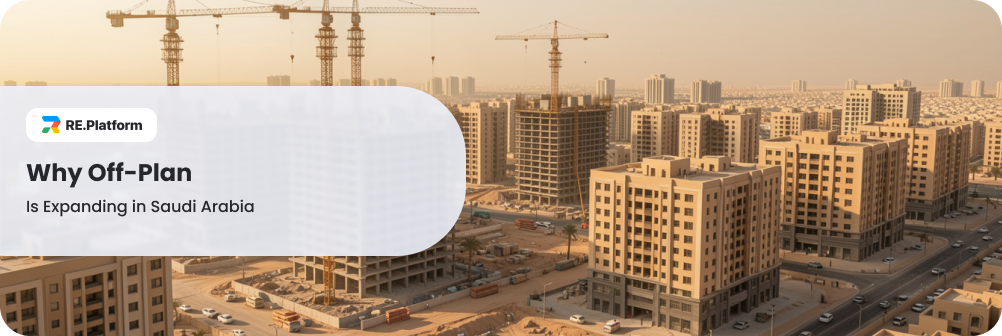
The growth of off-plan transactions is not accidental. It reflects a structural shift in how real estate is financed, marketed and delivered.
From a pricing perspective, early-stage units are typically offered below market value. This creates a built-in margin for investors who enter at launch and exit closer to completion. In rapidly developing areas, this difference can be significant.
Equally important is optionality. Early buyers have access to a wider selection of units — including premium locations within a project — which later become limited or unavailable.
At a broader level, the expansion of off-plan aligns with Vision 2030. Large development programs require capital inflow at early stages, and off-plan sales provide a mechanism to support construction cycles while distributing risk.
Despite its advantages, off-plan investment is fundamentally different from buying a completed property. The risk is not theoretical — it is embedded in the timeline.
Construction delays remain one of the most common challenges. Even in structured markets, timelines can shift due to supply chains, financing or regulatory adjustments. In emerging segments, this risk can be more pronounced.
There is also the question of execution. A project may evolve during development, leading to changes in layout, finishes or even positioning. While such changes are often within contractual allowances, they can affect perceived value.
Most importantly, the entire investment is tied to the developer’s ability to deliver. This places significantly more weight on due diligence than in traditional property purchases.
In mature markets, off-plan decisions are increasingly data-driven. Saudi Arabia is moving in the same direction, although the ecosystem is still developing.
Investors are shifting from evaluating individual units to analyzing projects as a whole. This includes understanding the developer’s portfolio, construction progress, and how a specific development fits within the city’s broader growth pattern.
Location remains critical, but not in isolation. The question is no longer just “where is the project,” but “what is being built around it” and “how does it connect to future infrastructure.”
This is where aggregated project-level visibility becomes important. Instead of navigating fragmented listings, investors are beginning to rely on structured platforms that map developments across cities and regions.
Solutions such as RE.Platform Explorer reflect this shift. By organizing projects geographically and at the development level, they allow users to identify where construction is concentrated, compare multiple projects and evaluate opportunities with more context. Rather than replacing traditional channels, these tools complement them by introducing a more systematic layer of analysis.
| Factor | Off-Plan Property | Completed Property |
|---|---|---|
| Entry Price | Lower at early stages | Market-level pricing |
| Risk Exposure | Higher | Lower |
| Capital Growth | Potentially higher | More stable |
| Liquidity | Limited until completion | Immediate usability or rental |
As the number and scale of developments increase, traditional sales approaches become less effective. Spreadsheets, static PDFs and fragmented listings cannot support the complexity of large-scale projects.
Developers are increasingly moving toward structured digital systems that centralize inventory, track sales and provide real-time visibility. For buyers, this translates into more transparency and faster decision-making.
At the market level, this shift is gradually changing how property is discovered. Instead of browsing individual listings, users are beginning to explore entire developments and compare them within a broader geographic context.
Consider a typical investor entering the Riyadh market. Without a structured approach, the process quickly becomes fragmented — multiple portals, inconsistent data, limited comparability between projects.
When projects are aggregated and visualized at the development level, the decision-making process changes. Patterns become visible: where new districts are forming, which developers are most active, how supply is distributed across the city.
This shift does not eliminate risk, but it reduces informational asymmetry — one of the key challenges in off-plan investment.