Why Buying Property in the Gulf Feels So Different from Europe

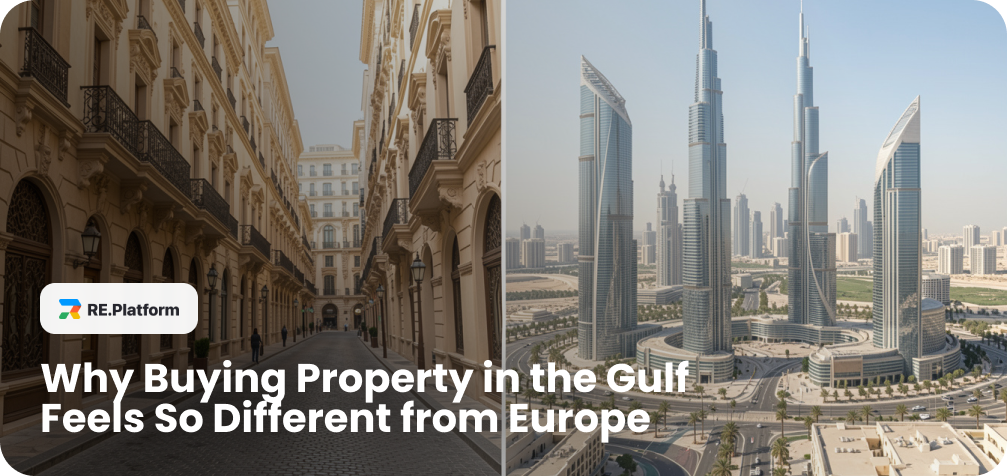
On paper, buying property is a universal process. A buyer defines a budget, explores available options, compares locations and makes a decision based on price, quality and long-term value. Whether in Paris, Berlin or Riyadh, the goal appears identical.
In practice, the experience diverges almost immediately.
Buyers entering the Gulf market — particularly Saudi Arabia — often describe a sense of disorientation. Not because the market is inaccessible, but because it operates on a different logic. The assumptions formed in European markets simply don’t hold.
What looks like complexity is, in fact, a structural difference in how the market is organized, how data flows and how transactions are executed.
Table of Contents
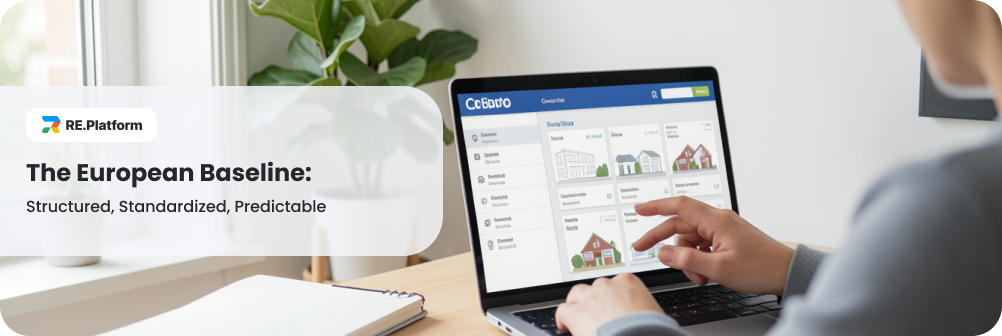
To understand the contrast, it helps to start with the European model — not as a benchmark of perfection, but as a system with established rules.
Property discovery in Europe is largely platform-driven. Listings are aggregated, updated regularly and structured in a way that allows buyers to filter, compare and shortlist options with relative confidence. While discrepancies do exist, the overall system is designed to reduce information asymmetry.
Agents play a central role, acting as intermediaries between fragmented supply and demand. Legal frameworks are well-defined, transaction steps are predictable, and pricing is generally transparent within a narrow range of negotiation.
The result is a process that feels linear. A buyer moves from discovery to decision through a series of clearly understood steps, supported by accessible data.
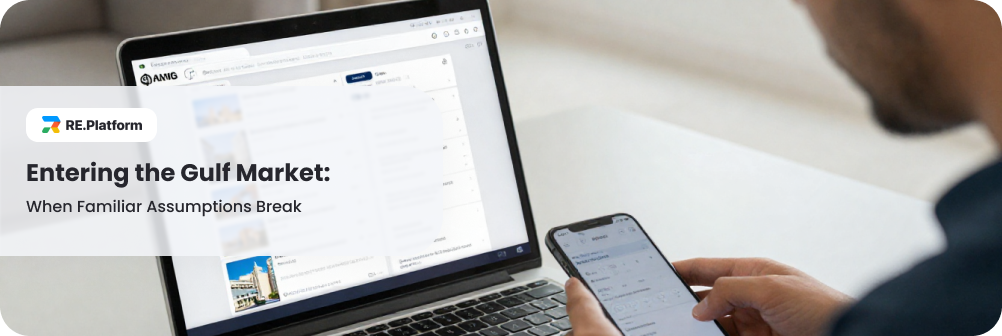
The Gulf market — and Saudi Arabia in particular — operates under a different set of conditions.
The first shift becomes apparent at the discovery stage. Instead of a structured overview of available properties, buyers encounter a fragmented landscape. Listings exist, but they rarely represent the full scope of what is actually available.
This is not a failure of technology. It reflects how supply is organized.
In Saudi Arabia, real estate is largely controlled by developers rather than distributed through independent agents. Projects are launched, marketed and sold through internal systems, with external platforms acting as secondary channels rather than primary sources of truth.
For a European buyer, this creates an immediate gap between expectation and reality.

At the core of the difference is the role of the developer.
In Europe, developers build and release inventory into a network of agents and platforms. Control over information is distributed. Data flows outward, and listings become a reliable interface for buyers.
In Saudi Arabia, developers retain control over inventory throughout the sales cycle. Availability, pricing and release strategies are managed internally, often with a high degree of flexibility.
This changes the entire dynamic of the transaction.
Instead of navigating a market through agents, buyers are effectively interacting with multiple self-contained ecosystems — each project operating as its own universe of data, pricing logic and availability.
A simplified comparison highlights the shift:
| Dimension | Europe | Saudi Arabia / Gulf |
|---|---|---|
| Market structure | Agent-driven | Developer-driven |
| Data distribution | Broad and standardized | Centralized and controlled |
| Listings accuracy | نسبيا reliable | Often partial or delayed |
| Buyer entry point | Platforms | Projects / developers |
The implication is not that one system is better than the other. It is that they require different approaches.
One of the most significant differences lies in how data is accessed.
In Europe, the challenge is filtering abundance. Buyers navigate large volumes of structured data to identify relevant options. In the Gulf, the challenge is accessing completeness. Data exists, but it is not aggregated in a way that reflects the full market.
This leads to a recurring pattern where buyers believe they are seeing “what’s available,” while in reality they are seeing a curated subset.
Pricing illustrates this gap clearly. Listings often display indicative ranges rather than unit-specific values. Actual prices depend on factors that are not always visible at the listing level — phase releases, internal allocation strategies or ongoing negotiations.
Availability follows a similar logic. Units can be reserved, released or repriced without immediate reflection on external platforms.
For buyers accustomed to European transparency, this creates a perception of opacity. In reality, the data is not hidden — it is simply not structured for public consumption in the same way.
The structural differences inevitably shape the buyer experience.
In Europe, predictability comes from standardization. Even when individual deals vary, the process remains familiar. Buyers know what to expect, when to expect it and how to interpret the information presented to them.
In the Gulf, the process is more fluid.
Information is often obtained through direct interaction rather than passive browsing. Decisions are influenced by timing — when a project releases new inventory, when pricing adjustments occur, or when specific units become available.
This introduces a layer of variability that can feel like uncertainty, particularly for international buyers.
However, it also reflects a market that is still evolving, where flexibility is built into the system rather than constrained by it.
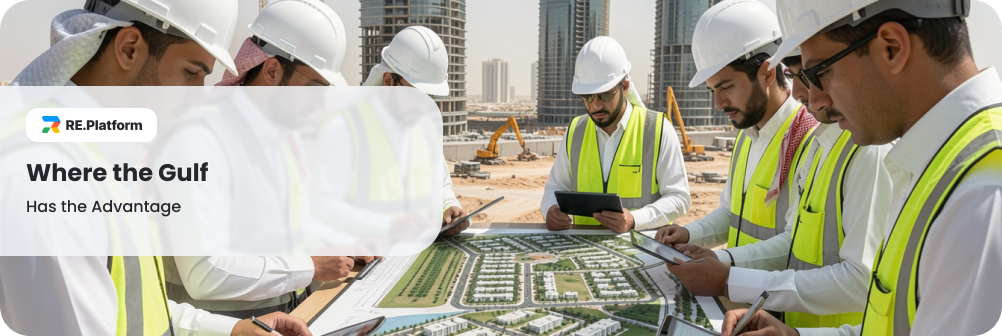
Focusing only on differences risks missing the strengths of the Gulf model.
Speed is one of them. Transactions can move faster, with fewer layers of intermediation. Developers have the ability to adjust pricing, structure offers and respond to demand in real time.
Scale is another factor. Large master-planned communities, integrated developments and rapid urban expansion create opportunities that are less common in mature European markets.
There is also a level of flexibility in deal structuring — payment plans, phased releases and developer incentives — that can be attractive to certain buyer profiles.
These advantages come from the same source as the perceived complexity: centralized control and a project-driven market structure.
As Saudi Arabia opens its real estate market to foreign buyers, the existing model is coming under pressure.
International investors bring different expectations. They are used to structured data, transparent comparisons and the ability to evaluate opportunities remotely.
At the same time, developers are scaling operations, managing larger inventories and engaging with a more diverse buyer base. This increases the need for systems that can bridge the gap between internal data and external visibility.
The market is not moving toward a European model. Instead, it is evolving toward something hybrid — maintaining the strengths of a developer-led structure while introducing greater transparency and accessibility.
Perhaps the most important shift for buyers is conceptual.
In Europe, property search is largely about navigation — finding and filtering options within a known framework. In the Gulf, it becomes an exercise in interpretation — understanding how projects are structured, how data is presented and how availability changes over time.
This requires a different mindset.
Rather than relying solely on listings, buyers need to think in terms of projects, phases and developer strategies. The question is no longer just “what is available,” but “how is this project evolving and where do I fit within it.”
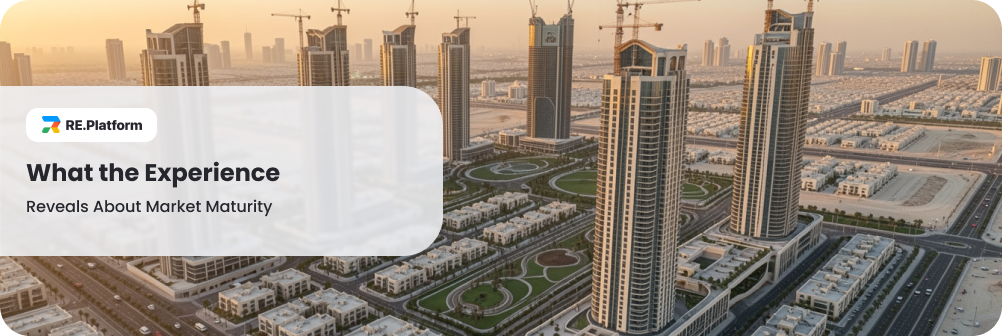
The contrast between the Gulf and Europe is not simply geographic. It reflects different stages of market development.
European markets have spent decades standardizing processes, distributing data and building layers of intermediation. The result is predictability, but also rigidity.
The Gulf, and Saudi Arabia in particular, is operating at a different point in that cycle. The market is expanding, structures are still forming, and flexibility remains a core characteristic.
For buyers, this means adapting expectations rather than applying a single framework across regions.
What initially feels like inconsistency is often a reflection of a market that has not yet fully converged on standardized models — and in some cases, may not need to.
As data infrastructure improves and new models of property discovery emerge, the gap between expectation and experience is likely to narrow.
Not because the Gulf will replicate Europe, but because it will develop its own version of transparency — one that aligns with a developer-driven ecosystem.
The transition is already underway. Structured project data, centralized visibility and more accessible interfaces are beginning to reshape how buyers engage with the market.
And as that shift continues, the experience of buying property in the Gulf will feel less like navigating an unfamiliar system — and more like understanding a different, but increasingly coherent one.