Why You Still Can’t Freely Buy Property in Saudi Arabia in 2026

Since the beginning of 2026, headlines across international media have repeated the same message: Saudi Arabia has opened its real estate market to foreign buyers.
At first glance, the narrative is compelling. A major Gulf economy, long closed to direct foreign ownership, is now “opening up” as part of broader economic reforms. For investors, developers and buyers, the implication is clear — a new market is available.
The problem is that this narrative is only partially true. While a legal framework for foreign ownership has indeed been introduced, the actual market conditions on the ground tell a different story. Access remains limited, procedures are still being implemented, and the system operates under strict regulatory control.
In other words, the market has not been fully opened. It has begun a controlled transition.
This distinction is rarely explained in media coverage. Either because the details are complex, or because simplified narratives travel further. To understand what is actually happening, it is necessary to look beyond headlines and examine how the system works in practice.
Table of Contents
The short answer is yes — but only under specific conditions that significantly limit access.
Foreign buyers are not entering an open, transaction-based market similar to Dubai or other international real estate hubs. Instead, they are operating within a framework that requires approval, restricts locations, and imposes eligibility criteria.
This is not a contradiction. It is a difference in structure. The law allows foreign ownership. The system controls how and where that ownership can take place.
As a result, the practical experience of a foreign buyer in Saudi Arabia today is far more constrained than many articles suggest.
One of the most important — and often overlooked — aspects of the new framework is that foreign ownership is not automatic.
All transactions involving non-Saudi buyers require approval from the Real Estate General Authority (REGA). This is not a procedural formality. It is a central mechanism of control.
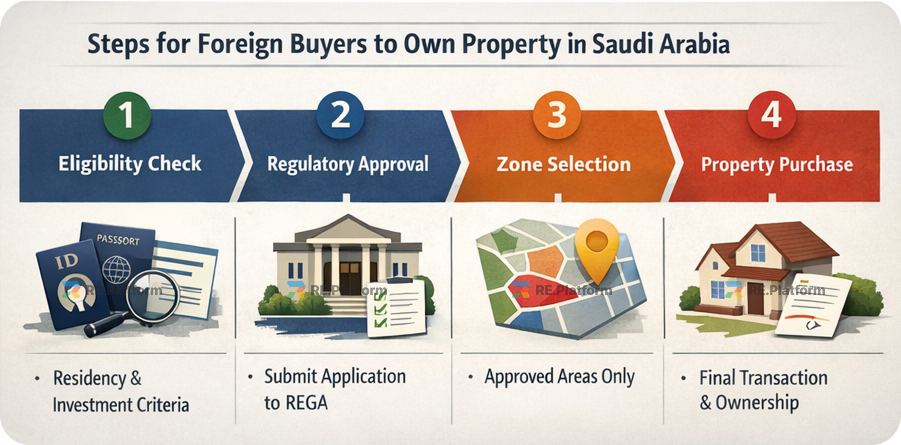
The approval process evaluates multiple factors, including:
In practical terms, this creates a permission-based system rather than a free market.
A foreign buyer cannot simply identify a property and complete a transaction. The purchase must be reviewed and approved within a regulatory framework that prioritizes broader market stability and policy objectives.
This is a fundamental difference from markets where ownership is governed primarily by contract law.
Another critical constraint lies in geography.
Foreign ownership is only permitted within specific zones approved by the authorities. These zones are intended to structure market access, control demand distribution and align development with national planning priorities.
However, the full list and implementation of these zones are still evolving.
This creates a situation where, in theory, ownership is allowed — but in practice, availability is limited and often unclear. Developers may market projects to international buyers, but eligibility depends on whether those projects fall within approved areas.
Until the zoning framework is fully defined and consistently applied, the market cannot function as a fully open environment.
The broader structure of the market reflects a deliberate policy choice.
Foreign ownership in Saudi Arabia is not being introduced as a free-flowing market mechanism. It is being implemented as a regulated system with defined parameters.
These parameters include:
This approach allows the government to manage the pace and direction of foreign participation, ensuring that it aligns with long-term economic and urban development goals.
For buyers, however, it introduces complexity. Access is not determined solely by demand or financial capacity. It is shaped by compliance with a framework that is still being developed.
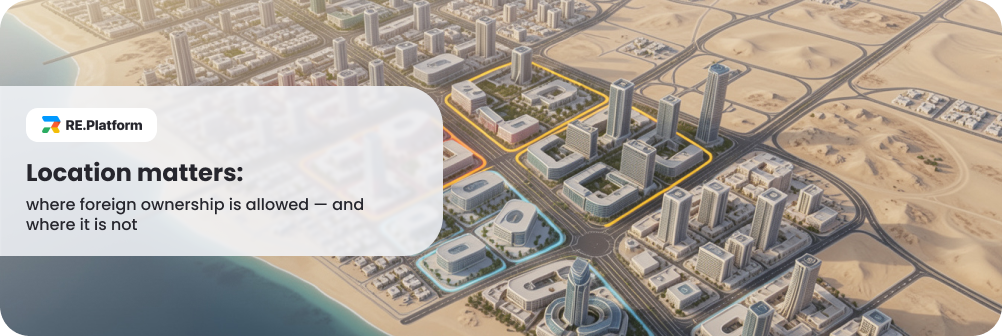
Even within the regulated system, access varies significantly by location. The following overview reflects the general structure of market access:
| Area | Status for Foreign Buyers |
|---|---|
| Riyadh | Allowed in designated zones |
| Jeddah | Allowed in designated zones |
| Dammam | Generally more accessible |
| Makkah | Highly restricted |
| Madinah | Highly restricted |
The restrictions on Makkah and Madinah are particularly significant, reflecting their religious importance and long-standing regulatory protections.
In other cities, access is theoretically possible, but still dependent on zoning and approval conditions.

Another layer of complexity comes from the profile of the buyer.
Not all foreign buyers are treated equally. Eligibility depends on residency status, investment intent and regulatory classification.
| Buyer Type | What You Can Do | Key Conditions |
|---|---|---|
| Residents (Iqama holders) | Buy 1 residential property | Must reside in Saudi Arabia |
| Non-residents | Buy in approved zones | Requires approval and compliance |
| Investors | Buy for development | Often subject to high investment thresholds |
| Companies / funds | Own property for operations | Must register and comply with regulations |
In some cases, particularly for commercial or development projects, minimum investment thresholds may apply.
To illustrate, consider a simplified example.
A foreign investor looking to develop a commercial property in Riyadh may be required to commit substantial capital — often in the tens of millions of Saudi riyals — and register through official investment channels before proceeding.
This is not a retail-level entry point. It is structured investment.
The gap between legislation and real-world implementation is not unusual, particularly in markets undergoing structural transformation.
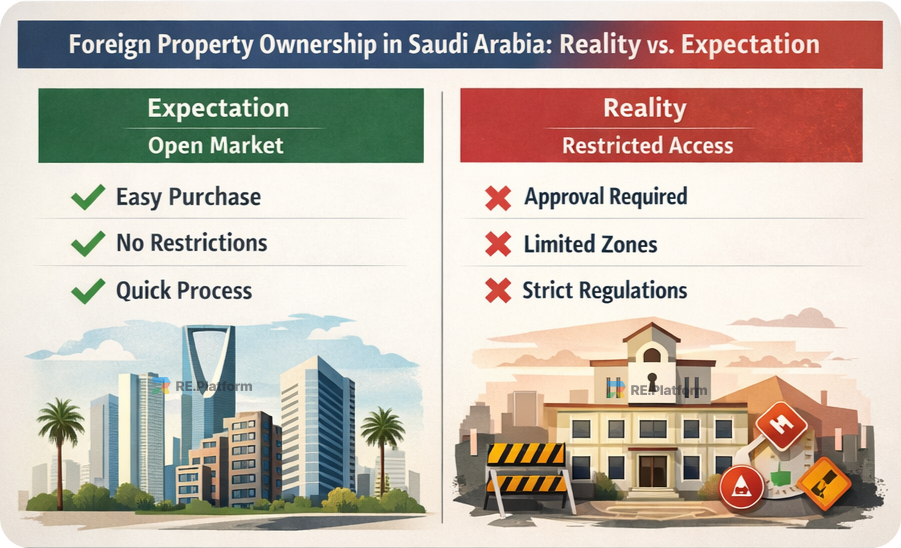
In Saudi Arabia’s case, several factors contribute to the slower-than-expected rollout:
Recent geopolitical tensions in the region have added another layer of caution, influencing both investor sentiment and the pace at which new policies are operationalized.
At the same time, local developers remain highly заинтересованы in broader market opening, as foreign demand represents a significant opportunity for growth and liquidity.
For investors, the current stage of the Saudi real estate market requires a different approach than what is typically applied in open, international property markets.
The primary challenge is not access to capital or even access to opportunities. It is access to clarity.
Understanding where foreign ownership is permitted, how approval processes work, and which projects are actually accessible requires more than surface-level research. It requires navigating a system where regulations, zoning and policy objectives are still evolving.
This creates both risk and opportunity.
On one hand, uncertainty increases the complexity of decision-making. Timelines are less predictable, processes are less standardized, and the ability to execute quickly is limited. For short-term, transactional investors, this can be a significant barrier.
On the other hand, early-stage markets often reward those who are able to operate within that complexity. Investors who understand the structure of the system — rather than relying on simplified assumptions — are better positioned to identify viable entry points and align with long-term development trends.
For developers, the implications are equally important, but slightly different.
The anticipated opening of the market to foreign buyers is not just about demand. It is about preparedness.
As access gradually expands, developers will face a new type of buyer — one that expects transparency, structured information and a level of clarity that is not always present in traditional sales processes. International investors are less tolerant of fragmented data, inconsistent communication and unclear availability. This is where operational structure becomes critical.
Developers who rely on manual processes, disconnected systems or limited visibility into their own inventory will find it difficult to meet these expectations. Conversely, those who have already invested in structured sales systems, centralized data and transparent workflows will be in a stronger position to capture foreign demand as it materializes.
There is also a timing factor. The market is not fully open today, but it is clearly moving in that direction. When access becomes broader and more predictable, competition will intensify — not only between projects, but between developers’ ability to present and manage those projects effectively.
In that context, the current phase is not a limitation. It is a preparation period.
For investors, it is a time to understand the system.
For developers, it is a time to build the infrastructure that will define how they compete when the market fully opens.
The short answer remains: not yet — at least not in the way most investors expect.
The introduction of a legal framework for foreign ownership has created the impression that Saudi Arabia has joined markets like the UAE, where property can be purchased relatively freely within defined zones. In reality, the current system operates very differently.
Foreign buyers are not entering a transactional market where access is determined by price and availability. They are entering a regulated environment where each step — from eligibility to location — is subject to approval and interpretation.
Even in cases where a property is technically available to foreign buyers, the transaction is not guaranteed. Approval from the regulator remains a critical step, and that approval is influenced by factors that go beyond the individual deal. Policy priorities, development goals and regulatory considerations all play a role.
This creates a level of uncertainty that does not exist in more mature international markets.
At the same time, the geographic limitations further reduce practical accessibility. Ownership is restricted to designated zones, and while these zones are being developed and expanded, they are not yet fully defined or consistently applied across the market. As a result, availability is uneven, and opportunities are often limited to specific projects or structures.
There is also a structural distinction between different types of buyers. Institutional investors and large-scale developers have clearer pathways into the market, often through investment frameworks and partnerships. Individual foreign buyers, particularly non-residents, face a more complex and less predictable process.
Taken together, these factors define the current state of the market.
Foreign ownership is legally possible.
But it is not operationally frictionless.
The system is still in transition — moving from a closed model toward a more open one, but not yet functioning as a fully accessible market. Until zoning, approval processes and regulatory clarity are further developed, foreign buyers will continue to operate within a controlled environment rather than a truly open marketplace.