How Military Tensions in the Middle East Impact Real Estate in Saudi Arabia

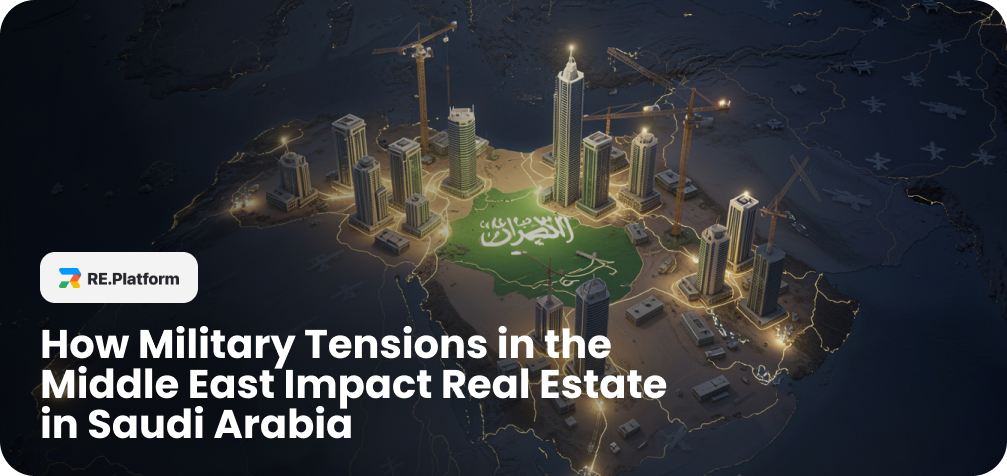
Geopolitical instability is a recurring factor in the Middle East, and each escalation inevitably raises the same question: what happens to real estate markets when uncertainty increases?
In Saudi Arabia, the answer is not as straightforward as a simple decline in demand or falling prices. The market behaves differently depending on the segment, type of buyer and stage of development. In many cases, short-term caution coexists with long-term growth.
Understanding this dynamic is essential for developers, investors and anyone operating in the region.
Table of Contents
The first visible impact of military tensions in the Middle East is not a sharp price correction, but a slowdown in transaction activity. In periods of heightened uncertainty, market participants tend to shift into a wait-and-see mode rather than exit the market entirely.
Buyers postpone decisions, investors reassess exposure and deal cycles become noticeably longer. This is especially evident in segments where transactions are driven by discretionary capital rather than immediate housing needs.
However, it is important to distinguish between reduced activity and structural weakness. In Saudi Arabia, these are not the same.
Unlike highly speculative markets, where pricing is closely tied to short-term sentiment, the Saudi real estate market is anchored by underlying demand and ongoing development. This limits the likelihood of rapid price corrections even when transaction volumes temporarily decline.
Another important dynamic is liquidity behavior. During periods of uncertainty, the market does not lose liquidity — it redistributes it. Buyers become more selective, focusing on projects with stronger fundamentals, established developers and clearer delivery timelines.
This creates a temporary imbalance:
weaker or less differentiated projects experience slower sales
well-positioned developments continue to attract demand
As a result, the market becomes more quality-driven rather than volume-driven.
Timing also plays a critical role. Many transactions are not canceled, but delayed. Once uncertainty stabilizes, activity tends to recover relatively quickly, as underlying demand remains intact.
In practical terms, this means that military escalation introduces friction into the transaction process, but does not fundamentally alter market direction. Prices remain relatively stable, while activity temporarily slows — a pattern that has been consistently observed across multiple periods of regional tension.
Not all parts of the real estate market respond to geopolitical tension in the same way. The impact varies depending on how each segment is structured, what type of demand it relies on and how far into the future buyers are committing capital.
In Saudi Arabia, the market is relatively diversified, which creates uneven sensitivity across asset classes. Some segments are driven by end-user demand and remain stable even during periods of uncertainty, while others are more exposed to investor sentiment and long-term expectations.
A key factor is the time horizon of the buyer.
Segments that are tied to immediate use — such as primary residential housing — tend to show minimal volatility. Buyers in this category are not entering the market for speculative reasons; they are responding to real housing needs. As a result, geopolitical events may delay decisions, but rarely eliminate demand.
In contrast, segments that depend on forward-looking expectations — particularly off-plan developments — are significantly more sensitive. These purchases require confidence in future market conditions, project delivery and long-term value growth. When uncertainty increases, hesitation grows accordingly.
Luxury real estate occupies a middle ground. While it is less volatile than purely speculative assets, it is still influenced by investor confidence and global capital flows. High-net-worth buyers tend to be more reactive to geopolitical signals, adjusting timing and allocation strategies.
Commercial real estate also responds differently. Its performance is closely tied to business activity, corporate expansion and economic outlook. During periods of tension, companies may slow down expansion plans, which in turn affects demand for office and retail space.
Another important dynamic is segmentation within each category. Even in more sensitive segments, well-located assets and projects backed by strong developers tend to maintain demand, while weaker or less differentiated offerings experience sharper slowdowns.
This uneven response creates a market environment where performance is no longer uniform. Instead, resilience becomes highly dependent on asset quality, location and developer credibility.
| Segment | Short-Term Impact | Reason |
|---|---|---|
| Primary residential (end-user) | Low | Driven by real housing demand |
| Luxury real estate | Medium | More exposed to investor sentiment |
| Off-plan developments | High | Requires long-term commitment |
| Commercial real estate | Medium | Linked to business confidence |
👉 Key takeaway: The more future-dependent the asset, the higher the sensitivity.
Unlike markets that rely heavily on foreign capital, Saudi Arabia benefits from a strong domestic demand base.
Population growth, urbanization and government-backed housing programs continue regardless of regional tensions. This creates a consistent demand floor.
Even during periods of uncertainty, people still need housing. This may delay decisions, but it does not eliminate demand.
International investors react more visibly to geopolitical risk, but the behavior is more nuanced than a simple exit.
Typical patterns include:
shifting toward completed properties instead of off-plan
prioritizing established developers
focusing on prime locations
extending decision timelines
What is important here is that capital often pauses rather than leaves.
In some cases, Saudi Arabia can even be perceived as a relatively stable option within a volatile region.

The off-plan segment is typically the first to reflect changes in market sentiment during periods of geopolitical uncertainty. Unlike completed properties, off-plan purchases require a higher degree of confidence in future outcomes — both in terms of market conditions and project delivery.
When military tensions escalate, this forward-looking nature becomes a critical factor. Buyers are no longer evaluating just the current state of the market, but also the level of risk associated with long-term commitments. As a result, hesitation increases more noticeably in this segment than in others.
Another important aspect is the structure of off-plan demand. A significant share of buyers in this segment consists of investors who are actively managing risk and return expectations. During uncertain periods, these buyers tend to become more selective, shifting focus toward projects with stronger fundamentals, clearer timelines and more established developers.
At the same time, off-plan transactions are closely tied to financing structures and payment schedules. Flexibility becomes a key lever. Developers often respond to changing market conditions by adjusting payment plans, extending post-handover options or introducing incentives designed to maintain buyer interest.
This creates a dynamic environment where activity does not disappear, but becomes more uneven:
projects with strong positioning continue to attract demand
less differentiated developments experience a sharper slowdown
Timing also plays a role. Many off-plan decisions are delayed rather than canceled. Once uncertainty stabilizes, deferred demand can return relatively quickly, especially in markets supported by strong underlying fundamentals.
In practical terms, the off-plan segment acts as an early indicator of market sentiment. It reacts faster, adjusts more visibly and provides a clearer signal of how buyers perceive risk at any given moment.
| Factor | Normal Market | During Tension |
|---|---|---|
| Buyer activity | High | Slower |
| Payment plans | Standard | More flexible |
| Developer incentives | Limited | Increased |
| Investor profile | Mixed | More cautious |
Developers often respond by adjusting pricing strategies, offering extended payment plans or delaying launches.
One of the defining characteristics of Saudi Arabia’s real estate market is the role of the state.
Large-scale developments are tied to long-term national strategy rather than short-term market cycles.
Projects linked to Vision 2030 continue to move forward even during periods of geopolitical uncertainty. This sends a strong signal to the market:
👉 development is not reactive — it is planned
This continuity reduces systemic risk and supports overall market confidence.
A critical factor in understanding the market is the gap between perception and actual conditions.
Global headlines often treat the Middle East as a single risk zone. In reality, different countries operate under very different economic and political frameworks.
This creates what can be described as a mispricing effect:
perceived risk increases
actual fundamentals remain stable
For informed investors, this gap can create entry opportunities.
Short-term volatility may create better entry points
Focus shifts toward completed or near-completion assets
Risk assessment becomes more location-specific
transparency becomes more important than ever
strong project positioning reduces uncertainty

To summarize the behavior:
| Factor | Effect |
|---|---|
| Transaction volume | Temporary slowdown |
| Prices | Relatively stable |
| Domestic demand | Remains strong |
| Foreign investment | Becomes selective |
| Off-plan segment | Most affected |
| Long-term growth | Unchanged |
Geopolitical events operate on a short-term timeline. Real estate development in Saudi Arabia operates on a long-term horizon.
The core drivers remain unchanged:
population growth
urban expansion
economic diversification
infrastructure investment
These factors continue to shape the market regardless of temporary instability.
Military tensions in the Middle East do influence real estate activity in Saudi Arabia, but primarily through timing and sentiment rather than structural change.
The market becomes more cautious, not weaker.
For investors and developers, the key is to separate short-term noise from long-term fundamentals. Those who understand this distinction are better positioned to navigate the market — and, in some cases, benefit from it.