Foreigners to Buy Property in Saudi Arabia From 2026: Why It Matters & How Re.Platform Can Help Developers


Starting in January 2026, Saudi Arabia will allow non-Saudis to purchase property in designated regions, marking a historic shift in the Kingdom’s real estate market. This move opens the doors for international investors, expatriates, and global developers to tap into a previously restricted but highly promising market.
For developers, this change is a significant opportunity to expand their buyer base, attract foreign clients, and increase sales. To fully capitalize on this shift, developers need digital tools that streamline property management, client engagement, and sales processes. RE.Platform provides exactly that: a unified ecosystem for property catalog management, CRM, AI-assisted customer interactions, online bookings, and analytics, empowering developers to scale efficiently and convert new demand into tangible revenue.
Table of Contents
To understand the significance of the 2026 reform, it’s important to grasp how tightly regulated the Saudi property market has been. Historically, non-Saudis faced serious limitations on real estate ownership. Only certain types of properties were accessible, and processes involved cumbersome approvals, often demanding high-level clearances.
Some of the most critical current limitations include:
Registered property only: Under the new law, non-Saudis will only be permitted to own registered properties. REGA (Real Estate General Authority) requires disclosure of detailed personal and financial information for foreign buyers.
High compliance and penalties: The new regulation imposes combined fees and taxes up to 10% for foreign-owned property. Violations — including false disclosures — may result in fines up to SAR 10 million or even public auction of the property.
Geographic restrictions: REGA is defining designated geographic zones where foreigners may own property — particularly in Riyadh and Jeddah. There are special rules for Mecca (Makkah) and Medina (Madinah), where ownership is more tightly regulated.
Religious and legal safeguards: According to the law, non-Saudis generally cannot hold ownership, easement, or usufruct rights in Mecca or Medina, except in narrow cases (e.g., via waqf trusts), underscoring the Kingdom’s intention to preserve the religious and demographic character of those cities.
Phased regulatory implementation: REGA has up to 180 days to publish executive regulations after the law’s formal announcement.
These constraints reflect a carefully calibrated opening—designed to stimulate foreign investment while maintaining control, protecting national interests, and respecting cultural sensitivities.
With the law coming into force in January 2026, several important changes and caveats will shape how foreign ownership will work in practice.
Broader eligible buyer categories: The law allows not just foreign individuals, but also foreign companies, Saudi companies with foreign shareholders, non-profits, and diplomatic missions to own property.
Mandatory registration: Ownership rights will only be valid if registered with REGA.
Financial burden: A 10% fee/tax applies, making foreign ownership a serious investment decision.
Geographic clarity: Official maps and detailed guidelines will soon be released, defining which zones foreigners can buy in — including precise ownership percentages and rights.
Religious cities exclusion: Mecca and Medina retain strict ownership rules. Foreigners who are non-Muslims are generally not allowed to own there, while limited rights may be given via endowments (waqf).
Digital ID requirement: Non-Saudis will likely need a formal digital identity (e.g., via the Absher system) to register property, enabling more transparent and secure transactions.
This policy is expected to increase property demand significantly, driving growth in both primary and secondary markets. Foreign buyers will look for modern developments, flexible payment options, and high-quality digital services — all areas where developers must adapt quickly to meet expectations.

The 2026 policy shift presents developers with unprecedented opportunities:
Broader client base: Developers can now market to international buyers, attracting investors from across the GCC, Asia, and Europe.
Higher sales velocity: Increased demand will accelerate property turnover, especially in urban and coastal regions.
Market differentiation: Developers offering digital experiences, virtual tours, and AI-driven client support will stand out.
Enhanced investor confidence: Transparent processes, online booking, and secure transactions will appeal to foreign buyers.
Read our article “What Real Estate Developers Will Face After Opening Property Sales to Foreign Buyers“, this article covers the topic in more detail.
Effectively, developers who embrace this market shift early will capture a significant competitive advantage.
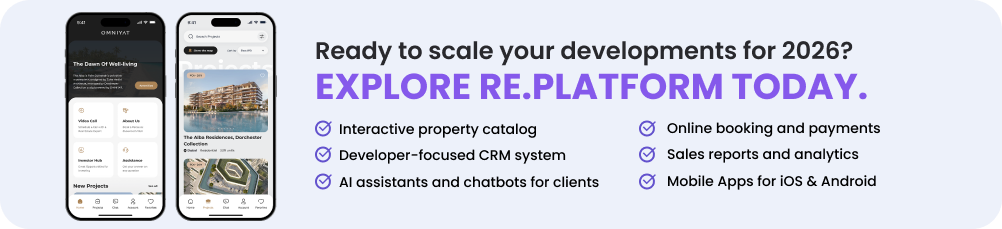
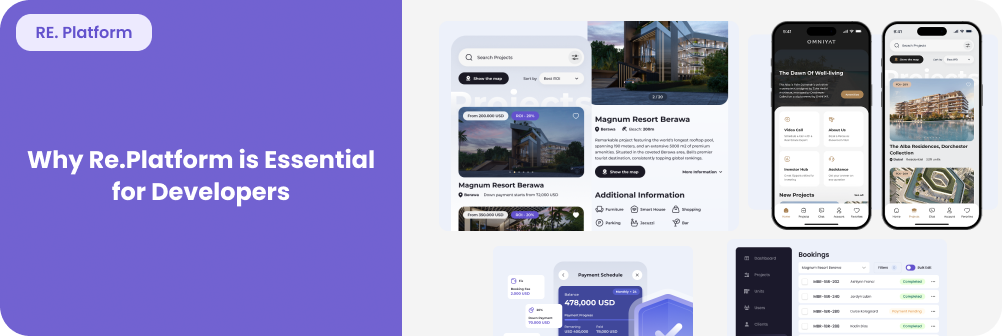
Re.Platform is designed to equip developers with all the tools needed to succeed in a newly internationalized market:
| Feature | Benefit for Developers |
|---|---|
| Interactive Property Catalog | Showcase every property interactively with live data and filtering by price, area, layout, or status. |
| Developer-Focused CRM | Manage leads, deals, and client communications efficiently, with full integration into the catalog and booking system. |
| AI Assistants & Chatbots | Provide instant, 24/7 support for potential buyers, answer queries, and route hot leads to sales managers. |
| Online Booking & Payments | Enable secure online bookings, payment processing, and contract generation to streamline sales. |
| Sales Reports & Analytics | Monitor performance in real-time, track KPIs, and make data-driven decisions for maximum ROI. |
| Mobile Apps (iOS & Android) | Offer international buyers seamless mobile access, boosting visibility and engagement. |
With these capabilities, developers can attract, engage, and convert foreign buyers efficiently, turning the policy shift into real business growth.
The 2026 real estate reform in Saudi Arabia is a landmark moment: for the first time, non-Saudis will gain structured access to property ownership under defined conditions. While the law brings controls — registration, fees, penalties, and geographic limits — it also unlocks significant new opportunities for developers ready to adapt.
For developers aiming to lead this transition, Re.Platform is more than a digital tool — it’s a strategic partner. With its unified ecosystem for sales, operations, analytics, and client engagement, Re.Platform enables you to prepare, scale, and convert foreign demand as the market opens.
In short: Saudi Arabia’s policy shift is not just regulatory — it’s a catalyst for global investment, and Re.Platform is your bridge to harness that momentum.