RE.Platform or Zoho CRM for Real Estate: What the best for business?


Today, the diversity of technologies across different industries is truly overwhelming. Dozens of messaging apps, CMS platforms, task trackers, AI tools, and CRM for Real Estate compete for attention. Every market has its own leaders, its own “top picks,” and its fair share of outsiders.
The real estate development sector is no exception. There are plenty of CRMs with big names behind them, built by large vendors and marketed as “solutions for real estate.” (You can read more about the TOP CRMs for developers in our dedicated article.)
But an important question often goes unanswered:
In this article, we’ll answer that question directly. Using a clear, practical comparison, we’ll show how a platform designed specifically for real estate developers solves real operational pain points — instead of offering a templated, one-size-fits-all solution.
Table of Contents
Many developers still rely on fragmented tools, outdated client interaction models, manual inventory tracking, and static presentations. Excel files, PDFs, and WhatsApp messages remain the backbone of daily operations.
If your company still uses these tools for:
maintaining client databases and reports,
presenting properties,
negotiating and sharing information with buyers,
then the situation is far from ideal.
Any business operating in a competitive market must adapt to current realities and modern technologies. Real estate is no different.
Below is a clear comparison between outdated practices and the baseline level of service expected from developers today:
| Outdated approach | Required standard |
|---|---|
| PDF brochures and static presentations | Interactive property catalogs in web and mobile apps |
| Lead qualification done manually by managers | Automated qualification with AI-powered chatbots |
| Offline or manual “reservations” | Online booking with card payments inside the sales funnel |
| Excel-based CRM tracking | Enterprise-grade, object-oriented CRM |
| Monthly reporting | Real-time analytics and instant sales signals |
The most important strategic shift is this: deals must be digital by default, not dependent on a specific sales manager.
Here’s a simple example. Your sales team works on a schedule. Even with shifts covering most of the week, there are still gaps. What happens if a potential buyer sends a message late at night? On a weekend? During a holiday?
Nothing happens. No reply. And that buyer simply goes to a competitor who responds faster.
AI assistants solve this problem directly — while also reducing operational costs. An AI assistant doesn’t sleep, doesn’t take breaks, and doesn’t require a salary. It’s available 24/7, ready to answer questions and qualify interest instantly.
And this is just one example. There are many more.
A new “minimum viable digital infrastructure” now defines competitiveness in real estate development.
These are not optional enhancements. They are mandatory requirements.
| Capability | Why it’s essential | Business impact |
|---|---|---|
| Interactive property catalog | Gives buyers autonomy and reduces reliance on direct manager interaction | Higher top-of-funnel conversion |
| Online booking with integrated payments | Instantly monetizes intent and removes friction between interest and transaction | Faster cash collection |
| Developer-focused CRM (not generic) | In real estate, properties matter more than contacts — the CRM must reflect that | Better control and predictability |
| Real-time sales analytics | Eliminates management blind spots | Faster corrective decisions |
| AI assistants and chatbots | Scales first-line communication without growing headcount | Lower cost per closed deal |
Any developer not using this technology stack will operate slower and at a higher cost than competitors who do. At this stage of industry evolution, digital tools are no longer “support systems.” They are the sales engine.
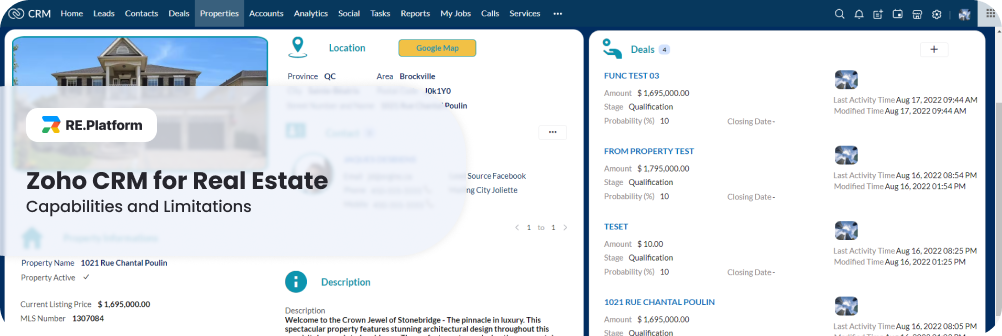
Zoho CRM offers a standard set of features typical for generic CRM systems: lead capture from multiple sources, pipeline stages, and basic lead scoring. On paper, this covers basic lead tracking.
In practice, it falls short for real estate development.
Zoho lacks native support for developer-specific logic: projects, buildings, construction phases, unit types, and direct linkage between a lead and a specific property. All of this must be recreated manually using custom fields and statuses — turning the CRM into an overloaded spreadsheet that is difficult for sales teams to work with.
Automated email responses follow generic templates and fail to react to critical real estate triggers such as price changes or availability updates. As a result, communication loses context and personalization suffers.
Zoho focuses on universal automation: lead assignment, reminders, and basic workflows. While useful in general sales, this approach proves superficial for development businesses.
The system doesn’t account for complex role structures: call centers, brokers, mortgage specialists, partner agencies, and internal sales teams. Configuring lead distribution across these scenarios requires constant manual logic and ongoing admin support.
More importantly, Zoho’s automation is disconnected from real developer workflows — bookings, price locking, payment schedules, installment plans, and mortgage processes. The CRM automates internal actions but doesn’t manage the full business process, forcing teams back into Excel files and messaging apps.
Zoho’s AI assistant, Zia, looks impressive in demos but offers limited value for real estate. It suggests optimal contact times based on CRM activity, yet ignores critical deal factors such as client intent, investment goals, project stage, or market conditions.
Developers need insights into demand by unit type, sales velocity by building, promotion effectiveness, and mortgage impact. Zia operates on abstract CRM metrics rather than real development analytics.
As a result, AI becomes a tactical helper for managers — not a strategic decision-making tool.
Feeds, chat integrations, and notifications simplify internal communication, but Zoho remains within generic CRM logic.
Discussions are not directly tied to property layouts, construction status, pricing updates, or contractual changes. Key information remains scattered across external tools, email, and file storage systems.
For developers who need tight alignment between sales, marketing, and product teams, this level of collaboration is insufficient.
Zoho provides centralized document storage with version control — useful in general business contexts.
In real estate, however, documents are part of legally binding transaction flows. Zoho lacks native support for reservation agreements, development contracts, addendums, or mortgage packages. Documents exist near leads but are not embedded into the deal lifecycle.
The CRM functions more like a filing cabinet than a transaction management system.
Zoho’s built-in reports offer a high-level view of sales activity, but this depth is insufficient for developers. The system isn’t designed for analysis by projects, buildings, unit types, or demand sources tied to specific properties.
Meaningful analytics require custom reports, data exports, and external BI tools — slowing down decision-making and reducing operational agility.
Zoho’s mobile app is stable and functional, but mirrors the same limitations as the desktop version. It supports task and contact management, but fails to address core mobile scenarios for developers: instant access to units, pricing, availability, bookings, and promotions.
For real estate teams, the CRM remains a supporting tool rather than a true mobile workspace.
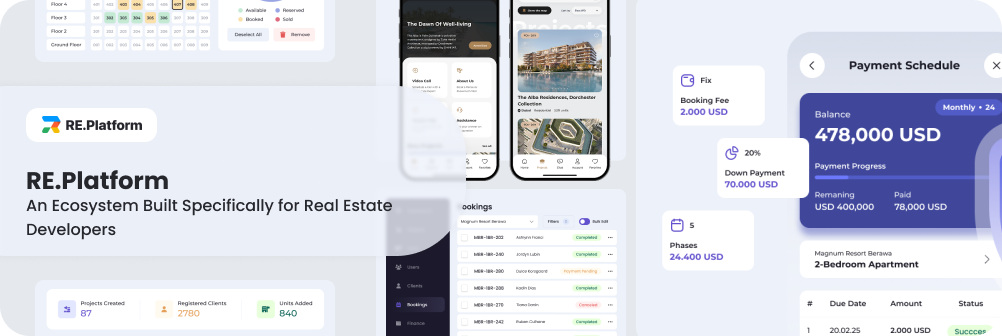
Unlike generic CRMs adapted for real estate, RE.Platform was designed from day one exclusively for developers. It is not a CRM with added modules — it is a unified digital environment where properties, sales, clients, bookings, payments, and analytics operate as a single system.
The platform natively understands developer logic: projects, buildings, phases, units, layouts, availability statuses, pricing dynamics, and long decision cycles. These are core system entities, not custom fields patched together over time.
As a result, RE.Platform doesn’t require constant reconfiguration — it already reflects real operational processes.
One of RE.Platform’s key differentiators is its interactive property catalog, fully synchronized with the CRM and developer database in real time.
Sales teams always work with up-to-date availability and pricing. Buyers see the same data across web and mobile apps: layouts, floors, areas, prices, and statuses. This eliminates the disconnect between marketing showcases and internal operations that plagues traditional CRMs.
RE.Platform enables developers to launch branded iOS and Android applications that function as full sales tools — not just showcases.
Buyers gain convenient access to projects and offers, while developers unlock an additional conversion channel, especially valuable for international sales. Every inquiry or booking flows directly into the CRM without losing context.
RE.Platform removes friction between interest and action. Online booking, applications, data entry, electronic signatures, and payments are fully integrated into a single flow. Deal statuses remain transparent and traceable in real time.
The CRM is the system’s core, not a separate module. Every lead, deal, booking, and document is directly linked to specific units and transactions.
Managers always understand deal context, while leadership gains a clear, unified view of sales without manual data consolidation.
Built-in AI assistants and chatbots handle first-line communication, answer common questions, qualify demand, and route high-intent leads to managers.
Integrations with Telegram, WhatsApp, and web chat keep communication where customers prefer — without losing data or context.
In practice, RE.Platform delivers a complete digital ecosystem. Developers receive a unified environment that includes a property landing page with live units and pricing, CRM, mobile apps, bookings, payments, and analytics.
This is the fundamental difference in approach. While other CRMs attempt to adapt to real estate, RE.Platform is built around it from the ground up. And for developers thinking strategically and long term, the real question is no longer feature count — but how closely a system aligns with the reality of their business.
| Criterion / Function | RE.Platform | Zoho CRM |
|---|---|---|
| Project-oriented logic | Built from the ground up for developers: native support for projects, buildings, phases, units, layouts, statuses, pricing | Generic CRM — real estate objects must be modeled manually with custom fields |
| Real-time availability & pricing | Live data synced automatically with CRM, web, and mobile | No real object catalog; updates are manual or through unstable integrations |
| Interactive property catalog | Yes — professional web & mobile interface with filters (price, layout, floor, status) | Not available; only basic data handling via custom fields |
| Online booking | Full in-system booking workflow | Only basic booking via customization or third-party modules |
| Payments integration | Secure, built-in payment flows directly in sales funnel | No native payments; requires external configuration |
| Mobile apps for buyers | Branded iOS & Android apps showcasing projects and units | Has a mobile app, but not buyer-focused |
| Interaction history & CRM context | All communication (calls, chats, emails) linked to specific units and deals | Supported, but lacks real estate context — lead-to-object linkage weak |
| AI & automated qualification | Intelligent bots and lead routing tuned for developer use cases | AI (Zia) present, but not tailored to real estate |
| Document & contract management | Auto generation from templates, e-sign workflows, versioned archive tied to deals | Basic document storage, not directly tied to deal lifecycle |
| Analytics & reporting | Built-in analytics by project, product type, sales trends | Generic reports; requires external BI tools for deeper insights |
| Industry-specific process support | Real estate workflows out of the box (stages, pricing updates, availability) | Available only via heavy configuration |
| Speed of deployment | Fast — preconfigured templates and real estate logic | Flexible, but lengthy configuration required |
| UX for end customers | Designed for buyers and sales teams (apps, booking, web catalog) | Focused on internal sales users, not on buyers |
| Purpose | Full developer ecosystem — CRM + catalog + transactions | General CRM for broad business use |
Zoho CRM makes sense as a general sales and lead management system. But for real estate developers, it often becomes a framework you need to bend, customize, and patch just to approximate industry processes. Static fields, custom objects, manual integrations — this quickly turns into overhead.
RE.Platform, in contrast, was built with real estate at its core:
The comparison highlights two fundamentally different approaches. Zoho serves many types of business needs broadly. RE.Platform is engineered specifically for end-to-end property sales and developer operations — covering everything from discovery to deal closing in one unified environment.