CRM for Real Estate Developers: What It Is and its Key Features


The real estate industry has entered a phase where operational discipline matters as much as location and pricing. Buyers expect instant responses, clear availability, transparent terms, and digital communication at every step of the journey. At the same time, developers are handling more moving parts than ever: leads from dozens of channels, complex inventories, long decision cycles, reservations, contracts, and payments.
Managing all of this with spreadsheets, PDF catalogs, and disconnected tools creates friction. Data gets outdated, follow-ups are missed, and teams lose visibility into what is actually happening across projects. As international buyers enter the market and sales volumes increase, these gaps become impossible to ignore.
This is where CRM for real estate stops being a “nice-to-have” tool and becomes core infrastructure. Not just a database of contacts, but a system that connects clients, inventory, sales processes, and decision-making into a single operational flow.
In this guide, we break down what CRM really means, how CRM for real estate works in practice, which features matter in 2026, and why industry-specific platforms are replacing generic CRM solutions.
Table of Contents
At its most basic level, a CRM (Customer Relationship Management system) is software that helps businesses organize interactions with customers. Traditionally, this meant storing contact details, logging calls, tracking emails, and monitoring deal stages.
But this definition no longer reflects how CRM systems are actually used today.
In modern businesses, a CRM is not just a record-keeping tool. It is the system that defines how work happens between people, data, and decisions. It connects communication, tasks, history, and outcomes into a structured process that can scale beyond individual employees.
A CRM answers a few critical questions at any moment:
Who is the customer, and what do we know about them?
What has already happened, and what needs to happen next?
Who is responsible, and at what stage is the process?
Without a CRM, these answers usually live in people’s heads, inboxes, or spreadsheets. With a CRM, they live in one shared system.
Over time, CRM platforms have evolved from simple contact databases into operational hubs. They now support automation, reporting, analytics, collaboration, and increasingly, AI-driven recommendations. This shift reflects a broader change in how businesses operate: growth is no longer driven by individual effort alone, but by systems that reduce chaos and create repeatable results.
A useful way to understand a CRM is to see it as a memory and coordination layer for the business.
People forget. Teams change. Volumes increase. Processes become more complex. A CRM exists to make sure that:
no interaction is lost,
no follow-up depends on personal memory,
no decision is made without context.
It captures what happened yesterday, supports what needs to happen today, and helps plan what comes next.
Ultimately, a CRM is not just software. It is a framework for managing relationships at scale. It replaces fragmented communication with shared visibility, replaces manual coordination with automation, and replaces intuition with data-supported decisions. In fast-moving, high-volume industries, this shift is not optional — it is what allows businesses to grow without losing control.
A CRM for real estate is a specialized version of CRM software built around the realities of property sales. Instead of treating products as abstract items, it works with real assets: projects, buildings, units, layouts, prices, and availability statuses.
For real estate developers, a CRM connects buyers directly to inventory. Leads are not just names in a database — they are matched to specific units, budgets, locations, and timelines. Every interaction, from the first inquiry to reservation and post-sale communication, is tracked in one system.
Unlike generic CRMs, real estate CRMs are designed to handle:
Long sales cycles
Multiple stakeholders per deal
Dynamic pricing and availability
Reservations, contracts, and payments
Post-sale relationships and retention
In practice, a real estate CRM becomes the operational backbone of sales, not just a contact list.
| Traditional Approach | CRM-Driven Approach |
|---|---|
| Spreadsheets and emails | Centralized CRM database |
| Manual follow-ups | Automated workflows |
| Static PDF catalogs | Live inventory visibility |
| Limited reporting | Real-time analytics |
| Reactive decisions | Data-driven planning |
In real estate development, CRM has a meaning that goes far beyond its classic definition. Developers are not selling standardized products with short sales cycles. They operate in an environment defined by long decision timelines, complex inventory structures, multiple stakeholders, and continuous changes in pricing and availability.
In this context, CRM is not simply a relationship tool. It becomes an operational coordination system that connects people, projects, units, and transactions into a single, manageable workflow.
Unlike agencies or brokerages, developers must manage sales at the project and unit level, often across several developments at the same time. This introduces a different set of operational challenges that generic CRMs were never designed to handle.
| Aspect | Without CRM | With CRM |
|---|---|---|
| Lead handling | Leads spread across emails, forms, spreadsheets | Centralized lead intake from all channels |
| Inventory visibility | Manual updates, outdated availability | Live unit status in real time |
| Sales coordination | Dependent on individuals | Shared pipelines and clear ownership |
| Decision cycles | Hard to track, inconsistent follow-ups | Structured stages with automated reminders |
| Management visibility | Limited, retrospective | Real-time dashboards and forecasting |
| Scalability | Breaks as volume grows | Designed to scale across projects |
This shift is critical. A CRM allows developers to move from reactive sales management to controlled, repeatable execution.
In real estate development, CRM has a meaning that goes far beyond its classic definition. Developers are not selling standardized products with short sales cycles. They operate in an environment defined by long decision timelines, complex inventory structures, multiple stakeholders, and continuous changes in pricing and availability.
In this context, CRM is not simply a relationship tool. It becomes an operational coordination system that connects people, projects, units, and transactions into a single, manageable workflow.
Unlike agencies or brokerages, developers must manage sales at the project and unit level, often across several developments at the same time. This introduces a different set of operational challenges that generic CRMs were never designed to handle.
In our view, CRM in real estate development is not about managing relationships — it is about managing complexity.
A developer-focused CRM exists to:
absorb operational complexity instead of passing it to people
reduce dependency on individual managers
turn fragmented processes into structured pipelines
create predictability in revenue and execution
When CRM is implemented correctly, sales performance becomes less dependent on heroic effort and more dependent on systems. That is the difference between scaling a project and scaling a business.
Ultimately, in real estate development, CRM is not a sales tool. It is the infrastructure that allows sales to function reliably as projects, teams, and markets grow.
Lead Capture and Automation
A CRM should automatically collect leads from all channels and route them into structured pipelines. Advanced systems prioritize leads based on behavior, interest, and readiness to buy.
Sales Pipeline Management
Clear visibility into deal stages helps teams forecast revenue, identify stalled opportunities, and focus on deals most likely to close.
Inventory and Transaction Management
The CRM should handle unit availability, reservations, contracts, and transaction milestones inside one environment.
Document Management
Secure storage, access control, and integration with e-signature tools reduce friction and legal risk.
Marketing Automation
Targeted campaigns, behavior-based triggers, and personalized communication improve engagement without increasing manual workload.
Reporting and Analytics
Dashboards and reports provide insight into sales velocity, conversion rates, and channel performance.
Integrations
Open APIs and native integrations ensure the CRM works seamlessly with payment systems, marketing platforms, and third-party tools.
Mobile Access
Sales teams need real-time access on the go, without sacrificing data security.
Scalability
A CRM must grow with the portfolio, supporting more projects, users, and data without replatforming.
Generic CRMs like Zoho, HubSpot, or Monday are powerful systems — but they were built for horizontal use cases. Sales teams, service desks, marketers. Not developers managing complex real estate inventories and long transactional cycles.
At first glance, these platforms seem flexible. They promise customization, workflows, and automation. In practice, developers quickly encounter structural limitations that cannot be solved with settings or plugins.
| Real Estate Scenario | Generic CRM (e.g. Zoho CRM) | Developer-Focused CRM (e.g. RE.Platform) |
|---|---|---|
| Units and inventory | Units treated as “products” or custom fields | Units are native entities with live status |
| Availability updates | Manual updates by managers | Automatic updates after bookings or payments |
| Project structure | Requires complex custom modules | Projects, phases, buildings built-in |
| Pricing logic | Static prices or manual rules | Dynamic pricing per unit and stage |
| Reservations | External tools or spreadsheets | Built-in booking and reservation flow |
| Payments | Disconnected accounting tools | Integrated payment and transaction tracking |
In our experience, developers rarely abandon generic CRMs because of missing features. They leave because of:
rising operational friction
growing dependency on manual processes
loss of data consistency
inability to get a real-time picture of sales
At a certain scale, no amount of customization can replace a system designed around real estate logic from day one. Real estate is not just sales. It is inventory, timing, financing, reservations, and trust — all happening simultaneously.
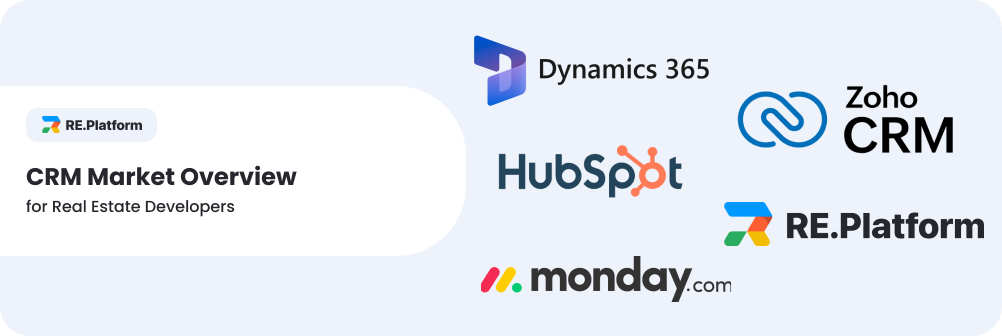
Based on market adoption, most developers eventually move away from generic solutions toward platforms built specifically for real estate. (Read more about TOP CRM for real estate developers here)
| CRM | Real Estate Fit | Automation | Scalability |
|---|---|---|---|
| Microsoft Dynamics | Medium | High | High |
| HubSpot | Medium | High | Medium |
| RE.Platform | Very High | Very High | Very High |
| Zoho CRM | Low | Medium | Medium |
| Monday CRM | Low | Low | Low |
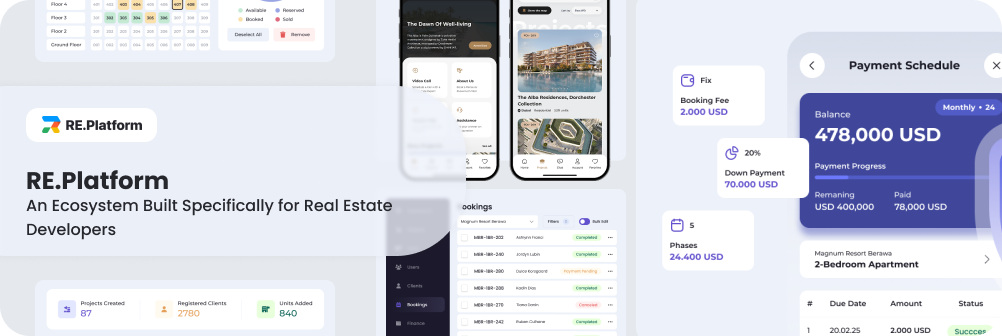
Most CRM systems treat real estate as a use case. RE.Platform treats it as the foundation.
Built specifically for developers, RE.Platform combines CRM, inventory management, booking, and financial workflows into a single ecosystem. Leads are automatically linked to units, availability updates in real time, and transactions flow without manual reconciliation.
Sales, marketing, and operations work from the same data set. This eliminates inconsistencies, reduces friction, and allows teams to focus on growth instead of administration.
To illustrate how this works in practice, consider the example of a large residential developer (one of the top real estate developer in Saudi Arabia)operating multiple mid- and high-rise projects in Saudi Arabia.
Before implementing RE.Platform, the developer relied on a combination of spreadsheets, PDF catalogs, WhatsApp communication, and a generic CRM. As sales volumes increased — especially after opening projects to foreign buyers — internal processes began to break down.
Key challenges before implementation:
Lead response times exceeded 24 hours on average
Unit availability data was updated manually, often with delays
Sales managers spent significant time reconciling reservations and payments
Management lacked real-time visibility into the sales pipeline
After migrating to RE.Platform and consolidating sales, inventory, and booking workflows into a single system, the results became visible within the first months.
Measured results after 6 months:
Average lead response time reduced by 68%
Sales conversion rate increased by 31%
Manual data handling reduced by over 40%
Reservation conflicts dropped to near zero due to real-time inventory sync
Management gained live dashboards for pipeline, inventory, and revenue forecasting
According to the developer’s sales team, the biggest improvement was not automation alone, but clarity. Every stakeholder — from sales managers to executives — worked with the same data, in the same system, without relying on parallel tools.
This case highlights a key difference in how RE.Platform approaches CRM. The platform does not optimize individual tasks in isolation. It aligns sales, inventory, payments, and reporting into a single operational layer built specifically for real estate development.
Modern CRM platforms for real estate developers are more than simple contact databases. They connect sales pipelines, property inventory, client communication, and analytics into a single operational system.
To explore the topic in greater detail, we have prepared several in-depth articles covering different aspects of CRM systems used by real estate companies — from choosing the right platform to understanding how CRM adoption is transforming the industry.
What Is a CRM for Real Estate
A practical introduction explaining how CRM systems help real estate companies manage leads, sales pipelines, and client relationships.
What Is an All-in-One CRM for Real Estate
An overview of how modern all-in-one platforms combine CRM, project management, and sales tools into a single ecosystem.
How to Choose a Real Estate CRM: A Practical Guide
A step-by-step guide explaining how developers and agencies can evaluate CRM systems and select the right platform for their operations.
Top 5 CRM for Real Estate Developers in 2026
A comparison of leading CRM solutions used by real estate developers and property companies.
RE.Platform or Zoho CRM for Real Estate: What’s Best for Business
A detailed comparison of two CRM approaches and how they support real estate development operations.
CRM Adoption in Real Estate: How Demand Has Grown Over the Last 5 Years
An analysis of how CRM adoption has accelerated across the real estate industry and why developers are increasingly moving toward structured digital systems.
How CRM Helps Businesses Grow: From Fragmented Operations to Scalable Systems
A deeper look at how CRM platforms help companies move from manual processes to scalable, data-driven operations.

The real estate development market is evolving faster than ever — especially in regions like Saudi Arabia, where digital sales, international buyers, and large-scale residential projects are becoming the new standard.
What once worked with spreadsheets, messaging apps, and generic CRMs is no longer sustainable. As projects grow in size and complexity, operational gaps become visible not only internally but also to clients, partners, and investors.
A CRM in real estate development is no longer just a sales tool. It is the operational backbone of the business. It connects inventory, sales teams, marketing channels, reservations, and financial flows into a single, reliable system. Without this connection, even strong demand cannot compensate for broken processes.
In our view, the key difference lies not in having a CRM, but in what the CRM understands. Generic systems require developers to adapt their business logic to the software. Industry-specific platforms do the opposite — they adapt to the reality of real estate development.
As more developers enter digital sales, open their projects to international buyers, and compete on transparency and speed, CRM systems designed specifically for real estate will shift from a competitive advantage to a baseline requirement.
Those who invest early in the right infrastructure gain more than automation. They gain clarity, control, and scalability — the three elements that define sustainable growth in modern real estate development.

A CRM for real estate developers is a system designed to manage leads, inventory, sales pipelines, and client interactions in one platform. Unlike generic CRMs, it connects buyers directly to real units, availability, pricing, and booking workflows.
Generic CRMs focus on contacts and deals. Real estate CRMs are built around projects, buildings, and units. They handle live availability, reservations, pricing logic, and long sales cycles that generic systems cannot support without heavy customization.
Yes. As soon as a developer manages more than one project or works with international buyers, manual tools like spreadsheets and PDFs stop scaling. A CRM provides structure, reduces errors, and keeps sales predictable as volume grows.
Yes, indirectly but consistently. CRM systems reduce response times, automate follow-ups, and help sales teams match buyers with relevant units. This improves buyer experience and increases conversion rates over time.
Yes. Even developers with a limited number of units benefit from centralized data, structured pipelines, and automated communication. A CRM prevents operational chaos before it appears and supports future growth.
Key features include live inventory management, automated lead handling, sales pipeline tracking, booking and reservation workflows, document management, analytics, integrations, and secure cloud access.
Most developers leave generic CRMs because they cannot handle real estate-specific complexity. Manual inventory updates, disconnected tools, and unreliable reporting create operational friction that grows with scale.
Yes. Modern real estate CRMs support multilingual buyers, cross-border communication, digital documentation, and online booking flows. This is essential in markets open to foreign investment, such as Saudi Arabia.
Both. For sales teams, CRM organizes leads and follow-ups. For management, it provides real-time visibility into pipelines, inventory status, and revenue forecasts, enabling data-driven decisions.