Real Estate Development Companies in Saudi Arabia (2026 Market Overview)


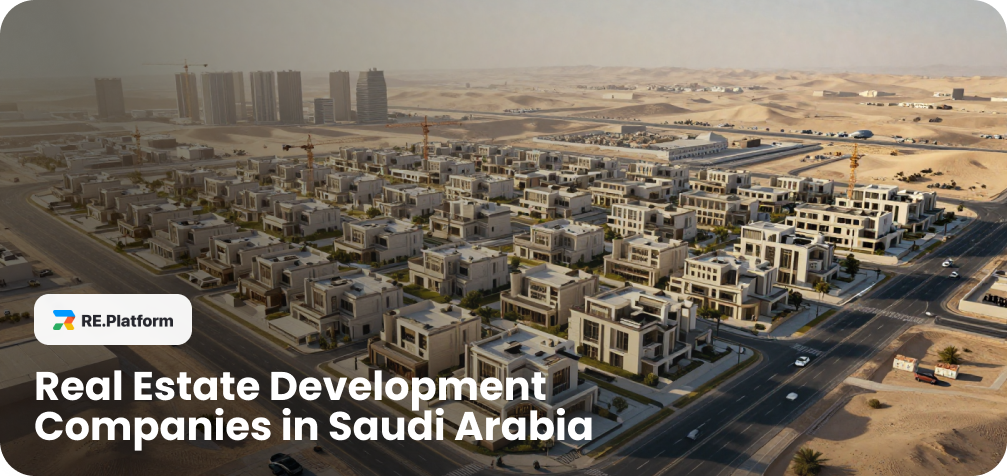
Saudi Arabia’s real estate market is often discussed through the lens of iconic luxury towers, branded residences and ultra-premium masterplans. Yet behind the headlines, a much larger structural transformation is unfolding. The residential market today is defined not only by landmark projects, but by scale, housing supply, public-private partnerships and long-term urban planning aligned with Vision 2030.
In 2026, real estate development companies in Saudi Arabia operate within one of the most ambitious housing expansion programs globally. Government-backed entities, publicly listed developers and large private groups are simultaneously delivering tens of thousands of units, reshaping Riyadh, Jeddah, Dammam and emerging urban clusters. This article examines the major development companies driving volume, infrastructure and long-term urban growth beyond the purely luxury segment.
Table of Contents
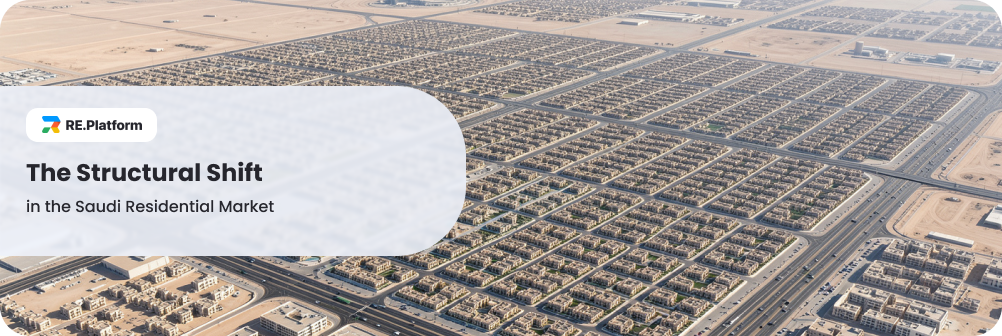
The housing strategy embedded within Vision 2030 has materially altered how residential supply is structured. Homeownership targets, mortgage market expansion and the role of institutional capital have created conditions for developers capable of delivering 5,000 to 50,000 units at scale.
Rather than boutique projects, the market today revolves around:
Integrated masterplans
Multi-phase suburban expansion
Public Investment Fund (PIF) participation
National Housing Company (NHC) partnerships
Mid-income and upper-mid residential communities
This shift explains why volume-focused real estate development companies in Saudi Arabia now represent the structural backbone of the sector.
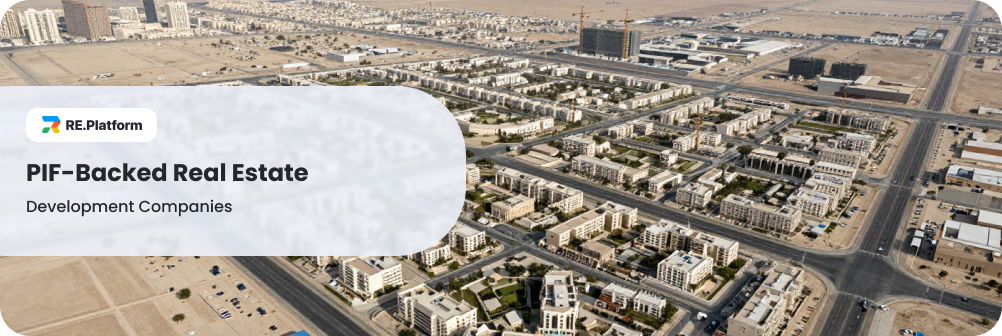
State-linked developers occupy a pivotal role in enabling large-scale residential transformation.
ROSHN has become synonymous with housing scale. With approximately 50,000 units under simultaneous construction and a target of 400,000 homes by 2030, the company functions as a central pillar of national housing supply.
Flagship developments such as SEDRA, ALAROUS, ALMANAR and WAREFA illustrate the multi-city, multi-phase delivery model. Annual sales around $2.5 billion underscore both market demand and execution capacity. ROSHN is not positioned as a niche luxury developer; it is an institutional housing operator shaping urban expansion corridors.
With PIF holding approximately 64 percent, Al Alkaria (Saudi Real Estate Co.). represents a hybrid of state-backed strength and public market transparency through Tadawul listing.
Its Al Widyan development, spanning 7 million square meters with SAR 10 billion in planned investment, illustrates masterplan-level ambition. Revenue for 2024 reached SAR 2 billion, with profit growth reportedly quadrupling year-on-year. This financial performance highlights how national developers are transitioning from landholding entities into performance-driven development platforms.
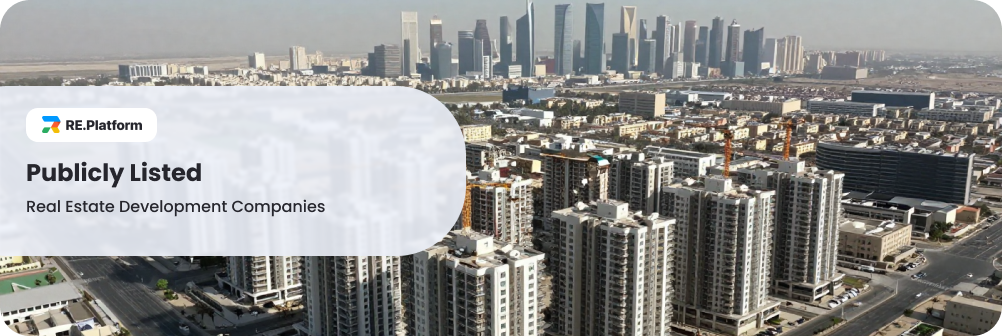
Public companies introduce additional transparency and capital market discipline into the sector.
As one of the largest private residential developers in the Kingdom, Dar Al Arkan has long been associated with large-scale planned communities. Shams Ar Riyadh alone exceeds 10,000 units, while Al Qasr remains one of the largest privately delivered masterplans.
With approximately $500 million in 2024 revenue and recognition from Euromoney as Best Residential Developer in KSA, Dar Al Arkan blends institutional scale with branding capabilities. Its activity demonstrates how publicly traded developers balance domestic housing demand and structured capital management.
Operating for more than 18 years across seven-plus Saudi cities, Sumou maintains a purely residential profile. Strategic partnerships with ROSHN, NHC, Qiddiya and NEOM reinforce its integration within national development frameworks.
Recognition in Forbes’ Most Influential Leaders in Real Estate 2025 reflects corporate leadership visibility rather than purely project aesthetics. Sumou exemplifies mid-to-large residential execution within complex multi-stakeholder environments.
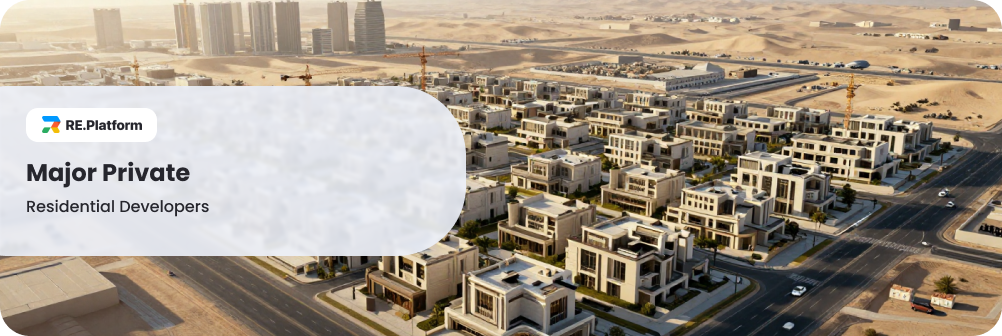
Beyond PIF-backed and listed entities, several private groups represent significant contributors to residential supply.
Retal’s portfolio valued at SAR 9.5 billion and more than 7,000 units in active construction positions it among the Kingdom’s most active private residential developers. Projects such as ALDANAH (4,839 units, $1.38 billion) highlight the company’s capacity to structure large-scale communities tied to NHC cooperation.
Retal’s role illustrates the importance of mid-cap private operators that combine flexibility with substantial balance-sheet execution.
Focused exclusively on residential development, Dar Wa Emaar has delivered more than 5,000 units across six Saudi cities. Projects such as Tala Al Khuzam, Saraya Al Ruba and Saraya Al Sharq reflect phased suburban housing strategies aimed at structured community building rather than iconic tower branding.
With a 50-year operating history, Mohammed Al Habib Real Estate combines legacy expertise with contemporary urban formats. Projects like Eyal Al Fursan and the Inar mixed-use development demonstrate cross-generational adaptability. International Property Awards recognition in 2024 underscores design standards alongside execution scale.
RAFAL gained prominence with Burj Rafal, the tallest residential tower in Riyadh. Yet beyond vertical landmarks, its Tilal Al-Khuzam masterplan of 3,583 units and portfolio valued at SAR 12 billion indicate broader community development capacity.
Ajdan’s INFINITI residential project, comprising 510 apartments valued at approximately $298 million and reportedly sold out within two months, demonstrates strong absorption rates in select urban segments. The company’s involvement in SEDRA phases and Makkah AlManar positions it within coordinated residential expansion frameworks.
Established in 1976, Al Saedan maintains an active construction portfolio valued around $1.27 billion. Developments such as Sama Najd and Al-Olaya Hills illustrate continued relevance in both Riyadh and Jeddah. Inclusion within GCC Top-100 developer rankings highlights sustained regional credibility.
| Company | Ownership Structure | Units in Active Development | Strategic Positioning |
|---|---|---|---|
| ROSHN Group | PIF-backed | ~50,000 | National housing scale operator |
| Saudi Real Estate Co. | PIF-majority, Public | Multi-phase masterplans | Public market institutional platform |
| Dar Al Arkan | Public (Tadawul) | 10,000+ flagship masterplan | Large private residential |
| Retal | Private | 7,000+ | NHC-linked residential expansion |
| RAFAL | Private | 3,500+ delivered | Mixed vertical & masterplan |
| Dar Wa Emaar | Private | 5,000+ cumulative | Multi-city suburban housing |
The defining feature across these companies is not exclusivity but throughput — land activation, phased delivery and absorption across middle and upper-middle income segments.
Luxury-focused developers typically prioritize branded residences, high-end villas or architectural landmark positioning. By contrast, the companies profiled here concentrate on:
Housing volume
Landbank activation
Integrated infrastructure
Affordability tiers aligned with mortgage expansion
Government-driven housing targets
This structural distinction ensures the market is not dependent on a narrow premium segment, but anchored by large-scale, repeatable development models.
For investors and institutional observers, scale-oriented development companies in Saudi Arabia signal long-term stability rather than speculative spikes. High unit pipelines, diversified city exposure and public-private cooperation reduce volatility and strengthen predictability of cash flow.
For buyers, these developers provide greater inventory depth and structured community planning compared to boutique projects. For policymakers, they represent the operational capacity required to meet national homeownership goals.
Saudi Arabia’s housing market is no longer defined only by iconic projects or high-end branded towers. The core of the sector now lies in scale: thousands of units delivered simultaneously, coordinated masterplans and structured partnerships between public capital and private operators.
The companies profiled above represent the operational backbone of the Kingdom’s residential transformation. Some are backed by PIF, others are publicly listed on Tadawul, and several remain privately controlled family groups with decades of experience. Despite different ownership models, they share one defining trait — capacity.
Capacity to activate landbanks.
Capacity to structure phased communities.
Capacity to align with national housing targets.
In practical terms, these developers determine how fast Riyadh expands, how suburban corridors evolve and how secondary cities absorb new population growth. They are less visible in global luxury rankings, yet far more influential in shaping everyday housing supply.
For investors, this segment offers exposure to structural growth rather than cyclical prestige projects. For buyers, it provides access to organized communities built within national planning frameworks. For the broader market, it ensures that Vision 2030 housing objectives move from policy documents to delivered homes.
In 2026, the defining narrative of Saudi real estate development is not exclusivity — it is execution at scale.