Property for Sale in Jeddah: Prices, Districts, and How to Find Real Projects in 2026

The demand for property for sale in Jeddah is rising alongside a broader shift in Saudi Arabia’s real estate landscape. While Riyadh dominates headlines as the capital, Jeddah plays a different role — it is a coastal city with a unique mix of residential demand, lifestyle-driven buyers, and long-term investment potential tied to tourism and trade.
For buyers, this creates a very specific challenge. The market is active, but not always transparent. Listings exist everywhere, yet they rarely show how the city is actually developing.
Table of Contents
Unlike Riyadh, where growth is driven by business expansion and population inflow, Jeddah’s real estate market is shaped by its coastal geography and role as a gateway city.
Demand is influenced by three main factors.
First, residential demand from local families remains stable, especially in established districts. Second, lifestyle buyers are increasingly interested in coastal properties and modern apartment complexes. Third, long-term investors are focusing on areas connected to tourism and infrastructure development.
This creates a market where pricing is less centralized and more fragmented compared to Riyadh.
| Zone | Market Character | Buyer Intent |
|---|---|---|
| North Jeddah | Premium coastal developments | Lifestyle + investment |
| Central Jeddah | Established residential areas | End-users |
| South Jeddah | Affordable entry-level housing | Budget buyers |
Northern districts, particularly those closer to the waterfront, are driving most of the price growth. At the same time, central areas remain liquid due to consistent demand.
The keyword property for sale in Jeddah covers a wide range of real estate types, but demand is concentrated in a few core segments.
Apartments are the most actively traded category. These range from compact units for young buyers to larger family-oriented layouts in newer developments.
Villas exist across the city but are more common in suburban and northern areas. In Jeddah, villas are often tied to lifestyle rather than purely investment logic.
Land plots are also relevant, particularly for investors looking at long-term appreciation. However, like in Riyadh, these are less visible on traditional listing platforms.
Coastal and branded residential projects are emerging as a niche segment, especially as Jeddah strengthens its position as a tourism hub.
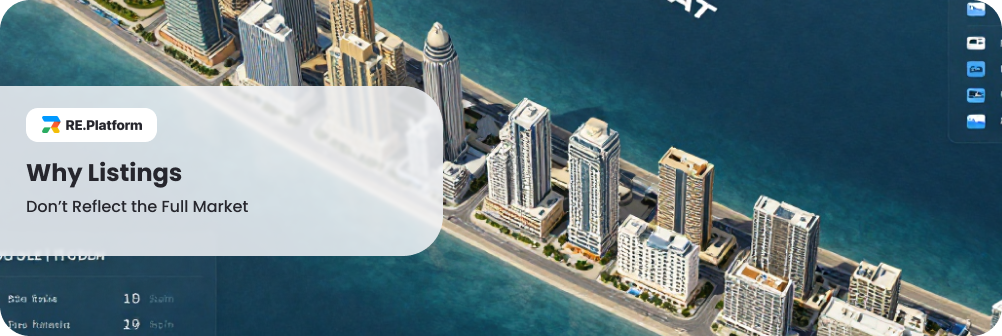
Searching for property for sale in Jeddah through listing portals gives a partial view at best.
Listings tend to focus on individual units, often without context. Prices may vary significantly for similar properties due to differences in timing, agents, or incomplete data.
More importantly, listings do not show where new developments are concentrated. This is critical in Jeddah, where growth is uneven and highly location-dependent.
As a result, buyers increasingly rely on project-level exploration instead of unit-level browsing.
A more structured way to approach the market is to explore real estate developments across the city in one place:
→ https://map.re-platform.io/city/jeddah
This allows you to:
This is especially useful in Jeddah, where coastal and inland markets behave differently.
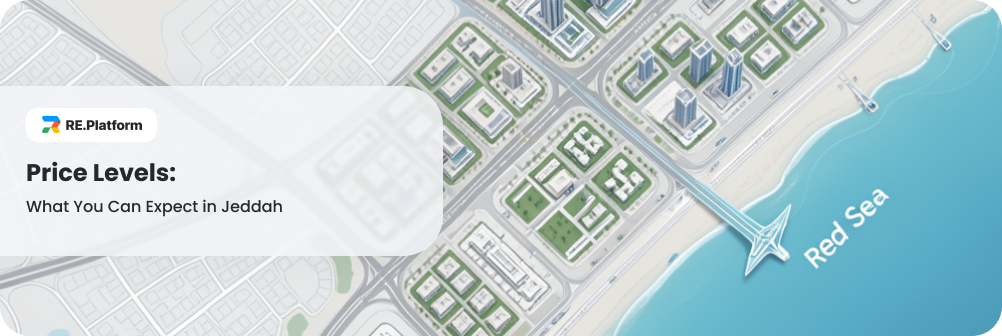
Property prices in Jeddah vary widely depending on proximity to the coast, infrastructure, and the type of development.
| Property Type | Typical Price Range (SAR) | Notes |
|---|---|---|
| Small Apartments | 300,000 – 700,000 | Entry-level segment |
| 1–2 Bedroom Units | 450,000 – 1,000,000 | Most active demand |
| 3 Bedroom Apartments | 700,000 – 1,400,000 | Family segment |
| Villas | 1,000,000 – 3,500,000+ | Strong variation by area |
Coastal proximity significantly affects pricing. Properties near the Red Sea, especially in northern Jeddah, command a premium.
At the same time, inland districts provide more accessible options, which continue to attract first-time buyers.
Search behavior around property for sale in Jeddah reflects a shift toward more specific intent.
Users are no longer searching broadly. Instead, they combine property type, location, and development status:
This indicates that buyers are not just exploring options — they are evaluating locations and projects simultaneously.
The most active areas include:
These are not just residential zones, but growth corridors where infrastructure and real estate development move together.
Compared to Riyadh, Jeddah is often seen as a secondary market. However, this perception creates opportunities.
The city benefits from tourism flows, port activity, and long-term development plans. While price growth has been less aggressive than in Riyadh, the market offers stability and lifestyle-driven demand.
Rental yields can be competitive, especially in well-located apartment projects. At the same time, capital appreciation is tied to infrastructure and coastal development.
For investors, the key is understanding where the city is expanding — not just what is currently listed.
The traditional listing-based approach is increasingly inefficient.
Instead of browsing individual properties, it is more effective to start with the city structure. Identify where development is happening, then narrow down to specific projects. This is particularly important in Jeddah, where location defines value more than almost any other factor.
To get a clearer picture of the market, you can explore:
→ https://map.re-platform.io/city/jeddah
It provides a structured view of real estate projects across the city, helping you move from random browsing to informed decision-making.
The property for sale in Jeddah market is not just about availability — it is about geography, development patterns, and long-term positioning.
Listings tell you what is being sold. Projects show you where the city is moving. In a market like Jeddah, that distinction makes all the difference.