Browse by category


Saudi Arabia’s property market is attracting growing international attention, especially as large-scale developments across Riyadh, Jeddah, and other Vision 2030 destinations continue expanding. Yet many foreign buyers still underestimate one important part of the process: the real cost of owning property beyond the purchase price itself.
Compared to many global real estate markets, Saudi Arabia remains relatively tax-efficient for residential investors. There is no traditional annual residential property tax for most homeowners, rental income treatment is generally favorable for individuals, and transaction costs are still lower than in several European or Asian markets.
At the same time, buyers should understand how closing costs, taxes, financing fees, service charges, and insurance actually work before entering the market.
This guide explains the key property-related costs foreign buyers and investors should expect in Saudi Arabia in 2026.
Table of Contents
What Are the Total Closing Costs in Saudi Arabia?

Closing costs in Saudi Arabia typically range between 6% and 9% of the property price when the buyer covers all major transaction expenses, including the Real Estate Transaction Tax (RETT).
However, the final number depends heavily on how the deal is structured.
In some transactions, sellers agree to absorb certain costs — particularly RETT — which can reduce total buyer-side closing expenses closer to the 1% to 4% range.
This flexibility is one of the more distinctive aspects of the Saudi market. Unlike countries where taxes and transfer fees are rigidly fixed, Saudi transactions often involve negotiation over who pays which costs.
Typical Property Purchase Costs in Saudi Arabia
| Cost Category | Typical Range |
|---|---|
| Real Estate Transaction Tax (RETT) | 5% |
| Brokerage Commission | 1% – 2.5% |
| Mortgage & Financing Fees | 0.5% – 1.5% |
| Legal & Administrative Costs | Varies |
| Translation & Documentation | Minor additional cost |
For most buyers, the single biggest expense is RETT, which is administered through official government tax systems.
Because the tax alone accounts for a significant share of the total transaction cost, understanding who pays it during negotiations can materially change the overall investment budget.
Understanding the Real Estate Transaction Tax (RETT)
The Real Estate Transaction Tax is currently one of the most important taxes affecting property purchases in Saudi Arabia.
RETT is generally charged at 5% of the transaction value and applies to most property transfers.
In practice, this tax functions as the primary transfer-related government cost during a real estate transaction. While the structure is relatively straightforward compared to more complex international systems, buyers should still account for it carefully during financial planning.
Many investors entering the Saudi market focus heavily on property pricing while underestimating the effect RETT can have on total acquisition costs.
For higher-value purchases, the difference becomes significant.
Is There an Annual Property Tax in Saudi Arabia?
One of the reasons Saudi Arabia continues attracting international investors is the absence of a traditional annual residential property tax for most owner-occupied homes.
As of 2026, homeowners generally do not pay recurring yearly taxes based on the market value of their residential property in the way owners do in many Western markets.
This creates a very different long-term ownership structure compared to countries where annual taxation substantially increases holding costs over time.
However, this does not mean property ownership is entirely cost-free after purchase.
Ongoing ownership expenses may still include:
- service charges in residential compounds
- maintenance costs
- municipality-related utility fees
- property management expenses
- insurance
There is also an important exception involving undeveloped land.
What Is the White Land Tax?
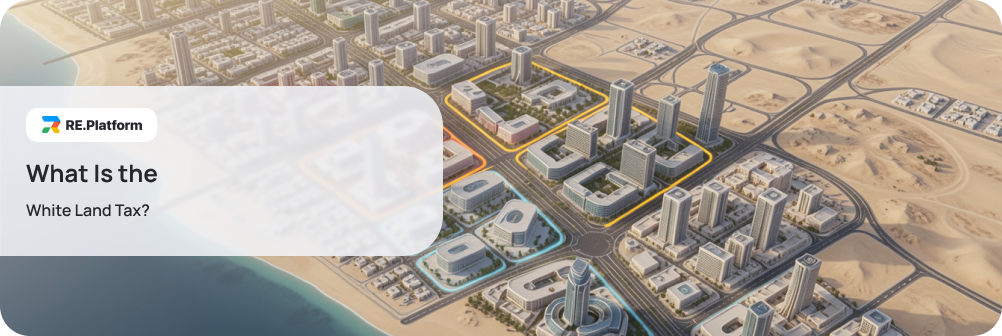
Saudi Arabia introduced the White Land Tax framework to encourage development of unused urban land.
This system primarily targets vacant plots located in designated urban areas rather than ordinary residential homes or completed apartments.
In some cases, undeveloped land may face charges equivalent to roughly 2.5% of the land’s value annually if it remains unused under applicable conditions.
For most foreign residential buyers purchasing apartments, villas, or completed units, the White Land Tax is not the central concern. However, investors considering land banking strategies or large undeveloped plots should evaluate the implications carefully.
How Is Rental Income Taxed in Saudi Arabia?
Saudi Arabia remains relatively attractive from a rental income perspective, especially for individual foreign investors.
As of 2026, Saudi Arabia does not apply traditional personal income tax to individuals in the way many countries do. For residential property owners, this means rental income treatment is generally far lighter than in most mature international real estate markets.
Residential leasing is also typically treated as VAT-exempt under the current framework.
For foreign owners holding residential property personally rather than through corporate structures, effective taxation on rental income is often extremely limited or effectively zero under current rules.
That said, investors should still maintain proper documentation and register lease agreements through official systems such as Ejar.
This is particularly important for:
- legal protection
- tenant dispute resolution
- future compliance changes
- financing or resale documentation
What Ongoing Costs Should Owners Expect?

Although Saudi Arabia does not impose a standard annual residential property tax, buyers should still budget for recurring ownership expenses.
The exact costs depend heavily on the property type and building quality.
For example, apartments inside managed towers or residential compounds often include:
- maintenance fees
- security costs
- shared facility expenses
- landscaping
- parking management
- concierge or amenities management
Luxury developments with extensive facilities naturally carry higher service charges than simpler residential buildings.
Investors sometimes underestimate these operational costs when comparing projects purely by purchase price.
Property Insurance in Saudi Arabia
Property insurance is becoming increasingly common in Saudi Arabia, particularly for financed properties and higher-value developments.
Banks often require insurance coverage as part of mortgage agreements, especially for apartments or villas inside professionally managed projects.
Typical Home Insurance Costs
| Property Value | Estimated Annual Insurance Cost |
|---|---|
| 1 million SAR property | ~1,000 – 3,000 SAR |
| 2 million SAR property | ~2,000 – 6,000 SAR |
| Luxury or custom properties | Higher depending on coverage |
Insurance pricing usually depends on:
- property location
- construction quality
- building age
- replacement value
- flood or environmental exposure
- security systems
Most standard policies focus primarily on structural coverage, including fire, accidental damage, and certain natural-event protections.
Why Saudi Arabia’s Tax Environment Attracts Investors
Saudi Arabia’s relatively light residential tax environment has become one of the market’s strongest competitive advantages internationally.
Compared to cities where investors face:
- annual property taxes
- capital-heavy transfer duties
- aggressive rental income taxation
- wealth taxes
- multiple municipal levies
…the Saudi market often looks considerably more efficient from a long-term holding perspective.
Combined with Vision 2030 infrastructure investment, rapid urban development, and increasing institutional participation in the sector, this tax structure continues attracting attention from both regional and international buyers.
Final Thoughts
Saudi Arabia’s real estate market remains relatively favorable from a tax and ownership-cost perspective, particularly for foreign buyers focused on residential investments.
The absence of a traditional annual residential property tax, combined with generally favorable rental income treatment, creates a cost structure that differs significantly from many global property markets.
At the same time, buyers should still approach the market with a realistic understanding of:
- transaction taxes
- closing costs
- financing fees
- service charges
- insurance expenses
- long-term maintenance obligations
Understanding these costs early helps investors evaluate opportunities more accurately and avoid surprises after purchase.
As Saudi Arabia’s real estate sector continues evolving through Vision 2030 initiatives and large-scale urban development, financial transparency and proper planning will remain increasingly important for both local and international buyers.