How CRM Helps Real Estate Developers and Simplifies Their Work

The real estate development business has changed dramatically over the last few years. Projects are larger, buyers are more demanding, and sales cycles have become more complex. At the same time, developers are expected to move faster, provide better transparency, and manage hundreds or even thousands of units across multiple channels. In this environment, relying on spreadsheets, emails, and disconnected tools is no longer sustainable.
This is where a modern CRM system designed specifically for real estate developers becomes not just useful, but essential. CRM is no longer about “tracking contacts”. For developers, it becomes the backbone of sales, operations, and customer experience.
Table of Contents
Many developers still operate with fragmented systems. Leads come from websites, brokers, WhatsApp, exhibitions, and partners, but there is no single place where this data is structured properly.
Sales managers manually update Excel files. Unit availability is checked through phone calls. Pricing changes are communicated with delays. Management receives reports after deals are already lost.
This does not look like a technical problem at first glance. In reality, it is a direct revenue issue.
When there is no unified CRM:
leads get lost or duplicated,
responses to buyers are slow,
sales managers rely on memory instead of data,
management cannot see real-time performance.
As competition increases, these gaps quickly turn into lost deals and shrinking margins.
A generic CRM is not enough for real estate. Developers do not sell subscriptions or services. They sell objects: units, apartments, villas, floors, and entire buildings.
This means the CRM must be object-driven, not contact-driven.
A developer-focused CRM connects:
projects,
buildings,
floors,
units,
pricing,
availability,
payment plans,
client interactions.
Everything is linked. When a unit is reserved, availability changes instantly. When a price is updated, it is reflected across all sales channels. When a client interacts with a unit, the system records intent, not just a name in a database.
For many real estate developers, sales operations still look the same as they did ten years ago. Leads arrive from different channels, managers manually distribute them, unit availability is checked in spreadsheets, and reports are built once a month, when it is already too late to fix mistakes.
In this model, sales depend almost entirely on people. If a manager misses a lead, delays a response, or works with outdated data, the company loses money. CRM changes this logic fundamentally. It turns sales from a manual process into a controlled system where every step is tracked, measured, and optimized.
A modern CRM does not replace sales teams. It removes chaos around them.
Without a CRM, sales operations usually grow organically and inconsistently. One manager works in messengers, another keeps notes in Excel, a third relies only on memory. Over time, this creates gaps: lost inquiries, duplicated work, inconsistent pricing, and zero visibility for management.
CRM brings structure into this environment. All leads are captured automatically, stored in one system, and assigned according to clear rules. Every interaction with a client is logged, every unit is tied to real availability, and every deal follows a defined pipeline.
As a result, sales teams stop reacting to problems and start working within a predictable framework.
One of the biggest challenges for developers is data fragmentation. Pricing lives in one file, availability in another, client communication in emails and messengers, and financial data in accounting software. None of these systems talk to each other.
CRM becomes a single source of truth. Unit status, prices, reservations, client history, and deal stages are synchronized in real time. When a unit is booked, it is immediately reflected across all channels. When a price changes, managers see it instantly.
This removes internal confusion and prevents costly mistakes that damage trust with buyers.
Speed matters, especially when working with international buyers or digital-first clients. If a response takes hours instead of minutes, interest fades quickly.
CRM automates lead processing from the first touchpoint. Leads from the website, ads, marketplaces, and partners are instantly captured and routed. Managers see context immediately: which project the client viewed, which unit they are interested in, and where they came from.
This allows sales teams to respond faster, personalize communication, and focus on closing deals instead of collecting information manually. In practice, this directly improves conversion rates without increasing headcount.
In modern real estate, CRM is no longer just a database. It becomes the core of the digital sales engine.
When CRM is connected to an interactive unit catalog, online booking, and payment systems, the sales funnel becomes seamless. A buyer can explore availability, reserve a unit, and move toward a transaction while the CRM tracks every action behind the scenes.
Sales managers stop acting as gatekeepers of information. Instead, they guide clients through the decision-making process, supported by real-time data, automation, and analytics.
This shift is especially critical when working with foreign buyers, who expect digital transparency and fast, predictable processes.
Traditional reporting shows what already happened. CRM analytics show what is happening right now.
Developers gain visibility into live sales funnels, conversion at each stage, average deal time, demand by project or unit type, and manager performance. This allows management to react immediately: adjust pricing, reallocate marketing budgets, or strengthen weak points in the funnel.
When decisions are based on live data rather than intuition, sales operations become more predictable and scalable.
| Area | Without CRM | With Developer-Focused CRM |
|---|---|---|
| Lead management | Manual, fragmented | Centralized and automated |
| Unit availability | Checked manually | Real-time, synchronized |
| Sales reporting | Delayed, incomplete | Live analytics |
| Client communication | Inconsistent | Structured and traceable |
| Scalability | Limited | Built for growth |
The real estate market is moving toward full digitalization. Online booking, digital contracts, AI-driven communication, and mobile-first experiences are becoming standard.
CRM is the foundation that makes all of this possible.
Without it, developers will struggle to integrate new tools. With it, they can build a complete digital ecosystem around their projects.
This is especially important as markets open to international buyers, where expectations are higher and tolerance for inefficiency is lower.
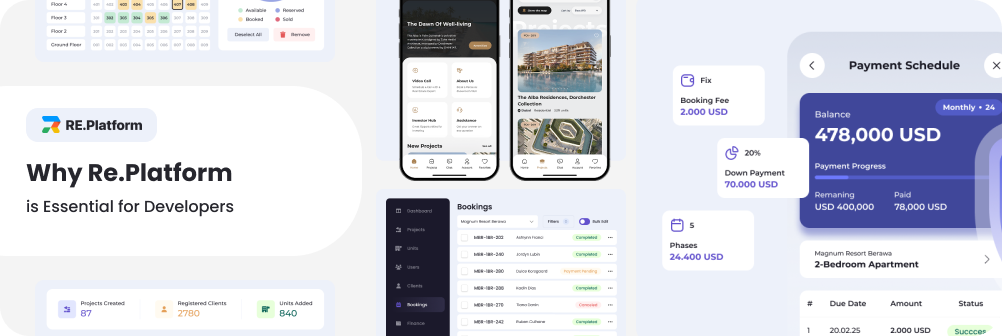
RE.Platform is designed to equip developers with all the tools needed to succeed in a newly internationalized market:
| Feature | Benefit for Developers |
|---|---|
| Interactive Property Catalog | Showcase every property interactively with live data and filtering by price, area, layout, or status. |
| Developer-Focused CRM | Manage leads, deals, and client communications efficiently, with full integration into the catalog and booking system. |
| AI Assistants & Chatbots | Provide instant, 24/7 support for potential buyers, answer queries, and route hot leads to sales managers. |
| Online Booking & Payments | Enable secure online bookings, payment processing, and contract generation to streamline sales. |
| Sales Reports & Analytics | Monitor performance in real-time, track KPIs, and make data-driven decisions for maximum ROI. |
| Mobile Apps (iOS & Android) | Offer international buyers seamless mobile access, boosting visibility and engagement. |
With these capabilities, developers can attract, engage, and convert foreign buyers efficiently, turning the policy shift into real business growth.
CRM is no longer an optional tool for real estate developers. It is a core business system that directly impacts revenue, efficiency, and competitiveness. Developers who adopt modern, object-driven CRM platforms simplify internal work, improve customer experience, and gain full control over their sales process. Those who delay digital transformation will find it harder to compete in a market that is moving faster every year.
With solutions like Re.Platform, CRM becomes not just software, but a strategic advantage for developers ready to grow.