Operational Challenges in Real Estate Development: Bottlenecks in Large-Scale Residential Projects

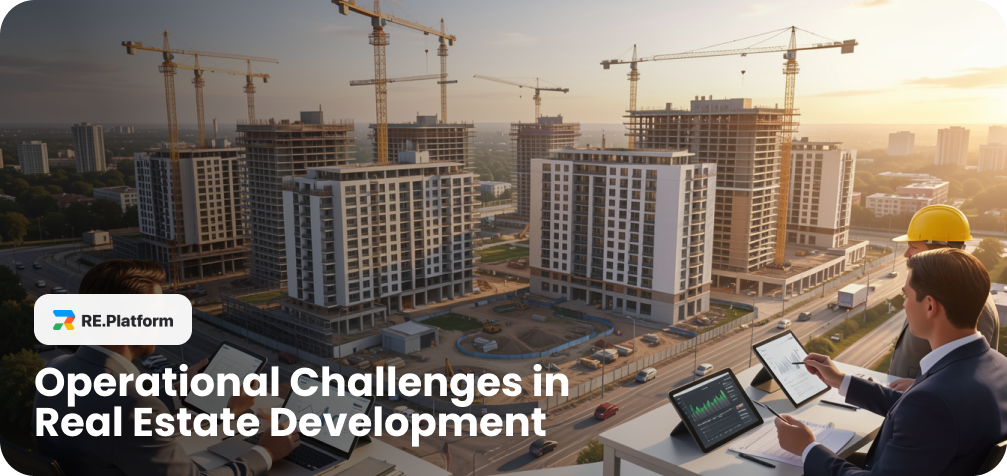
Large residential developments are often presented as ambitious architectural visions: thousands of units, modern infrastructure, and integrated urban communities. Behind these projects, however, lies a complex operational reality that is rarely discussed.
For real estate developers, delivering a large project is not simply a matter of construction. It involves coordinating dozens of parallel processes — land acquisition, design, financing, marketing, sales, and delivery — all of which must move in sync. When these processes begin to fall out of alignment, operational bottlenecks appear.
In small developments these inefficiencies may remain manageable. But in projects involving hundreds or thousands of residential units, even minor operational delays can cascade into serious challenges affecting timelines, revenue forecasts, and investor expectations.
Understanding where these bottlenecks occur is essential for developers attempting to scale their operations.
Table of Contents
Real estate development is inherently multidisciplinary. A single project may involve architects, construction contractors, engineering consultants, financial partners, legal teams, and large internal sales departments.
As projects scale, the number of moving parts increases dramatically. Instead of managing one project timeline, developers often coordinate multiple construction phases, staggered sales releases, and evolving pricing strategies simultaneously.
At this stage operational challenges often emerge not because the project is poorly designed, but because the underlying operational systems were never built for that level of scale.
Many development companies still rely on fragmented workflows: spreadsheets for inventory, separate tools for sales pipelines, disconnected financial systems, and manual coordination between departments. As projects expand, this fragmented infrastructure becomes a major operational constraint.
One of the most common bottlenecks in large residential developments is the lack of unified data visibility.
Different departments often work with separate datasets. Sales teams track leads and reservations. Finance departments monitor payments and revenue forecasts. Project management teams focus on construction timelines.
When these systems are not integrated, decision-makers struggle to obtain a clear operational picture of the project. Even basic questions — such as the exact number of units available or the current sales velocity of a specific building — may require manual reconciliation across multiple reports.
These gaps in visibility create delays in decision-making and increase the risk of operational errors. In large developments, even small inconsistencies in data can affect pricing strategies, marketing campaigns, and sales planning.
Large residential projects depend heavily on efficient sales operations. Yet this is one of the areas where operational friction frequently appears.
Sales teams often manage hundreds or thousands of potential buyers across multiple project phases. Without structured systems, managing this volume of leads becomes difficult.
Developers may encounter several operational problems at this stage:
• duplicate leads across different channels
• delayed responses to buyer inquiries
• limited visibility into sales pipelines
• difficulty coordinating reservations across multiple teams
These challenges slow down the sales cycle and create uncertainty around revenue projections. In large developments where financing and construction timelines depend on predictable sales performance, such delays can become critical.
Another major operational challenge appears in the management of unit inventory.
In large developments every unit has its own parameters: size, layout, floor level, price, reservation status, and expected delivery timeline. As projects grow, the number of data points associated with inventory multiplies rapidly.
When inventory is managed manually or through spreadsheets, errors become inevitable. Units may appear available in one system but reserved in another. Pricing updates may not reach all sales teams simultaneously. Marketing campaigns may promote units that are already sold.
These operational inconsistencies do more than create internal confusion. They also affect the customer experience and can undermine buyer confidence in the project.
Operational bottlenecks in development projects are not limited to sales and inventory. Financial reporting often becomes another challenge as projects scale.
Large developments involve complex financial structures that include construction financing, phased revenue recognition, investor reporting, and ongoing cost monitoring. Inaccurate financial reporting or incomplete documentation can lead to poor strategic decisions and misinterpretation of a project’s financial performance.
When financial data is fragmented across different systems, finance teams spend significant time consolidating information instead of analyzing it.
For developers managing multiple projects simultaneously, this lack of financial clarity can make it difficult to assess portfolio performance or allocate capital efficiently.
Residential developments typically unfold in phases. Construction progresses building by building, while sales launches may occur at different times depending on market demand.
Coordinating these phases requires close alignment between construction progress, sales teams, and marketing activities.
Operational bottlenecks often appear when these timelines diverge. Sales teams may launch campaigns before certain units are ready to be released. Construction delays may affect delivery schedules. Marketing strategies may fail to reflect the actual availability of inventory.
Without strong operational coordination, these misalignments can disrupt the entire development cycle.
Many of the operational challenges described above are closely linked to the technological infrastructure used by development companies.
Historically, real estate has been one of the least digitized industries. Many organizations continue to rely on legacy systems or manual workflows, even when managing large development portfolios.
As projects grow more complex, these traditional tools become insufficient. Developers increasingly require integrated digital platforms capable of connecting sales operations, project management, financial reporting, and inventory management within a unified operational framework.
When such systems are implemented effectively, they allow developers to monitor projects in real time, identify emerging bottlenecks early, and coordinate operations across departments.
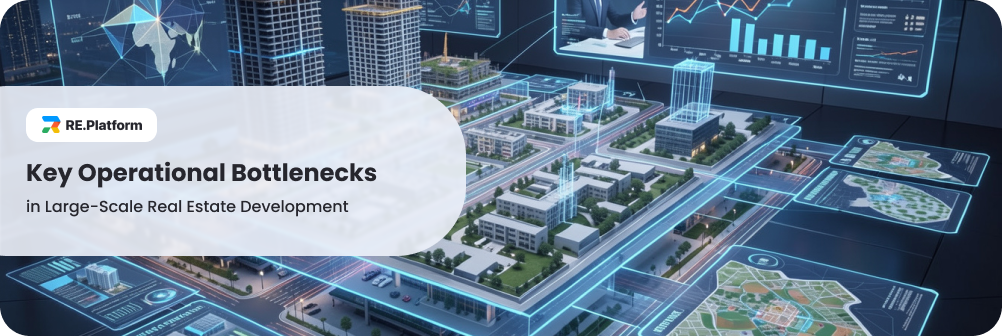
| Operational Area | Typical Bottleneck | Impact on Large Residential Projects |
|---|---|---|
| Data Management | Project data scattered across spreadsheets and separate systems | Poor visibility into project status and slower decision-making |
| Sales Operations | Unstructured lead management and fragmented sales pipelines | Delayed deal closures and unpredictable revenue flow |
| Inventory Management | Manual tracking of unit availability and pricing | Double reservations, outdated listings, and sales confusion |
| Project Coordination | Misalignment between construction timelines and sales releases | Marketing campaigns or sales launches happen before units are ready |
| Financial Reporting | Fragmented financial data across departments | Difficulties in forecasting revenue and tracking project profitability |
| Cross-Team Communication | Limited synchronization between sales, construction, and finance teams | Operational delays and inconsistent project execution |

Large-scale residential projects are among the most complex operational undertakings in the real estate industry. They combine elements of construction management, financial planning, sales strategy, and long-term asset development.
Operational bottlenecks are therefore inevitable at some stage of the process. What distinguishes successful developers is not the absence of these challenges, but their ability to detect and resolve them before they escalate.
By improving data visibility, structuring sales operations, and implementing integrated management systems, development companies can transform operational complexity into a competitive advantage.
As residential developments grow in scale, operational challenges become one of the defining factors influencing project success.
Fragmented data, inefficient sales workflows, manual inventory tracking, and complex financial structures can all slow down development operations and create costly delays.
For modern real estate developers, overcoming these bottlenecks requires more than operational discipline. It requires building systems and processes capable of supporting projects at scale.
In an industry where projects may involve thousands of residential units and billions in investment, operational clarity is no longer a luxury — it is a fundamental requirement for sustainable growth.