Browse by category


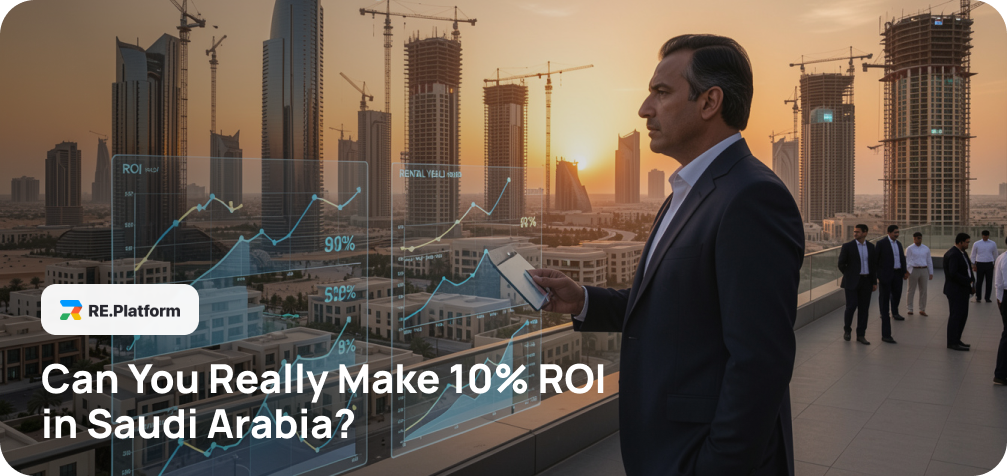
Saudi Arabia’s real estate market has become one of the most discussed investment stories in the Gulf. Rising apartment prices in Riyadh, massive infrastructure spending, new residency pathways, and the rapid expansion of districts like North Riyadh have pushed more foreign investors to ask the same question:
Can you realistically make 10% ROI in Saudi Arabia real estate?
The short answer is yes — but not everywhere, not with every property type, and definitely not in the way many social media posts suggest.
A 10% return is possible in certain segments of the Saudi market, especially in high-demand rental zones, off-plan investments, short-term rental strategies, and selected commercial assets. But average residential properties in mainstream districts usually generate lower yields once all ownership costs are included.
Understanding where that 10% figure actually comes from is critical before entering the market.
Table of Contents
What Does ROI in Saudi Real Estate Actually Mean?
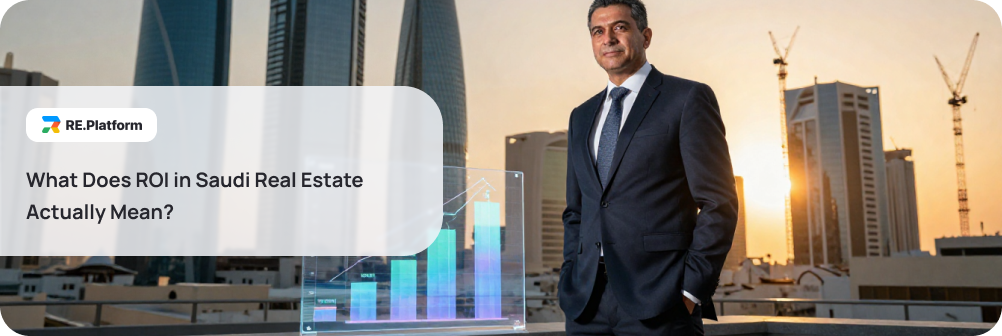
ROI, or return on investment, measures how much profit a property generates relative to the total amount invested into it.
In Saudi Arabia real estate, ROI is usually calculated using:
- annual rental income
- property appreciation
- maintenance and operational costs
- vacancy periods
- financing expenses
- transaction fees and taxes
A simple example:
If an investor purchases an apartment in Riyadh for SAR 1,000,000 and receives SAR 100,000 in annual net rental income after expenses, the property delivers a 10% annual net ROI.
But in practice, real estate returns are rarely that straightforward.
Many listings online show gross rental yields rather than net profitability. A property advertised as producing “10% ROI” may actually generate closer to 6–7% after vacancy, maintenance, service fees, furnishing costs, broker commissions, and financing are included.
That is why understanding the structure of the Saudi market matters more than chasing headline numbers.
Why Riyadh Became the Center of the ROI Conversation
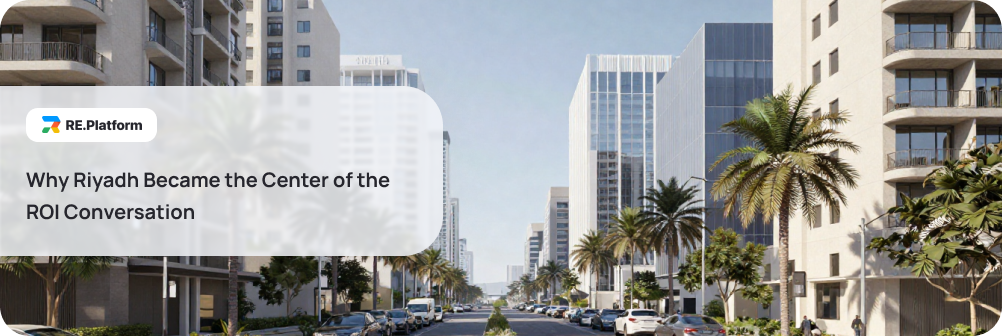
Most of the excitement around Saudi real estate returns is tied directly to Riyadh.
Over the last few years, the city has gone through an unusually aggressive expansion cycle. Corporate relocations, population growth, infrastructure projects, metro development, and increasing international business activity all pushed residential demand higher at the same time.
That combination created a situation where apartment demand in some parts of the city started moving faster than supply.
Districts in North Riyadh became the clearest example of this shift. Areas like Al Narjis, Al Malqa, Hittin, and Al Sahafa suddenly stopped being viewed as just residential neighborhoods. They turned into investment zones where buyers expected both rental income and long-term appreciation.
For investors who entered those areas early, returns were often exceptionally strong.
But that does not automatically mean the same opportunities still exist today at the same scale.
As prices increase, yields naturally compress. An apartment that generated outstanding returns two or three years ago may now require a much larger entry budget while producing only slightly higher rent. This is one of the biggest misconceptions foreign investors have when they first look at Saudi Arabia. They see stories about rapid appreciation and assume yields continue rising at the same speed indefinitely.
Real estate markets rarely work that way.
Where 10% ROI Is Actually More Realistic
The strongest returns in Saudi Arabia usually come from properties that sit in the middle of fast-growing demand rather than from ultra-luxury inventory.
Smaller apartments in business-oriented districts often perform better than expensive villas because the tenant pool is significantly larger. Young professionals, expatriates, corporate employees, and relocating families continue driving demand for modern apartments in well-connected parts of Riyadh.
This is one reason many investors now focus less on trophy assets and more on practical residential products with stable occupancy potential.
Short-term rental strategies have also started attracting attention, especially in areas benefiting from business travel, tourism growth, and large-scale events. In some cases, furnished apartments operating under short-term rental models outperform traditional leasing structures.
However, these higher returns come with more operational involvement. Managing occupancy, furnishing standards, maintenance, and guest turnover is very different from holding a long-term rental unit.
Can This Property Reach 10% ROI?
Use this simple formula to quickly estimate whether a property in Saudi Arabia can realistically approach a 10% annual return.
Step 1: Estimate annual net income
Annual rental income minus vacancy, maintenance, service charges and management costs.
Step 2: Divide by total investment cost
Include the purchase price, transaction tax, brokerage fees, furnishing and other acquisition costs.
Simple ROI formula:
Annual Net Income ÷ Total Investment Cost × 100 = ROI
Example
If a property generates SAR 80,000 in annual rent, but SAR 15,000 goes to vacancy and maintenance, the net income becomes SAR 65,000.
If the total investment cost is SAR 1,000,000, the net ROI is 6.5%, not 8%.
A 10% ROI is possible in Saudi Arabia, but usually only when the property combines strong rental demand, controlled ownership costs and attractive entry pricing.
Commercial real estate can also approach or exceed the 10% range in specific situations, particularly in logistics, retail, and mixed-use developments connected to growing business activity. But commercial assets behave differently from residential property and usually require a more experienced investment approach.
The Biggest Mistake Investors Make When Calculating ROI
One of the most common problems in the Saudi market is that investors focus entirely on gross rental income.
That creates a distorted picture of profitability.
Owning property in Saudi Arabia involves real operational costs that directly affect net returns. Maintenance, furnishing, management expenses, transaction taxes, legal work, financing costs, and vacancy periods all reduce final profitability. Off-plan investments can introduce additional uncertainty if project timelines shift or market conditions change before delivery.
This is why experienced investors rarely evaluate a property using only one percentage number.
They look at:
- sustainability of rental demand
- long-term district growth
- future supply
- infrastructure expansion
- tenant profile stability
- developer reputation
In other words, strong ROI in Saudi Arabia is usually the result of market positioning rather than luck.
Is Saudi Arabia Still One of the Strongest Real Estate Markets in the Gulf?
Despite growing competition and rising prices, Saudi Arabia remains one of the most closely watched real estate markets in the region.
The scale of economic transformation happening across Riyadh and other major cities continues attracting both regional and international attention. Infrastructure expansion, new business activity, tourism growth, and changing ownership frameworks are all contributing to long-term market momentum.
At the same time, the market is becoming more mature.
A few years ago, many investors entered Saudi Arabia simply because prices appeared lower than Dubai. Today the conversation is much more sophisticated. Buyers increasingly analyze districts individually, compare rental performance across different areas, and pay closer attention to actual end-user demand rather than hype alone.
That shift is healthy for the market.
It also means that achieving strong returns now depends more on research and timing than on broad optimism.
So, Can You Really Make 10% ROI in Saudi Arabia?
Yes — but not by approaching the market blindly.
Saudi Arabia still offers investment opportunities capable of generating very strong returns, particularly in fast-growing residential zones, selected commercial assets, and high-demand rental segments. But the idea that every property in Riyadh automatically delivers double-digit profitability is no longer realistic.
The market has evolved beyond that stage.
Investors who continue achieving exceptional results are usually the ones studying district-level dynamics, understanding where demand is actually growing, and entering projects before pricing fully catches up with the surrounding market.
The opportunity is real. But Saudi Arabia’s real estate market in 2026 rewards informed positioning far more than speculation.