Browse by category


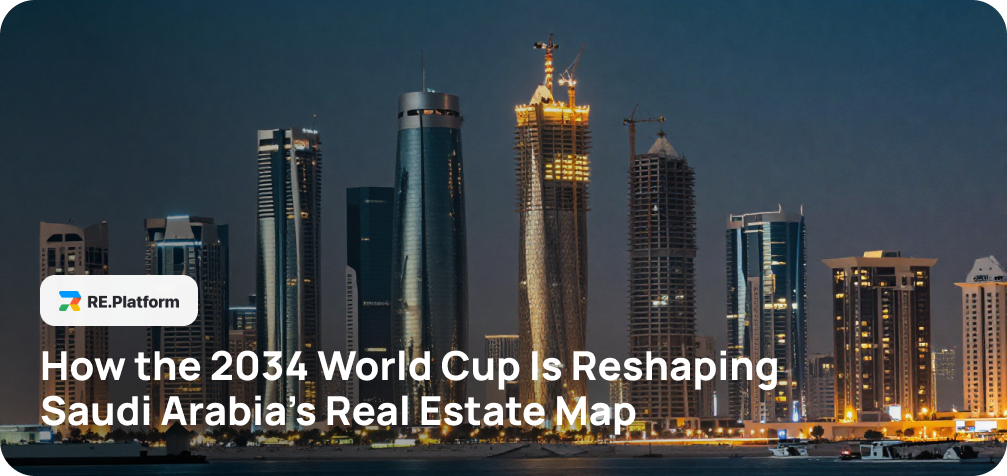
The 2034 FIFA World Cup is still eight years away, but its impact on Saudi Arabia is already visible far beyond football.
For the real estate market, the tournament is effectively a long-term development deadline. New stadiums have to be delivered, but so do the districts, hospitality facilities, public spaces, transport connections and commercial infrastructure required to support them.
That makes the World Cup relevant not only to construction companies and tourism operators, but also to property developers and investors trying to understand where Saudi Arabia’s next major urban growth nodes are emerging.
Table of Contents
Where Will the 2034 World Cup Be Held in Saudi Arabia?
Saudi Arabia’s current tournament plan includes 15 proposed stadiums across five host cities: Riyadh, Jeddah, Al Khobar, Abha and NEOM.
According to the official Saudi 2034 platform, the stadium portfolio combines four existing venues, three stadiums already under construction and eight planned new builds. Saudi Arabia was formally announced as the 2034 World Cup host on December 11, 2024.
That geographic distribution is important for real estate.
Unlike a tournament concentrated primarily in one metropolitan area, the Saudi plan links several very different property markets: the rapidly expanding capital, a Red Sea commercial and tourism hub, the Eastern Province, the mountain economy around Abha and the new urban development model represented by NEOM.
| Host City | Real Estate Angle to Watch |
|---|---|
| Riyadh | Mixed-use districts, entertainment, hospitality and large-scale urban infrastructure |
| Jeddah | Waterfront development, tourism, hospitality and new mixed-use destinations |
| Al Khobar | Eastern Province infrastructure and commercial development |
| Abha | Tourism-led real estate and hospitality |
| NEOM | New-build urban infrastructure and destination development |
The World Cup therefore does not create one Saudi real estate story. It reinforces several regional development stories simultaneously.
Saudi Arabia Is Not Building Stadiums in Isolation
The most important real estate feature of Saudi Arabia’s World Cup strategy is that many venues are being treated as parts of wider urban destinations rather than standalone sports buildings.
Riyadh provides several examples.
The planned King Salman International Stadium, with capacity above 92,000, is intended to host the opening match and final. The official World Cup plan describes the stadium and surrounding precinct as an anchor within the wider Green Riyadh masterplan.
Elsewhere in the capital, the Prince Mohammed bin Salman Stadium is being developed within Qiddiya City. The project is designed for more than 46,000 football spectators and is surrounded by over 50,000 square metres of retail, dining and entertainment space. Qiddiya estimates that the venue could attract 7.6 million visits annually across sports and other events.
This is a very different development model from constructing a stadium, hosting a tournament and then trying to determine how the asset should be used afterward.
The commercial ecosystem is being planned alongside the venue.
Stadium-Led Development Is Becoming Part of Riyadh’s Urban Model
The pattern continues at New Murabba.
Its planned stadium, with capacity exceeding 45,000, is scheduled for completion in 2032. New Murabba describes the venue as a catalyst for the destination’s sports and entertainment economy rather than an isolated World Cup facility.
ROSHN Stadium takes a similar approach.
The 45,000-seat venue will occupy a 450,000-square-metre site in southwest Riyadh and is being developed with integrated restaurants, retail and hospitality facilities as well as walking areas and green space.
These projects show why the World Cup matters to Saudi real estate even for investors with no interest in stadium assets themselves.
A major venue can create a permanent flow of visitors and accelerate roads, public realm, hotels, retail, food and beverage, entertainment and other commercial uses around it. When the stadium forms one component of a master-planned district, the property opportunity extends well beyond match days.
The Real Estate Impact Will Extend Beyond Riyadh
Riyadh will inevitably absorb a large share of World Cup-related development, but the selection of five host cities broadens the potential effect.
Jeddah already combines a large residential market with major waterfront, tourism and mixed-use development. Hosting World Cup matches adds another fixed deadline to infrastructure and hospitality projects in the city.
Al Khobar presents a different case. Its position within the Eastern Province means World Cup investment intersects with an established commercial and energy economy rather than a tourism market alone.
Abha introduces a further dimension. The city and wider Aseer region have been positioned increasingly around domestic and international tourism, making accommodation and destination real estate particularly relevant to the tournament.
NEOM is different again: World Cup infrastructure is being incorporated into a city that is itself still under development.
The result is a tournament whose real estate impact will depend heavily on location. The investment case around a stadium in Riyadh cannot simply be copied to Abha, Jeddah or Al Khobar.
World Cup Development Does Not Mean Every Nearby Property Will Rise in Value
Large international events inevitably generate speculation around property prices, but the relationship between a stadium and surrounding real estate is more complicated.
A venue can improve the investment case for an area when it arrives together with useful transport infrastructure, permanent entertainment, public space, employment and year-round commercial activity.
A stadium surrounded by limited everyday uses produces a very different real estate outcome.
For investors looking at Saudi Arabia before 2034, proximity to a World Cup venue by itself is therefore a weak investment thesis. The more important question is what is being built around that venue and whether those surrounding assets still create demand when no tournament is taking place.
This is one reason Saudi Arabia’s integration of stadiums into developments such as Qiddiya, New Murabba and ROSHN’s wider mixed-use ecosystem is particularly relevant.
Private Capital Could Play a Growing Role
How these projects are financed is also beginning to change.
In July 2026, Reuters reported that ROSHN Group was seeking investors for Aramco Stadium in Al Khobar, another planned World Cup venue. The potential transaction could use a lease-and-leaseback model, giving private investors exposure to a long-term income stream while allowing the developer to release capital for other projects.
Aramco operates the stadium under a 25-year concession, according to Reuters, while ROSHN owns and develops the asset. The stadium is expected to be completed by the end of 2026.
If this approach is successfully replicated, the World Cup could influence Saudi real estate in another way: by expanding the range of structures through which institutional and international investors can participate in major Saudi assets.
That could eventually matter as much as the construction pipeline itself.
What the 2034 World Cup Means for Saudi Real Estate Investors
The World Cup should be viewed as an accelerator rather than the sole cause of Saudi Arabia’s real estate transformation.
Many of the projects connected to the tournament already form part of larger Vision 2030 development programs. What 2034 provides is a fixed global deadline and a reason to coordinate stadiums, transport, hospitality, public realm and mixed-use development around the same timetable.
For real estate investors, the most interesting opportunities are therefore unlikely to be defined simply by which properties sit closest to a football stadium.
The stronger question is where tournament infrastructure overlaps with districts that already have a credible long-term residential, tourism, commercial or entertainment economy.
Over the next several years, following these projects at city and district level will become increasingly important. RE.Platform Explorer allows users to discover real estate projects across Saudi Arabia and compare how development is spreading through Riyadh, Jeddah and other emerging locations across the Kingdom.