Real Estate Sales Reporting and Forecasting for Developers

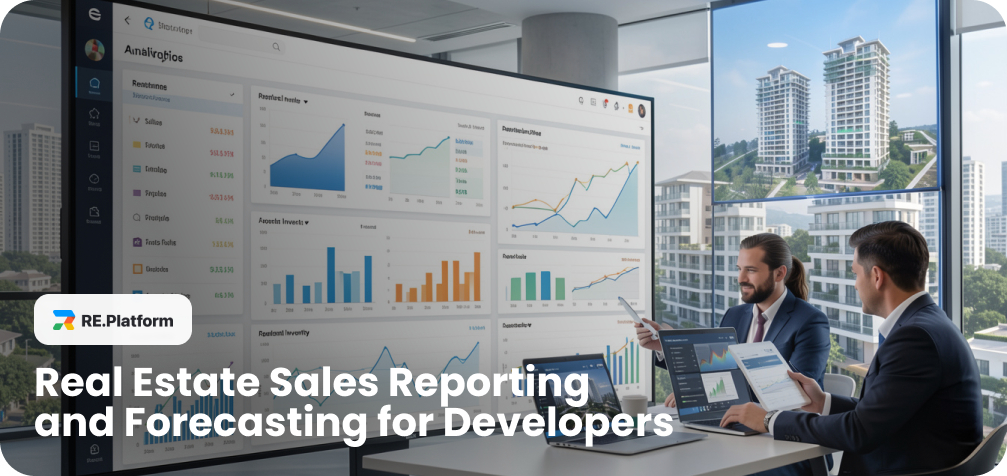
Large residential developments rarely fail because demand disappears. Much more often the problem lies inside the developer’s own operations: fragmented reporting, delayed insights, and forecasts built on intuition instead of data. When sales teams manage thousands of units across several projects, spreadsheets and disconnected systems quickly become a bottleneck.
This is why many development companies are moving toward structured digital systems for managing sales pipelines, reporting, and forecasting. Modern reporting tools allow developers to see what is actually happening inside their sales operations in real time: which projects are performing well, where conversion drops, and how future revenue will evolve over the coming months.
Understanding how reporting and forecasting work together is essential for developers who want predictable growth and better control over their projects.
Table of Contents
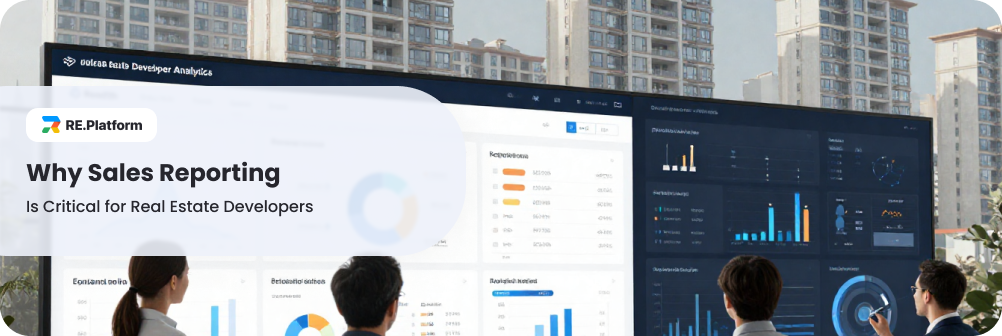
Sales reporting in real estate development is fundamentally different from reporting in most other industries. Developers are not selling thousands of identical products. Instead, each project contains hundreds or thousands of units with different prices, layouts, and release stages.
Without a structured reporting system, teams typically rely on weekly spreadsheets sent by sales managers. These reports often contain outdated numbers, inconsistent definitions, and limited visibility into the actual sales pipeline.
A well-structured reporting system allows developers to monitor several critical indicators simultaneously.
| Metric | Why It Matters |
|---|---|
| Units reserved vs available | Shows real absorption rate of the project |
| Conversion rate from lead to deal | Indicates marketing and sales effectiveness |
| Sales velocity | Helps estimate project sell-out timeline |
| Revenue pipeline | Predicts expected cash flow |
For example, a developer launching a 1,500-unit residential project may initially see strong reservations. However, without proper reporting, it can take weeks to notice that many of those reservations never convert into signed contracts. By the time management identifies the issue, marketing budgets may already be misallocated.
Real-time reporting eliminates this delay.
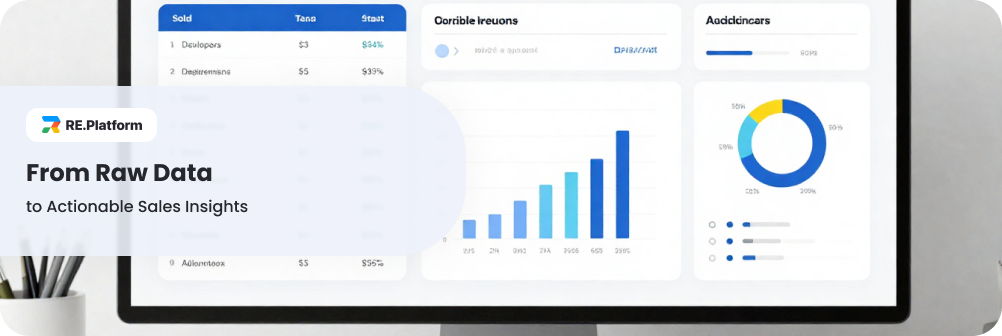
The challenge is rarely the absence of data. Sales departments generate massive volumes of information: leads, reservations, deals, cancellations, payment schedules, and broker activity.
The real difficulty lies in structuring this data into meaningful insights.
Modern development teams increasingly rely on centralized systems where all sales activity is captured in a single environment. These platforms allow management to view performance across projects without waiting for manual reports from individual teams.
For instance, developers using structured CRM ecosystems can monitor the entire sales funnel in one place, connecting marketing leads, reservations, contract signing, and payments into a unified pipeline.
This operational shift is one of the reasons many companies are adopting specialized platforms described in RE.Platform real estate CRM environments or similar developer-focused solutions.
A broader explanation of how CRM systems help developers move away from fragmented operations is discussed in the article Real Estate CRM in Saudi Arabia: Why Developers Move From Chaos to Control, which explains how structured digital infrastructure becomes the foundation for operational control.
Sales forecasting transforms historical and current sales data into projections about future performance. For developers managing multi-year projects, accurate forecasting directly influences investment decisions, construction timelines, and financing strategies.
The forecasting process typically combines several data layers.
| Forecast Input | Description |
|---|---|
| Historical sales velocity | How quickly similar units were sold previously |
| Current pipeline activity | Reservations, negotiations, pending contracts |
| Market demand indicators | Price sensitivity and absorption rates |
| Marketing performance | Lead generation and conversion patterns |
Imagine a developer launching three residential towers simultaneously. One tower may sell significantly faster due to layout configuration or price positioning. Without forecasting models, management may assume all towers will perform similarly, which leads to inaccurate revenue projections.
Forecasting tools highlight these differences early and allow developers to adjust strategy.
For example:
marketing budgets can be shifted toward slower-selling inventory
pricing strategies can be recalibrated
construction phases can be optimized based on actual demand
Despite the obvious benefits, many development companies still struggle to implement effective reporting and forecasting.
The root cause is often operational fragmentation.
Sales teams use different tools. Marketing works in separate platforms. Brokers submit deals through email or messaging apps. Financial departments track revenue independently from sales pipelines.
As a result, management receives inconsistent data.
Common symptoms include delayed reporting cycles, conflicting numbers between departments, and forecasts that change dramatically from month to month.
A developer managing 10,000 units across several projects cannot rely on manually aggregated spreadsheets. The scale of operations simply makes this impossible.
When developers centralize their sales operations into a unified system, forecasting accuracy improves significantly.
Instead of collecting reports manually, management dashboards automatically aggregate key metrics across projects. Decision makers can immediately see how the sales pipeline evolves.
The operational benefits typically include:
consistent reporting across all projects
unified definitions of sales stages
real-time revenue visibility
faster decision making
For example, when reservation cancellations increase in a specific project, management can detect the trend early and investigate possible causes. Perhaps price positioning is incorrect, or perhaps marketing is attracting the wrong audience segment.
Without centralized reporting, this signal might remain hidden for months.
Consider a developer building a large residential complex with 3,000 apartments.
During the first quarter after launch:
900 units receive reservations
600 convert into signed contracts
300 reservations cancel
Without structured forecasting tools, management might incorrectly assume demand is slowing down.
However, a detailed sales report may reveal that cancellations mostly occur within a specific price segment or building phase. Forecast models can then predict the realistic sell-through timeline and help developers adjust release strategies.
This type of insight is only possible when sales reporting is granular and continuously updated.

Developers looking to improve sales reporting and forecasting typically begin by restructuring their operational data environment.
This involves centralizing sales pipelines, defining consistent deal stages, and ensuring that every interaction with potential buyers is recorded in a structured system.
The next step is building dashboards that reflect real operational metrics rather than abstract financial summaries.
Experienced development companies often focus on three reporting layers simultaneously:
| Reporting Layer | Purpose |
|---|---|
| Operational dashboards | Daily monitoring of reservations and deals |
| Sales analytics | Conversion analysis and performance tracking |
| Strategic forecasts | Long-term revenue projections |
When these layers are integrated, developers gain the ability to manage sales operations proactively rather than reactively.
Sales reporting is the process of collecting and analyzing data related to property sales, including reservations, contracts, cancellations, and revenue. Developers use this data to track project performance and understand how effectively units are being sold.
Forecasting allows developers to estimate future revenue and project sell-out timelines. This information helps companies plan construction schedules, financing strategies, and marketing investments.
Modern development companies increasingly use specialized real estate CRM platforms that connect leads, reservations, contracts, and payments into a unified system. These platforms generate real-time dashboards and predictive sales analytics.
Forecast accuracy depends on data quality and operational structure. When sales pipelines are properly tracked and historical data is available, forecasting models can become highly reliable.
Yes. Even mid-size development companies gain major advantages from structured reporting systems because they reduce operational chaos and improve visibility across projects.
Real estate development has always been a capital-intensive business where timing and demand determine success. In today’s market, however, intuition is no longer enough. Developers managing large portfolios must rely on structured data to understand how their projects perform.
Sales reporting provides visibility into the current state of the pipeline. Forecasting transforms that visibility into predictions about future revenue.
Together, they allow developers to make smarter strategic decisions, optimize pricing strategies, and maintain operational control across complex multi-project portfolios.
As development companies continue to scale their operations, structured sales reporting and forecasting will become not just an operational advantage but a fundamental requirement for staying competitive in modern real estate markets.