What Is a CRM for Real Estate?

Real estate development has changed significantly over the past few years. Today, buyers expect fast responses, transparent pricing, clear availability, and digital communication at every stage of the transaction. At the same time, developers are managing more data than ever before: leads coming through websites, social media, Google search, email campaigns, and third-party marketplaces; dozens or hundreds of units across multiple locations; dynamic pricing models; reservations; contracts; and payments.
In this environment, traditional sales tools are no longer enough. Spreadsheets, static PDF catalogs, and disconnected systems create friction, slow down teams, and increase the risk of errors. As projects scale and international buyers enter the market, these cracks in the process become impossible to ignore. What once felt manageable now directly affects buyer satisfaction, trust, and conversion rates.
This is why CRM systems have become a core component of modern real estate development. A CRM for real estate is not just about storing contacts. It is about structuring sales workflows, connecting buyers to real inventory, prioritizing opportunities, and giving developers reliable, real-time control over their pipelines.
In this article, we explain what a CRM for real estate really is, how it works specifically for developers, which features matter most in 2026, and why industry-specific platforms like RE.Platform are replacing generic CRM solutions.
Table of Contents

A CRM for real estate is a software system designed to manage relationships with potential buyers and customers throughout the entire sales lifecycle. For developers, this lifecycle starts long before a contract is signed and often continues well after the transaction is completed.
Unlike generic CRM systems, a real estate CRM works with industry-specific objects such as properties, units, availability statuses, pricing plans, booking stages, and legal documents. Instead of focusing only on contacts, emails, and calls, it connects clients directly to listings, unit details, and real sales actions.
For developers, CRM usage typically includes:
capturing leads from websites, social media, forms, and marketplaces
logging calls, emails, messages, and meetings in one place
scheduling follow-ups and automated drip campaigns
managing unit selection, reservations, and contract progress
storing documents securely and tracking approvals
maintaining a complete buyer profile with preferences and history
All interactions are recorded in a shared system, ensuring that agents, managers, and team members always work with the same data.
CRM stands for Customer Relationship Management. In real estate development, however, it functions less like a contact database and more like an operational hub.
Developers deal with long buying cycles, multiple decision-makers, and complex requirements around pricing, financing, and legal compliance. A CRM helps keep this complexity organized by acting as a single source of truth across sales, marketing, and management.
Modern CRM platforms offer built-in analytics, lead scoring, segmentation, and automation. Instead of simply storing data, they help teams analyze behavior, identify high-intent buyers, and prioritize actions that drive results.
AI-powered assistants, smart pipelines, and automated workflows allow developers to respond immediately, maintain timely communication, and avoid missed opportunities. This is especially important when juggling international buyers, multiple projects, and growing sales volumes.
Many development companies start with generic CRM tools originally built for agencies, brokerages, or traditional sales teams. While these systems may appear flexible at first, they rarely scale well for real estate development.
Generic CRMs usually lack native support for:
unit-level inventory management
live availability updates
dynamic pricing and payment plans
reservation and contract workflows
integration with listings and project catalogs
As a result, teams are forced to rely on spreadsheets, shared folders, PDFs, and manual updates. Over time, this fragmentation creates serious operational risks.
Sales agents work with outdated availability. Leads are duplicated across systems. Follow-ups are skipped. Management loses visibility into real progress. What should be seamless collaboration turns into constant reconciliation.
In competitive markets, these inefficiencies directly impact revenue, buyer trust, and long-term growth.
In 2026, CRM adoption is no longer optional for real estate developers. Buyers expect professional digital experiences. Teams need clarity, speed, and structure. Management requires accurate data to plan, forecast, and scale.
A purpose-built CRM for real estate aligns technology with real operational needs. It supports collaboration, ensures data security, integrates seamlessly with existing tools, and adapts as the business grows.
Ultimately, CRM is no longer just a tool to “manage leads.” It is the foundation that allows developers to build stronger relationships, close deals more efficiently, and compete in a market that is increasingly digital, global, and demanding.
A real estate-focused CRM addresses these challenges by centralizing operations and automating routine processes.
First, it provides a unified lead management system. All inquiries from websites, marketplaces, advertising campaigns, and partners are collected in one database. This eliminates manual data entry and reduces the risk of losing potential buyers.
Second, a CRM connects leads directly to real inventory. Sales teams can instantly see which units are available, reserved, or sold, and match clients with suitable options based on budget, layout, or location.
Third, automation plays a critical role. Follow-ups, reminders, and status changes are triggered automatically, reducing dependency on individual managers and improving overall conversion rates.
Finally, analytics and reporting tools allow developers to track performance in real time. Management can see which channels generate quality leads, where deals stall, and how quickly projects are selling.
| Traditional Approach | CRM-Driven Approach |
|---|---|
| Leads stored in spreadsheets | Centralized lead database |
| Manual follow-ups | Automated workflows |
| Static PDF catalogs | Live interactive catalogs |
| Limited sales visibility | Transparent deal stages |
| Decisions based on experience | Decisions based on data |
When choosing a CRM, developers should focus on features that support real estate-specific workflows rather than generic sales functionality.
An interactive property catalog is a core requirement. It allows teams and clients to browse units with live availability, pricing, and filters. This reduces manual explanations and speeds up decision-making.
Online booking and payment tools are equally important. They enable buyers to reserve units digitally, while developers gain faster cash flow and clearer forecasting.
Sales reports and analytics help monitor KPIs such as lead conversion rates, average deal duration, and project performance. AI assistants and chatbots further enhance the process by handling first-level inquiries and qualifying leads 24/7.
Mobile applications for iOS and Android are becoming standard, especially for international buyers who expect instant access to information.
In our previous article, Top 5 CRM for Real Estate Developers in 2026, we analyzed the most popular solutions on the market. Below is a simplified comparison:
| CRM | Real Estate Fit | Automation | Scalability |
|---|---|---|---|
| Microsoft Dynamics | Medium | High | High |
| HubSpot | Medium | High | Medium |
| RE.Platform | Very High | Very High | Very High |
| Zoho CRM | Low | Medium | Medium |
| Monday CRM | Low | Low | Low |
While some platforms can be adapted, most developers eventually move toward solutions built specifically for real estate.
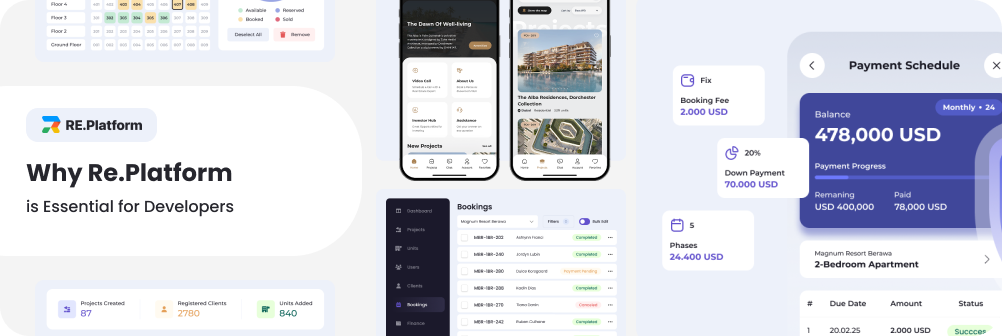
Most CRM systems were not designed with real estate development in mind. They treat properties as simple products and lack deep integration between inventory, sales, and payments.
RE.Platform was built as a real estate ecosystem from the ground up. It combines CRM functionality with property management, booking systems, and financial workflows inside a single environment.
This means every lead is automatically connected to specific units, every reservation updates availability in real time, and every transaction is tracked without manual reconciliation. Sales, marketing, and operations work with the same data, eliminating inconsistencies and delays.
| Feature | Benefit |
|---|---|
| Interactive Property Catalog | Live unit data with flexible filtering |
| Developer-Focused CRM | Full sales lifecycle management |
| AI Assistants & Chatbots | 24/7 client support and lead qualification |
| Online Booking & Payments | Faster reservations and secure transactions |
| Sales Analytics | Real-time performance tracking |
| Mobile Apps | Better engagement with international buyers |
A CRM for real estate is no longer a supporting tool; it is a strategic foundation for modern development businesses. As competition increases and buyers expect digital-first experiences, developers who rely on disconnected systems lose efficiency and control.
Choosing a CRM designed specifically for real estate development allows companies to scale faster, reduce operational risk, and deliver a consistent customer experience across all projects.
Yes. Even developers managing a limited number of projects benefit from centralized data and structured workflows. A CRM helps keep all leads, client communications, unit availability, and documents in one place. This reduces manual work, prevents missed follow-ups, and creates a professional buyer experience from the first inquiry. As demand grows, the same system can scale without disrupting existing processes.
Yes, indirectly but consistently. CRM systems reduce response times, automate follow-ups, and help sales teams match buyers with the most relevant units based on preferences and budget. By removing delays, human errors, and fragmented communication, CRMs increase trust and keep buyers engaged throughout the decision-making process. Over time, this leads to faster deal cycles and higher close rates.
Yes. RE.Platform is designed to support cross-border sales workflows, multilingual buyers, and international communication channels. The platform allows developers to manage inquiries from different regions, track buyer activity across time zones, and maintain clear visibility into inventory and reservations. Digital documentation, online booking, and integrated payment flows make it suitable for projects targeting foreign buyers and global investors.
Implementation time depends on the size of the portfolio and the level of customization required. In most cases, core CRM functionality can be deployed within weeks. Structured onboarding, data migration, and team training help ensure smooth adoption without disrupting ongoing sales activity.
Yes. A real estate CRM is designed to replace spreadsheets, static catalogs, and disconnected tools by consolidating inventory management, lead tracking, communication, and reporting into a single system. This improves data accuracy, reduces operational risk, and gives management real-time visibility into sales performance.