What Is an All-in-One CRM for Real Estate?

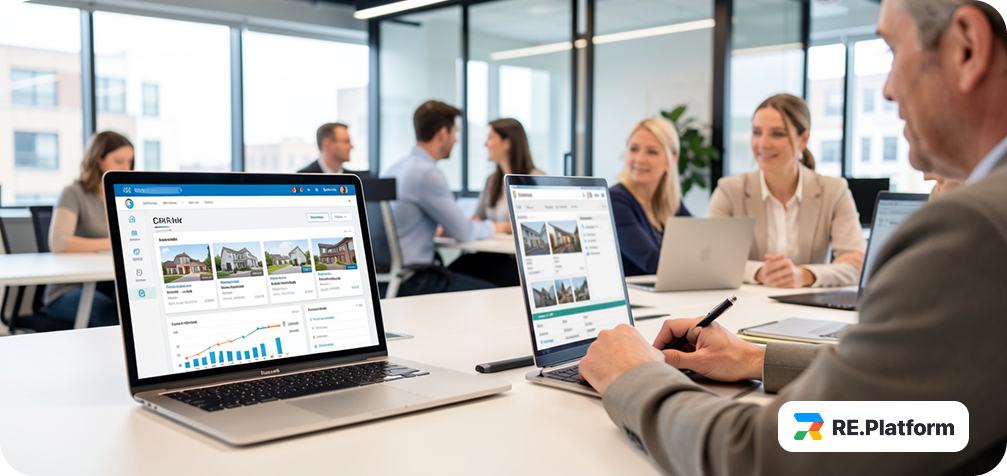
Real estate businesses rarely suffer from a lack of tools. More often, the problem is the opposite. Agents, brokers, and developers juggle multiple platforms every day: one system for leads, another for marketing, a third for transactions, and separate tools for reporting, communication, and document storage. Over time, this fragmented setup creates inefficiencies, data silos, and operational blind spots.
This growing complexity is the reason why the concept of an all-in-one CRM for real estate has gained traction. Instead of stitching together disconnected solutions, companies are increasingly looking for a single platform that brings core processes under one roof. But what does “all-in-one” really mean in a real estate context, and how does it differ from a traditional CRM?
Table of Contents

At a basic level, any CRM manages contacts and interactions. An all-in-one CRM for real estate goes several steps further. It is designed to support the entire operational lifecycle of a real estate business, not just lead tracking.
Rather than acting as a standalone database, an all-in-one system becomes the central workspace where teams manage leads, communicate with clients, oversee transactions, monitor performance, and coordinate internal workflows. The key distinction lies in consolidation. Instead of exporting data between systems or relying on manual updates, all critical information lives within a single environment.
In real estate, where deals often span weeks or months and involve multiple stakeholders, this unified structure provides clarity. Every interaction, document, and task is connected to a specific client or property, allowing teams to understand context instantly rather than reconstructing it from scattered tools.
Traditional real estate CRMs typically focus on one primary function: lead and contact management. While many of them offer add-ons or integrations, their core architecture assumes that other operational needs will be handled elsewhere.
An all-in-one CRM is built on a different philosophy. It assumes that lead management, marketing, transactions, analytics, and internal coordination are not separate processes, but parts of a single workflow. This changes how the system is structured and how users interact with it on a daily basis.
The difference becomes clearer when comparing the two approaches side by side:
| Aspect | Traditional Real Estate CRM | All-in-One CRM for Real Estate |
|---|---|---|
| Core focus | Leads and contacts | End-to-end operations |
| Data structure | Fragmented across tools | Unified data environment |
| Integrations | Required for most functions | Native, built-in modules |
| Workflow visibility | Limited to sales stage | Full lifecycle visibility |
| Scalability | Often requires new tools | Designed to scale within one system |
This structural difference has practical implications. Teams using traditional CRMs often spend time reconciling data between platforms, while all-in-one systems reduce duplication and operational friction.
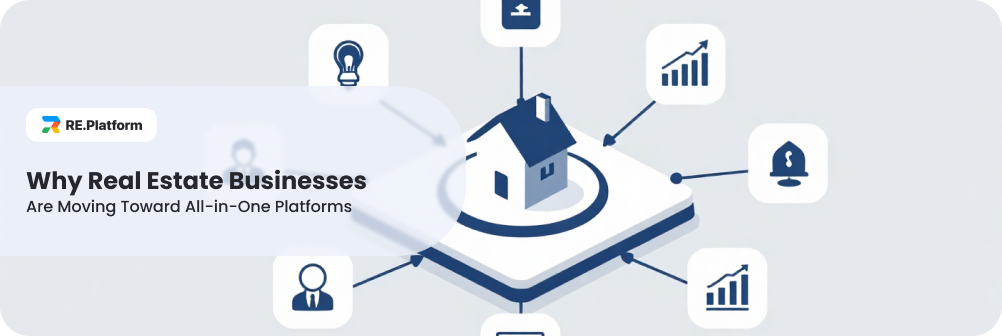
The shift toward all-in-one CRMs is not driven by technology trends alone. It is largely a response to operational realities within real estate organizations.
As agencies grow, so does the volume of data they manage. Marketing campaigns generate leads, agents handle negotiations, finance teams track commissions, and management monitors performance. When each function relies on a different system, decision-making becomes slower and less accurate.
An all-in-one CRM addresses this by creating a shared operational picture. Managers can see how marketing efforts translate into deals, how agents perform across regions, and where bottlenecks occur in the transaction pipeline. This level of visibility is difficult to achieve when data is fragmented.
Another important factor is user adoption. Agents are far more likely to engage with a platform that simplifies their daily work instead of adding extra steps. When communication, task management, and client history are accessible in one place, the system becomes a natural part of the workflow rather than an administrative burden.
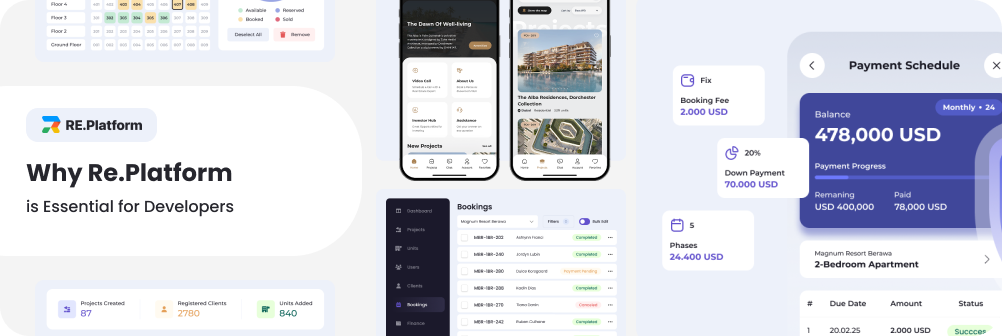
Replatform illustrates how the all-in-one CRM concept translates into real-world use. Instead of positioning itself as a single-purpose CRM, it functions as a unified operating system for real estate businesses.
Within one platform, teams can manage leads, track client interactions, coordinate transactions, and analyze performance data. Rather than relying on external tools for each stage of the process, workflows remain consistent and connected from the first inquiry to post-deal follow-ups.
What makes this approach effective is not the number of features, but how those features work together. Data entered at the lead stage remains relevant throughout the transaction and beyond, supporting long-term relationship management and strategic planning. For growing agencies and developers, this reduces operational complexity while improving transparency across teams.

While all-in-one CRMs offer clear advantages, they are not a universal solution. Smaller teams with very simple workflows may find that a lightweight CRM combined with a few specialized tools meets their needs just fine.
However, as transaction volume increases and operations become more complex, the limitations of fragmented systems become more apparent. At that stage, the ability to centralize data, standardize workflows, and gain holistic insights often outweighs the flexibility of using multiple disconnected platforms.
The decision ultimately depends on scale, growth plans, and operational maturity. An all-in-one CRM is best viewed not as a software upgrade, but as an infrastructure choice.
An all-in-one CRM for real estate represents a shift in how real estate businesses manage their operations. Instead of treating lead management, marketing, transactions, and reporting as separate functions, these systems bring them together into a single, coherent environment.
By reducing fragmentation and improving visibility, all-in-one CRMs help teams work more efficiently, make better decisions, and build stronger client relationships over time. Platforms like Replatform demonstrate how this approach can support both daily operations and long-term growth.
As the real estate industry continues to evolve, the question is no longer whether technology is needed, but how integrated that technology should be. For many modern real estate businesses, the answer is increasingly clear.