Browse by category


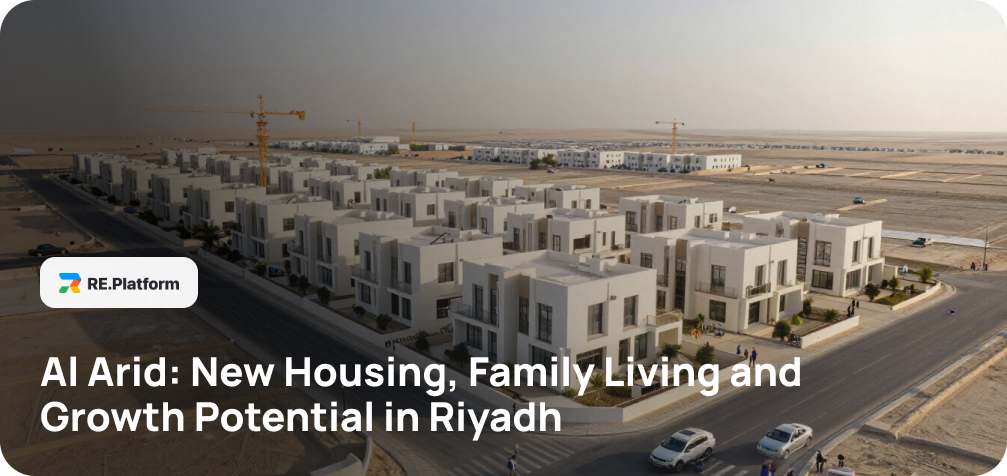
Al Arid is one of the districts that shows how quickly Riyadh’s residential map is changing. It is not a mature central district like Olaya, not a premium villa market like Hittin and not a business-adjacent apartment district like Al Aqiq or Al Sahafa. Its appeal is different: new housing supply, larger residential plots, family demand, more accessible entry points and long-term exposure to Riyadh’s northern expansion.
For many buyers, Al Arid sits in an interesting middle ground. It is already active enough to have apartments, villas, rental listings and visible residential demand, but it still feels more like a growth district than a fully mature urban neighborhood. That makes it relevant for families who want newer housing and more space, and for investors looking for a district where pricing can still feel more flexible than in the most established northern areas.
The district is especially important because Riyadh’s housing demand is not moving in only one direction. Some buyers want premium villas in Hittin. Others want apartments near KAFD in Al Aqiq or Al Sahafa. Families looking for newer homes and more practical budgets are often pushed toward districts like Al Arid, Al Narjis and Al Qirawan.
That does not mean Al Arid is a simple bargain. Buyers still need to check road access, building quality, surrounding services, infrastructure maturity and exact micro-location. In a growth district, the difference between a strong property and a weak one can be significant.
Table of Contents
Looking to buy property in Al Arid?
Describe what you are interested in and we will contact you.
Send requestAl Arid’s Main Appeal Is New Residential Growth
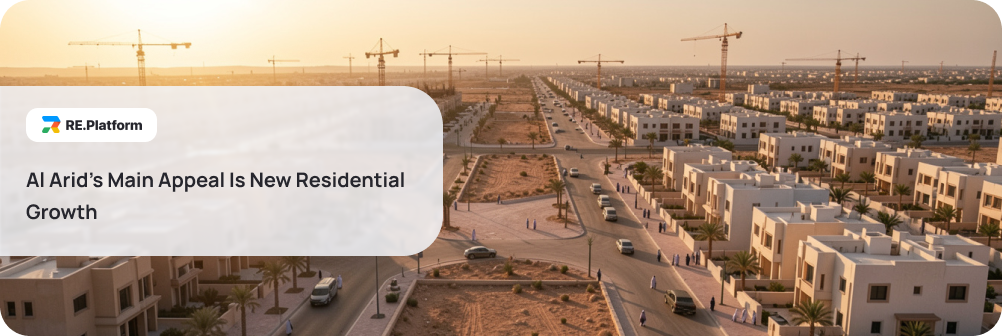
Al Arid is located in northern Riyadh, in a part of the city where residential growth has become one of the strongest market themes. The district is commonly associated with newer villas, apartments, duplexes, residential floors and ongoing development activity.
This gives Al Arid a different character from more established districts. In Hittin, the story is premium family living. In Al Malqa, it is mature demand and lifestyle convenience. In Al Sahafa, it is urban apartment living. In Al Arid, the story is expansion.
That expansion matters because Riyadh’s population, employment base and housing needs continue to grow. As more residents look for homes in northern districts, areas with new housing supply become increasingly relevant. Al Arid benefits from this demand because it can offer buyers and tenants property formats that are harder or more expensive to find in older districts.
For residents, this means access to newer homes and family-oriented layouts. For investors, it means a district where demand can be supported by end users, not only by speculation. But the investment logic should be realistic. Al Arid is not a guaranteed short-term flip market. It is better understood as a long-term residential growth district.
Al Arid on the Map
Al Arid is located in northern Riyadh, close to Al Narjis, Al Yasmin, Al Qirawan and other expanding residential districts. The map below helps show why Al Arid is often viewed as part of Riyadh’s northern housing growth corridor.
What Makes Al Arid Different From Nearby Districts
Al Arid’s identity is shaped by newer residential supply and growth potential. It is not trying to compete with Hittin as a prestige district. It is not as business-oriented as Al Aqiq. It is not as urban and apartment-led as Al Sahafa. Its strongest comparison is with districts like Al Narjis and Al Qirawan, where buyers look for space, newer homes and long-term residential development.
This matters because Al Arid should not be judged only by today’s amenities. In growth districts, the future shape of the area matters as much as the current street-level experience. Buyers need to ask what is already available, what is still developing and whether the property’s location will remain practical as the area matures.
Al Arid can appeal to families that want newer villas or larger apartment formats without entering the most expensive established districts. It can also appeal to investors who want a district with broader family demand and more accessible ticket sizes compared with premium northern areas.
However, the district requires more due diligence. In mature areas, the value of location is usually easier to read. In growth areas, one street, one road connection or one nearby service cluster can make a big difference.
Who Lives in Al Arid?
Al Arid attracts a resident profile that is closely tied to Riyadh’s housing expansion. The district can suit Saudi families, young households, first-time buyers, long-term renters and investors looking for practical residential demand rather than only prestige.
Families may choose Al Arid because the district offers villas, duplexes, larger apartments and newer residential formats. Compared with more established northern districts, buyers may find more options with larger spaces or newer layouts at a more flexible budget.
Young families and couples may look at apartments and smaller residential units. These buyers often want to enter the Riyadh market without paying the highest prices found in premium districts. For them, Al Arid can be a practical compromise: newer housing, residential surroundings and exposure to northern Riyadh growth.
Renters may choose Al Arid when they want more space or better value than in more central areas. However, tenants should check daily access carefully. A rental that looks attractive on price may be less convenient if it is far from work, schools or major roads.
For investors, the tenant base is mainly residential. Al Arid is not as business-driven as Al Aqiq or Al Sahafa. Its strongest investment case is built around families, long-term renters and buyers looking for newer homes in a growing district.
Property Types in Al Arid
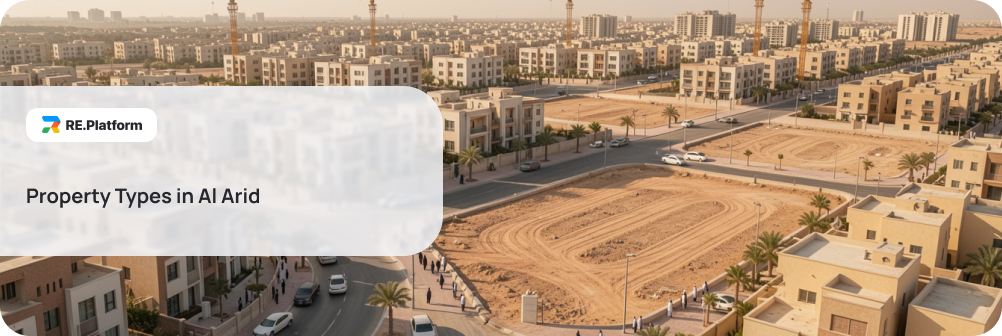
Al Arid has a broad residential property mix. Apartments, villas, duplexes, residential floors and new-build units are all part of the district’s market. This gives buyers several entry points, from apartment purchases to larger family homes.
Apartments are important because they create a more accessible path into the district. Three-bedroom apartments are especially visible in current listings and can suit families who want a practical layout without buying a villa. Smaller apartments can appeal to first-time buyers or investors, but building quality and management should be checked carefully.
Villas and duplexes are central to the family-living story. Many buyers looking at Al Arid are not only comparing apartments. They are comparing the possibility of owning or renting a larger home in a district that still has growth potential.
Residential floors can also appear in the market. These may suit larger families or renters who want more space than a standard apartment but do not want or cannot afford a full villa.
| Property type | Role in Al Arid | Best suited for |
|---|---|---|
| 2-bedroom apartments | Accessible residential entry | Couples, small families, first-time buyers |
| 3-bedroom apartments | Core family apartment format | Families, long-term tenants, investors |
| Furnished apartments | Smaller rental niche | Shorter stays, convenience-driven renters |
| Villas | Main family ownership product | Families, high-budget buyers |
| Duplexes | Space-focused residential format | Families wanting more privacy |
| Residential floors | Larger rental or ownership option | Larger households, value-focused families |
Buying Property in Al Arid
Al Arid’s buying market is broad, but public listings show that apartments are often more accessible than villas. Visible Bayut listings for apartments in Al Arid include examples around SAR 937,000, SAR 1.1 million, SAR 1.19 million, SAR 1.59 million and SAR 1.7 million, depending on size, bedroom count, finishing and building quality.
Three-bedroom apartments are especially relevant in the district. Visible listings show three-bedroom units around SAR 937,000 to SAR 1.7 million, with sizes and layouts varying significantly. This range makes Al Arid attractive for buyers who want a family-sized apartment without entering the highest-priced districts.
Villas and larger residential properties are much higher-ticket assets. Depending on size, land, finishing and exact location, villa pricing can move into the multi-million-riyal range. Buyers should not assume that Al Arid is cheap across every segment. Apartments may be more accessible, but larger homes still require serious capital.
| Segment | Indicative market picture | What buyers should understand |
| Smaller apartments | Lower entry than villas | Useful for first-time buyers and investors |
| 3-bedroom apartments | Around SAR 937,000–1.7m in visible examples | Strong fit for family apartment demand |
| Furnished or premium apartments | Can price higher | Needs strong rentability to justify premium |
| Duplexes / floors | Mid-to-upper residential category | More space, but harder to compare directly |
| Villas | Multi-million-riyal market | Family demand, higher maintenance and capital exposure |
For buyers, the key is to avoid judging Al Arid by one listing. A lower-priced apartment may be attractive, but only if the layout, building, access and parking are practical. A villa may offer strong long-term value, but only if the price reflects location quality and future resale potential.
Renting in Al Arid: What Tenants Should Expect
Al Arid’s rental market includes apartments, furnished units, residential floors and villas. Rental prices vary widely because the district serves several different tenant profiles.
Visible listings show three-bedroom apartments around SAR 58,000 per year in some cases, while furnished or hotel-style apartment listings can be priced monthly, with examples around SAR 11,000 per month for higher-service or temporary-use formats. Villa rental listings also appear in the district, with examples such as four-bedroom villas around SAR 120,000 per year.
This range shows that Al Arid is not one simple rental market. A standard family apartment, a furnished monthly apartment and a villa are different products.
| Rental product | Indicative annual range | Practical reading |
| Small apartment | Around SAR 35,000–50,000+ | Depends on size, age and building quality |
| 2-bedroom apartment | Around SAR 45,000–65,000+ | Practical for couples and small families |
| 3-bedroom apartment | Around SAR 58,000–85,000+ | Strong family rental format |
| Furnished apartment | Can be priced monthly | Higher rent, but more service-driven |
| Residential floor | Around SAR 70,000–100,000+ | More space than a standard apartment |
| Villa | Around SAR 100,000–140,000+ in visible examples | Family-focused, higher absolute rent |
Tenants should compare total value, not only rent. A slightly cheaper unit may be less attractive if it has poor access, weak parking or limited nearby services. In a growth district, daily convenience can vary strongly by micro-location.
For landlords, Al Arid’s rental story is mainly residential. A well-priced family apartment can be easier to understand than a speculative furnished-rental strategy. Furnished units may work in some cases, but investors should not assume that Al Arid has the same short-term rental profile as business-side districts.
Utilities, Maintenance and Housing Costs
Housing costs in Al Arid depend heavily on property type. Apartments are generally easier to manage and more predictable than villas, but electricity can still rise during hotter months because of air conditioning.
For families renting or buying villas, utility and maintenance costs can be more significant. Larger homes require more cooling, cleaning, AC maintenance and occasional repairs. Outdoor areas, parking spaces and private entrances may also add to upkeep.
Apartments may have lower utility exposure, but buyers should check building management, elevators, parking, shared maintenance and common-area quality. In newer districts, building standards can vary. A modern-looking building still needs good management to remain attractive over time.
Furnished rentals require separate calculations. Furniture, appliances, cleaning and tenant turnover can reduce net returns for landlords.
| Cost category | Why it matters in Al Arid |
| Electricity | Higher in summer, especially for villas and larger homes |
| Water | Depends on household size and property type |
| Internet and mobile | Important for families and remote workers |
| Parking | Critical for apartment and villa usability |
| Maintenance | Higher for villas, duplexes and furnished units |
| Building management | Important for apartment investors |
| Vacancy | Can affect investors if pricing is too aggressive |
Everyday Cost of Living in Al Arid
Al Arid is generally more practical than premium-luxury. Residents can manage everyday costs depending on housing type, lifestyle and commute pattern. A family renting a villa will have a different budget from a couple renting an apartment.
Groceries, pharmacies, cafes and daily services are available in and around the wider northern Riyadh area, but convenience can depend on exact location. In developing districts, some pockets feel more complete than others.
Transport remains important. Riyadh is car-oriented, and Al Arid’s value depends partly on road access. Residents should check commute times to work, schools and regular destinations before choosing a unit. A property that looks affordable can become less practical if daily travel is difficult.
| Monthly cost item | Practical interpretation |
| Groceries | Flexible depending on local or premium shopping habits |
| Dining and cafes | Available, but stronger options may be in nearby districts |
| Utilities | Higher for larger villas and during hotter months |
| Transport | Car ownership or ride-hailing remains important |
| Healthcare | Clinics and hospitals reachable by car |
| Schools | Can dominate family budgets |
| Maintenance | Relevant for owners and villa tenants |
Al Arid is best understood as a value-and-growth district. It may not yet offer the same urban density as Al Sahafa or the same premium environment as Hittin, but it can provide more space and newer housing options.
Schools, Clinics and Daily Infrastructure
Al Arid’s infrastructure is developing alongside its residential demand. Families can access schools, nurseries, clinics, pharmacies and retail services across the northern Riyadh area, but specific routes should be checked carefully.
For families, school access is one of the most important practical factors. A good property in Al Arid should be evaluated against the daily route to school and work. In Riyadh, commute time can shape quality of life more than the district name itself.
Healthcare access is practical by car, with clinics and medical facilities available across nearby districts. Residents should still check how easily they can reach regular healthcare providers from the exact property location.
Daily retail is improving, but Al Arid may feel less complete than more mature districts in certain pockets. This is normal for a growth area. Buyers should decide whether they are comfortable with a district that is still maturing or whether they prefer a more established environment.
Main Risks for Buyers and Investors
The first risk is buying too early in a weak micro-location. Growth districts can be attractive, but not every street matures equally.
The second risk is overpaying for “future potential.” Future growth can support value, but it should not justify any price.
The third risk is infrastructure timing. Some services may still be developing, and residents may need to drive to nearby districts for certain needs.
The fourth risk is building quality. Newer does not always mean better. Buyers should check construction quality, finishing, parking, maintenance and building management.
The fifth risk is rental assumptions. Al Arid has demand, but it is not the same as a KAFD-side furnished apartment market. Investors should model family residential rents, not speculative short-term income.
The sixth risk is foreign ownership complexity. International buyers should check eligibility, approved areas, registration requirements and resale options before making assumptions.
Al Arid Is a Practical Bet on Riyadh’s Residential Growth
Al Arid is one of Riyadh’s most relevant districts for buyers who want exposure to the city’s northern residential expansion without entering the most expensive premium areas. Its strength is not prestige, centrality or direct business access. Its strength is new housing, family demand, more accessible entry points and long-term growth potential.
For residents, the district can offer newer homes and more space. For renters, it can provide practical family housing. For investors, it offers a patient growth story, but not a shortcut.
The best way to approach Al Arid in 2026 is to think carefully about the exact property. The district has potential, but performance depends on micro-location, layout, building quality, parking, access and realistic rent.
Al Arid is attractive because it sits where Riyadh’s affordability challenge and northern expansion meet. That makes it worth watching — but not worth buying blindly.