Browse by category


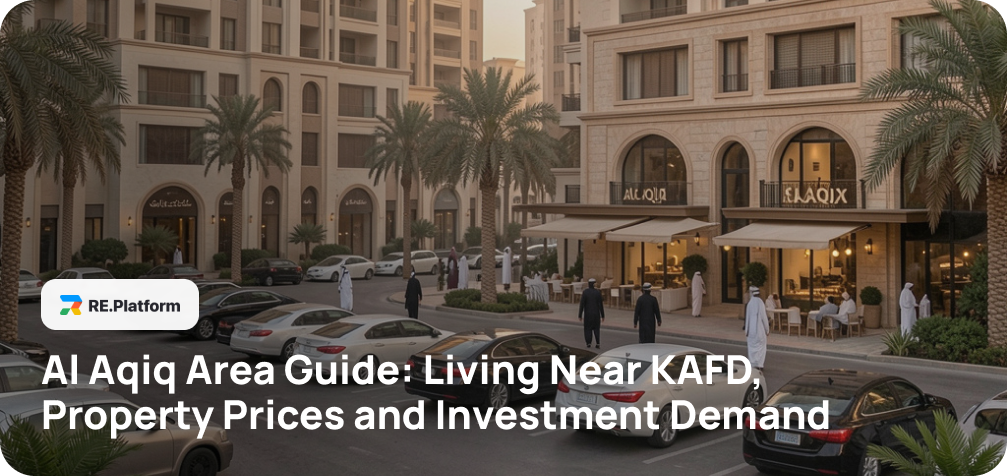
Al Aqiq is one of Riyadh’s most strategically positioned residential districts. It is not the quietest family neighborhood in the capital, and it is not purely a premium villa market like Hittin. Its strength comes from something different: location. Al Aqiq sits close to King Abdullah Financial District, major northern roads, business demand, apartment supply and several of Riyadh’s most active residential and commercial zones.
That makes the district especially relevant in 2026. As Riyadh becomes more important as a regional business hub, housing demand is no longer driven only by families looking for villas. Professionals, executives, consultants, relocated employees, entrepreneurs and expatriates also need practical housing close to business infrastructure. Al Aqiq is one of the districts that benefits from that shift.
For residents, the area offers access to offices, retail, restaurants, services and nearby districts such as Al Malqa, Hittin, Al Sahafa and Al Nakheel. For investors, it offers a market where apartments can be more interesting than large villas because the tenant base is often linked to work, mobility and convenience. But Al Aqiq is not a simple “buy anything near KAFD” story. Prices, rents and returns vary sharply by property type, furnishing, building quality and exact micro-location.
Table of Contents
Looking to buy property in Al Aqiq?
Describe what you are interested in and we will contact you.
Send requestAl Aqiq’s Main Advantage Is Business-Side Location
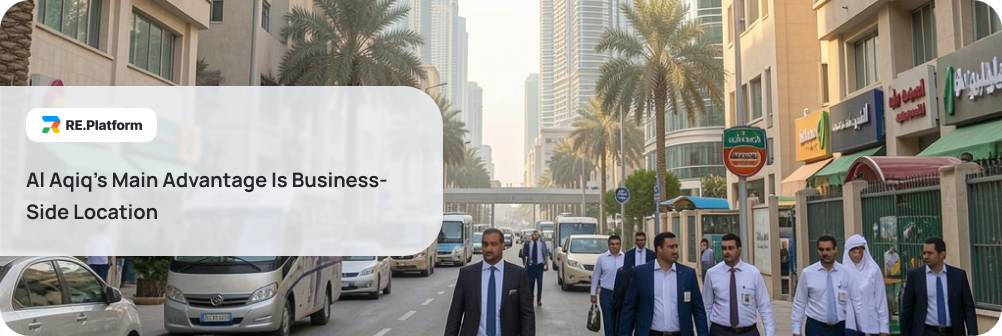
Al Aqiq is located in the northern part of Riyadh, close to King Abdullah Financial District and several of the capital’s strongest residential and commercial corridors. This gives the district a different identity from purely family-oriented areas such as Al Yasmin or villa-led districts such as Hittin.
The district is attractive because it sits close to where people work, commute, meet clients and access city services. In Riyadh, this matters more than it may seem from a map. The city is large, car-oriented and heavily shaped by road access. A residential district becomes more valuable when it reduces daily friction: shorter drives to work, easier access to major roads, nearby retail and practical services.
Al Aqiq benefits from proximity to KAFD, King Fahd Road, Northern Ring Road and surrounding neighborhoods with strong commercial and residential activity. This makes it useful for professionals who want to live close to business areas without choosing a fully commercial district.
For investors, this location creates a clear demand logic. Al Aqiq is not only about families buying long-term homes. It also appeals to renters who need convenience, furnished apartments, shorter commutes and access to business infrastructure.
Al Aqiq on the Map
Al Aqiq is located near KAFD and several important northern Riyadh districts. The map below helps show why the area is often discussed as a practical residential base for professionals, families and investors looking at the business side of Riyadh’s housing market.
What Makes Al Aqiq Different From Nearby Districts
Al Aqiq’s identity is shaped by business proximity and residential convenience. It is not as villa-prestige driven as Hittin, not as lifestyle-balanced as Al Malqa and not as emerging-growth oriented as Al Narjis. It is more practical, more apartment-relevant and more closely linked to professional demand.
That does not mean Al Aqiq is only for office workers. Families also live there, and villas are available in the district. But the investment logic is different. In Al Aqiq, the apartment market can be especially important because the area attracts renters who care about location, furnishing, commute time and access to commercial zones.
This makes Al Aqiq useful for buyers who want exposure to Riyadh’s business growth without buying directly into the most expensive premium villa markets. It also makes the district more sensitive to building quality. A modern apartment with parking, good finishing and a practical layout can perform very differently from an older unit in a weaker micro-location.
Who Lives in Al Aqiq?
Al Aqiq attracts a mixed resident profile. Families live in the district, but the area also appeals strongly to professionals, consultants, executives, couples and expatriates who want practical access to Riyadh’s business and lifestyle infrastructure.
For families, Al Aqiq can offer villas, larger apartments and access to nearby services. It may not feel as purely family-residential as Al Yasmin or as premium-villa focused as Hittin, but it still works for households that want a connected northern location.
For professionals, the district is especially relevant. A modern apartment in Al Aqiq can reduce commute stress, especially for people working around KAFD or nearby office areas. This is also why furnished apartments and smaller units appear in the rental market. Some renters are not looking for a long-term family villa. They want convenience, location and a unit that is ready to use.
For investors, this mix is useful. A district with several renter profiles can be more flexible than a market dependent on one narrow audience. But it also means investors need to choose the right product. A villa, a furnished one-bedroom apartment and a family-sized apartment in Al Aqiq are three different investment strategies.
Property Types in Al Aqiq
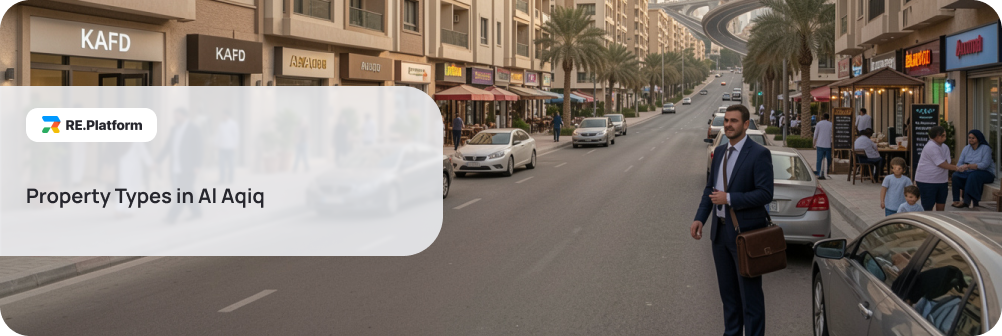
Al Aqiq offers apartments, villas, furnished units, residential floors and duplex-style homes. The district’s property mix reflects its location: part residential, part business-adjacent, part lifestyle-access market.
Apartments are central to the Al Aqiq story. One-bedroom and two-bedroom units can appeal to professionals, consultants and couples. Three-bedroom apartments can serve small families or long-term tenants who want access to North Riyadh without paying villa-level rent.
Furnished apartments are also important. In districts close to business areas, furnished rental demand can be stronger than in purely suburban neighborhoods. This can benefit landlords, but it also increases operating responsibility. Furniture, appliances, cleaning standards and tenant turnover all affect net returns.
Villas and larger homes are available for families and high-budget buyers. However, villas in Al Aqiq should be evaluated carefully because the total purchase price can be high, and the renter pool may be narrower than for apartments.
| Property type | Role in Al Aqiq | Best suited for |
|---|---|---|
| 1-bedroom apartments | Business-side rental product | Professionals, singles, consultants |
| 2-bedroom apartments | Practical apartment format | Couples, small families, investors |
| 3-bedroom apartments | Larger rental and family product | Families, long-term tenants |
| Furnished apartments | Convenience-driven rental product | Expats, consultants, short-to-medium stays |
| Villas | Family and long-term ownership product | Families, high-budget buyers |
| Duplexes / residential floors | More space without full villa positioning | Local families, larger households |
Buying Property in Al Aqiq
Property prices in Al Aqiq vary sharply by type. Apartments, villas and furnished units follow different pricing logic, and buyers should avoid treating the district as one simple average.
Current public listings show villas in Al Aqiq frequently appearing in the multi-million-riyal range. Visible examples include villas around SAR 3 million, SAR 3.5 million, SAR 4.6 million, SAR 4.9 million, SAR 8.6 million, SAR 9 million and above, depending on land size, number of bedrooms, finishing and exact location.
Apartments are more accessible than villas, but pricing varies by building quality, size and whether the unit is new or furnished. In a district with business-side demand, a smaller apartment may sometimes be more liquid than a large high-ticket unit because the renter base is broader.
| Segment | Indicative market picture | What buyers should understand |
| 1-bedroom apartments | Lower ticket than family units | Useful for business-linked rental demand |
| 2-bedroom apartments | Practical investment format | Often fits professionals, couples and small families |
| 3-bedroom apartments | Higher ticket and more family-oriented | Needs strong layout and parking |
| Furnished apartments | Can command stronger rent | Requires more active management |
| Standard villas | Often several million SAR | Strong family appeal, but high entry budget |
| Premium villas | Can reach high multi-million levels | More capital-value play than simple yield product |
The key investment question is not whether Al Aqiq is expensive. The key question is whether the property’s rent potential, tenant profile and resale appeal justify the entry price. A well-located apartment can be more practical than a villa bought at a premium without a clear rental strategy.
Renting in Al Aqiq: What Tenants Should Expect
Al Aqiq has a wide rental range because it contains several rental products. Small apartments, furnished units, family apartments and villas do not compete directly with each other.
Current Bayut listings show apartments starting from around SAR 31,000 to SAR 35,000 per year for smaller units, while two-bedroom and three-bedroom apartments can appear around SAR 75,000 to SAR 90,000 per year and above depending on size, condition and furnishing. Aqar listings also show examples from around SAR 25,000 per year for small units, with furnished or better-positioned units around SAR 56,000, SAR 65,000, SAR 80,000 and SAR 90,000 per year.
Villa rents are significantly more variable. Visible listings show villas around SAR 90,000, SAR 115,000, SAR 140,000, SAR 250,000 and much higher for exceptional or premium listings. This wide spread reflects the difference between smaller villa formats, larger homes and high-end properties.
| Rental product | Indicative annual range | Practical reading |
| Small apartment / studio | Around SAR 25,000–40,000+ | Most accessible rental format |
| 1-bedroom apartment | Around SAR 31,000–60,000+ | Useful for professionals and single tenants |
| 2-bedroom apartment | Around SAR 56,000–90,000+ | Strong fit for couples and small families |
| 3-bedroom apartment | Around SAR 75,000–100,000+ | More family-oriented and quality-sensitive |
| Furnished apartment | Around SAR 65,000–90,000+ in visible examples | Convenience premium, more management required |
| Villas | Around SAR 90,000–250,000+ | Wide range depending on size and quality |
| Premium villas | Can move far higher | Narrower tenant pool, high absolute rent |
These figures should be treated as market indicators, not fixed prices. A small unfurnished apartment and a furnished apartment near major roads are not the same rental product. The same is true for villas: land size, age, finishing and exact street can change the rent dramatically.
Utilities, Maintenance and Housing Costs
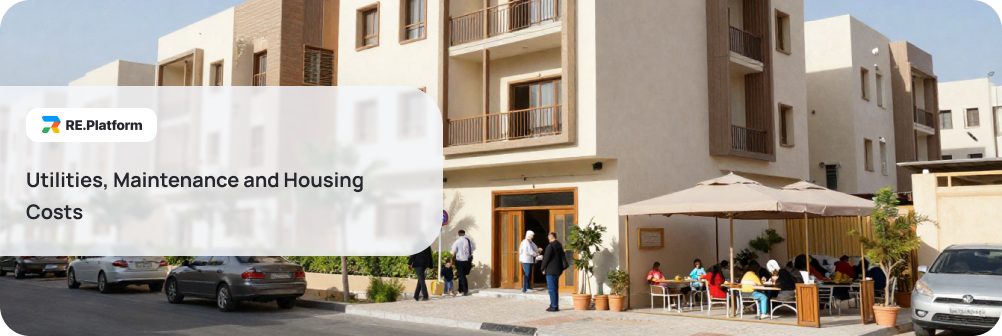
Housing costs in Al Aqiq depend heavily on property type. A small apartment rented by a professional will have a very different monthly cost profile from a villa occupied by a family.
Electricity is one of the most important recurring costs in Riyadh because of air conditioning. Apartments are usually more predictable, while villas can become expensive to cool during hotter months. Water, internet and mobile plans are easier to estimate, but usage still depends on household size.
Furnished apartments require extra attention. They may generate stronger rent, but furniture, appliances, cleaning, repairs and tenant turnover can reduce net returns. Investors should not calculate furnished rental income without budgeting for replacements and maintenance.
For villas, maintenance can be more significant. Larger homes may require AC servicing, exterior upkeep, cleaning, minor repairs and occasional upgrades. These costs matter because they affect the real yield after expenses.
| Cost category | Why it matters in Al Aqiq |
| Electricity | Air conditioning can increase monthly costs, especially in villas |
| Water | Depends on property type and household size |
| Internet and mobile | Predictable but varies by plan and provider |
| Furnishing | Can raise rent but increases replacement costs |
| Maintenance | Important for villas and furnished rentals |
| Parking | Critical for rentability in a car-oriented city |
| Vacancy | Business-linked renters may move more often than family tenants |
Everyday Cost of Living in Al Aqiq
The cost of living in Al Aqiq depends on lifestyle and household structure. A single professional renting a furnished apartment near work will spend differently from a family renting a villa with children in private school.
Daily shopping is practical. The district and surrounding areas provide supermarkets, cafes, restaurants, pharmacies, service shops and delivery options. Residents do not need to leave the northern part of Riyadh for every routine need.
Dining and lifestyle spending can be flexible. A resident can keep costs moderate with local stores and casual restaurants, or spend much more through premium cafes, delivery, gyms and nearby lifestyle destinations.
Transport remains a central budget item. Riyadh is still heavily car-based, and Al Aqiq’s value partly comes from its road access. Residents should still check commute time to work, schools and regular destinations because traffic and exact location inside the district can change daily convenience.
| Monthly cost item | Practical interpretation |
| Groceries | Flexible; local products help control costs |
| Dining and cafes | Accessible, with casual and premium options nearby |
| Utilities | Higher in summer, especially for larger homes |
| Transport | Car ownership, ride-hailing or driver costs matter |
| Healthcare | Clinics and hospitals are accessible by car |
| Schools | Important for families and can dominate monthly costs |
| Furnished living | Convenient but usually more expensive |
Al Aqiq is best understood as a convenience-driven district. It is not purely low-cost, and it is not purely luxury. Its value comes from location, mobility and access to Riyadh’s business-side infrastructure.
Schools, Clinics and Daily Infrastructure
Al Aqiq benefits from being surrounded by active residential and commercial districts. Residents can access supermarkets, clinics, pharmacies, restaurants, cafes, gyms and service businesses both inside the district and in nearby areas.
Families choosing Al Aqiq should check school routes carefully. The district can be practical for families, but school choice and commute times may matter more than the district name itself. In Riyadh, a good housing decision often depends on how home, school and work connect every day.
Healthcare access is also practical. Private clinics, pharmacies and larger medical facilities are reachable across northern and central Riyadh. For expats and professionals, this type of access can be more important than living in a district with a purely residential identity.
Al Aqiq vs Nearby Districts
Al Aqiq should be compared with districts that serve similar residents or investors. The closest comparisons are Al Malqa, Hittin, Al Sahafa, Al Nakheel, Al Yasmin and Olaya.
| Area | Best known for | Compared with Al Aqiq |
| Al Malqa | Modern residential demand, apartments and villas | More family-lifestyle balanced; Al Aqiq is more business-adjacent |
| Hittin | Premium villas and high-income family demand | More prestigious and villa-led; Al Aqiq is more mixed and practical |
| Al Sahafa | Apartments, urban services and business-linked demand | Similar urban logic, often more apartment-focused |
| Al Nakheel | Established residential and expat-friendly living | More settled and family-oriented; Al Aqiq is more connected to KAFD demand |
| Al Yasmin | Practical family district | More residential and calmer; Al Aqiq is more commute-driven |
| Olaya | Central business and commercial activity | More central and office-heavy; Al Aqiq offers a northern residential base near business zones |
Al Aqiq’s advantage is that it does not need to compete as the most premium or the most affordable district. Its role is different: it gives residents access to business-side Riyadh while still functioning as a residential area.
Investment Demand in Al Aqiq
The investment case for Al Aqiq is built around business access, apartment demand and rental flexibility. This is not the same investment logic as a family villa district. Investors should look closely at who the tenant is likely to be.
A one-bedroom furnished apartment may appeal to a consultant, expatriate professional or business traveler. A two-bedroom apartment may suit a couple or small family. A three-bedroom unit can work for longer-term family tenants. Villas may appeal to families with larger budgets, but they require more capital and may not offer the same percentage yield as apartments.
This makes Al Aqiq a district where property selection matters more than general market enthusiasm. A good unit with parking, modern finishing and realistic rent can perform well. A poorly priced unit with weak layout or maintenance issues can struggle even in a strong location.
Investors should also be careful with gross yield. Furnished rentals and high-rent villas may look attractive, but net return depends on vacancy, maintenance, management, service costs and tenant turnover.
How KAFD Demand Shapes the District
King Abdullah Financial District is one of the strongest demand anchors near Al Aqiq. Its role as a business and office destination supports demand from professionals, executives, consultants and companies. This does not mean every property in Al Aqiq automatically benefits equally, but it does give the district a clearer rental story than many purely residential areas.
The Riyadh office market has remained tight, with high occupancy in Grade A buildings and continued demand for quality workspace. When office demand is strong, nearby residential districts can benefit because employees, consultants and relocating professionals need housing.
Al Aqiq is well positioned for that logic. It is close enough to business activity to be practical, while still offering a residential environment with apartments, villas and daily services.
The key for investors is not to overstate this effect. KAFD proximity is a demand driver, not a guarantee. The property still needs to be well-priced, well-maintained and suited to the tenant profile.
What Could Support Long-Term Value in Al Aqiq?
Several factors can support Al Aqiq’s long-term value.
First, the district is close to one of Riyadh’s most important business centers. As KAFD and surrounding office markets continue to mature, nearby housing demand can remain relevant.
Second, Al Aqiq has a flexible rental base. It can serve professionals, couples, small families, expats and some high-budget villa tenants.
Third, the district benefits from road access and proximity to stronger residential neighborhoods. This makes it part of a larger northern urban network rather than an isolated area.
Fourth, apartments give the market more depth. Districts with a mix of apartments and villas can serve more types of renters and buyers than villa-only neighborhoods.
Main Risks for Buyers and Investors
The first risk is overpaying for KAFD proximity. A property near a strong business district still needs to make sense on rent, layout and resale value.
The second risk is tenant turnover. Furnished apartments and business-linked rentals can produce good income, but tenants may move more often than family renters.
The third risk is maintenance and furnishing costs. A furnished unit can command stronger rent, but furniture replacement, appliance repairs and cleaning reduce net return.
The fourth risk is competition from other nearby districts. Al Sahafa, Al Malqa, Al Nakheel and even central areas can compete for similar renters depending on budget and lifestyle.
The fifth risk is regulatory and ownership complexity for foreign buyers. International investors should check current ownership rules, eligibility, registration procedures and resale options before committing.
Al Aqiq’s Strength Is Strategic Convenience
Al Aqiq is one of Riyadh’s most useful districts for understanding how business growth affects residential demand. It is not just another northern family neighborhood. It is a district shaped by KAFD access, road connectivity, apartment demand and the practical needs of professionals and families who want to live close to major activity centers.
For residents, Al Aqiq offers convenience. For renters, it offers apartments, villas and furnished options near business infrastructure. For investors, it offers real demand, but only when the property is selected carefully.
The best way to approach Al Aqiq in 2026 is to think at the unit level. The district has a strong location, but the return depends on the property itself: layout, parking, furnishing, maintenance, rentability and price.
Al Aqiq is attractive because it sits where Riyadh’s business growth and residential demand meet. That makes it worth watching — but not worth buying blindly.
If You Still Have a Questions
Is Al Aqiq a good area to live in Riyadh?
Yes. Al Aqiq is a practical district for residents who want access to KAFD, northern Riyadh roads, nearby services and a mix of apartments and villas.
Is Al Aqiq close to KAFD?
Yes. Al Aqiq is one of the districts commonly associated with access to King Abdullah Financial District, making it relevant for professionals and business-linked renters.
What types of properties are available in Al Aqiq?
Al Aqiq offers apartments, furnished units, villas, duplexes and residential floors. Apartments are especially relevant for professionals and investors, while villas serve families and long-term buyers.
How much does rent cost in Al Aqiq?
Current listings show small apartments starting around SAR 25,000–40,000 per year, while two-bedroom and furnished apartments can appear around SAR 56,000–90,000 per year. Villa rents vary widely, from around SAR 90,000 to SAR 250,000+ depending on size and quality.
How much do villas cost in Al Aqiq?
Visible listings show villas in Al Aqiq commonly in the multi-million-riyal range, with examples around SAR 3 million to SAR 9 million and above depending on size, land area and finishing.
Is Al Aqiq good for property investment?
Al Aqiq can be attractive for investors because of its location near KAFD, apartment demand and rental diversity. The best opportunities are usually properties with practical layouts, parking, realistic rents and strong tenant appeal.
Is Al Aqiq better than Al Malqa?
Al Aqiq is more business-adjacent and commute-driven, while Al Malqa feels more balanced as a family and lifestyle residential district. The better choice depends on whether the buyer prioritizes KAFD access or broader family living.
Is Al Aqiq suitable for expats?
Yes. Al Aqiq can suit expats who work near KAFD or want furnished apartments, business access and proximity to northern Riyadh services.