Browse by category


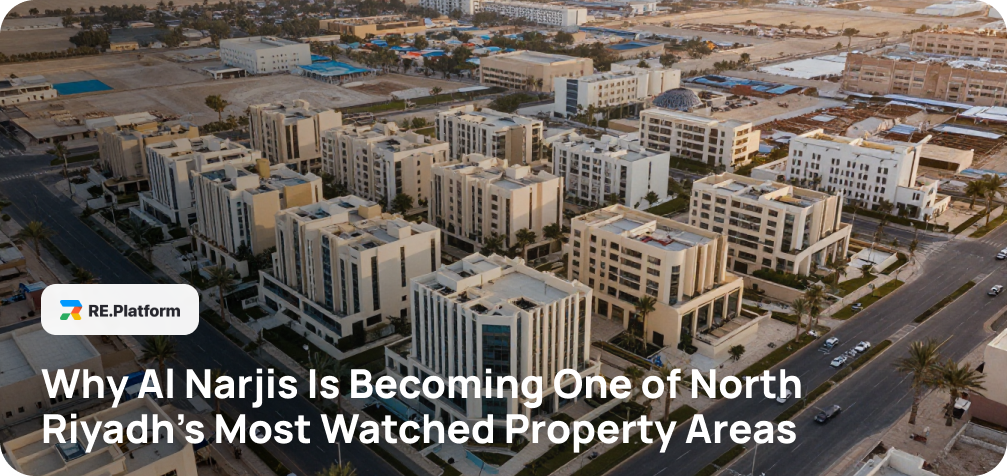
Al Narjis is one of the clearest examples of how quickly Riyadh’s residential map is changing. It is not as established in the minds of international buyers as Al Malqa or Hittin, and it does not have the central-business identity of Olaya or Al Aqiq. But that is exactly why investors have started watching it more closely.
The district sits in the northern part of the capital, close to major roads, universities, airport access, new housing projects and expanding residential communities. For residents, Al Narjis offers a practical version of North Riyadh living: newer homes, quieter streets, family-oriented layouts and access to the city’s growing northern infrastructure. For investors, the area offers something more specific — a residential market that is still developing, but already has enough real demand to be taken seriously.
That balance is what makes Al Narjis interesting in 2026. It is no longer just a distant emerging district where buyers are betting only on future growth. At the same time, it has not fully become a mature premium market where most of the upside is already priced in. Al Narjis sits between those two stages, and that is often where property buyers start paying closer attention.
Table of Contents
The Location Is the First Reason Buyers Notice Al Narjis
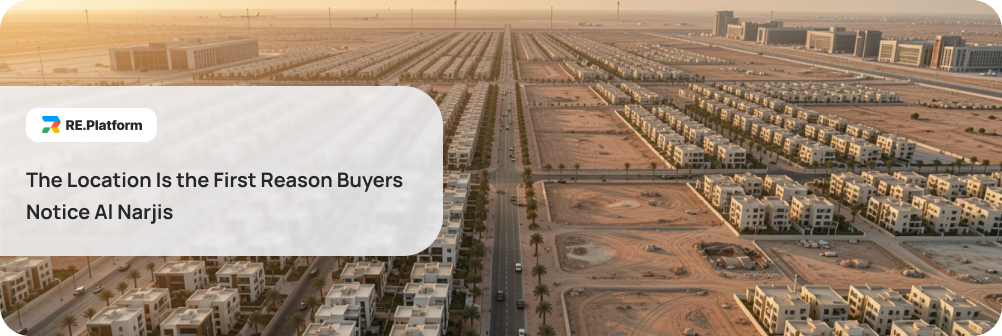
Al Narjis is located in North Riyadh, in a part of the city that has become increasingly important for both residential demand and long-term property investment. The district is commonly associated with several major road connections, including King Salman Road, Anas bin Malik Road, Abu Bakr Al-Siddiq Road and Prince Faisal bin Bandar Road.
This location gives Al Narjis a strong practical advantage. The district is close to King Khalid International Airport, Princess Nourah bint Abdulrahman University, Imam Muhammad bin Saud Islamic University, Riyadh Front and several growing residential areas such as Al Yasmin, Al Arid and Al Qirawan. It is also within reach of the broader North Riyadh business and lifestyle corridor.
Al Narjis is part of Riyadh’s northern expansion and sits close to several districts that are now central to the city’s residential growth. The map below helps show why the area is often discussed together with Al Yasmin, Al Arid, Al Qirawan, Al Malqa and other North Riyadh neighborhoods.
In a city like Riyadh, this matters. A residential district is not judged only by how the buildings look. It is judged by daily mobility: how quickly residents can reach work, schools, universities, supermarkets, clinics, airports, cafes and major roads. Al Narjis has become more attractive because it solves several of those practical problems at once.
Why Buyers Are Watching Al Narjis Now
Al Narjis has a different market story from Al Malqa. Al Malqa already feels more established and polished as a North Riyadh residential address. Al Narjis still has more of a growth-market profile. Buyers are not only looking at what the district is today. They are also looking at what it may become as northern Riyadh continues to expand.
The first reason is new housing supply. Al Narjis has a mix of apartments, villas, residential floors, duplexes, compounds and townhouse-style homes. This gives buyers more choice than in some older districts where the housing stock is less modern or more fragmented.
The second reason is relative positioning. Al Narjis sits close enough to established northern districts to benefit from the same demand corridor, but it can still offer more varied entry points depending on the exact property type and micro-location. For buyers priced out of the most mature areas, that makes the district worth comparing.
The third reason is the resident profile. Al Narjis appeals to families, professionals, university-linked households, frequent travelers and people who want North Riyadh access without necessarily paying the highest premiums found in the most established addresses. This gives the district a broader demand base than a purely speculative location.
Al Narjis is not a speculative bet on empty land. The district already has residents, housing supply, services and daily-use infrastructure. That is why investors are starting to look at it as a working residential market, not just a future-growth story.
A Residential District Built Around Practical Living
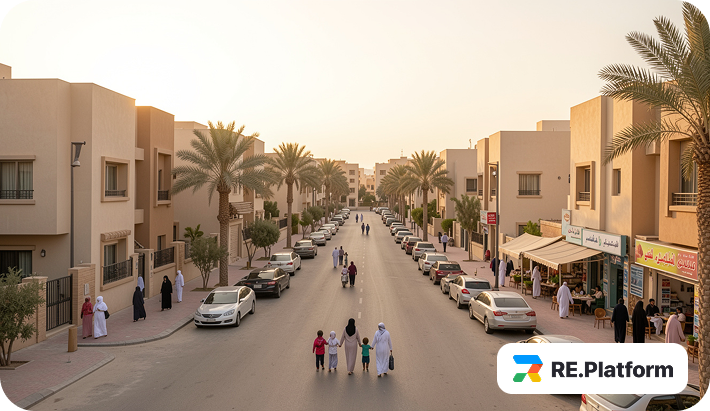
Al Narjis does not sell itself through one iconic landmark. Its appeal is more practical. It offers the kind of housing and daily environment many Riyadh residents now look for: larger spaces, newer buildings, organized streets, access to major roads and a growing set of everyday services.
The district has restaurants, cafes, supermarkets, pharmacies, fuel stations, local shops and family-oriented amenities. Some area guides mention casual dining and coffee options such as Shawarma Shaker, Al Baik, Shawarma House, Herfy, Starbucks, Tim Hortons, Overdose Cafe and Kyan Cafe in or around the district. This does not make Al Narjis a luxury lifestyle destination in the same way as Riyadh’s prime entertainment zones, but it makes everyday living easier.
There is also a quieter side to the district. Al Narjis is often chosen by people who want more space and less density than central commercial areas. That is important for families, especially those moving from older apartments or more congested neighborhoods.
For expatriates and professionals, the appeal is slightly different. Al Narjis can work as a practical base because of its airport access, road connectivity and availability of newer apartment products. It may not be the first district every newcomer knows by name, but it is becoming more relevant for people comparing North Riyadh beyond the most obvious areas.
Who Is Al Narjis Best Suited For?
Al Narjis works best for residents who want a modern North Riyadh lifestyle but still care about value. It is not a low-cost district in the broad Riyadh sense, but it may offer a more flexible market than some mature premium areas.
For families, the district is attractive because of larger apartments, villas, residential floors and access to daily services. The proximity to universities and northern road corridors also makes it practical for households with education, work and travel needs across different parts of the city.
For young professionals and couples, apartments are usually the more relevant product. Smaller units, two-bedroom apartments and modern rental stock can make Al Narjis a reasonable alternative to more expensive areas, especially when the goal is to stay in the north without choosing the most premium address.
For investors, Al Narjis is more interesting as a growth-and-demand play than a simple high-yield bet. The district has real housing demand, but the investment outcome depends heavily on entry price, layout, finishing, parking, building quality and future competition.
Property Types in Al Narjis
Al Narjis has a wider housing mix than some buyers may expect. The district includes apartments, villas, duplexes, residential floors, penthouses, townhouse-style homes and compound-style projects. This diversity is one of the reasons investors are watching the area.
Apartments are the most accessible product for many buyers. They can serve professionals, couples, smaller families and investors looking for a more liquid rental unit. Two- and three-bedroom apartments are especially important because they fit the needs of Riyadh’s family-oriented rental market while keeping the ticket size below villas.
Villas and duplexes serve a different audience. They are more relevant for families that want privacy, larger internal spaces, parking and long-term residential stability. From an investment point of view, villas may provide stronger land-backed value, but they require more capital and usually need more conservative yield assumptions.
Residential floors and penthouses are also visible in listings. These can appeal to local buyers who want larger layouts without necessarily buying a full villa. They can also work for families that need space but prefer a more flexible format than a standalone home.
| Property type | Role in Al Narjis | Best suited for |
|---|---|---|
| 1-bedroom apartments | Smaller rental and entry-level product | Professionals, singles, short-term relocations |
| 2-bedroom apartments | Practical mid-market format | Couples, investors, small families |
| 3-bedroom apartments | Strong family rental format | Families, long-term tenants, owner-occupiers |
| Residential floors | Larger layouts without full villa ownership | Saudi families, local buyers |
| Villas and duplexes | Privacy, space and family living | Larger families, high-income buyers |
| Penthouses / premium units | More exclusive apartment-style living | Buyers seeking space and status |
Buying Property in Al Narjis: Price Signals in 2026
Prices in Al Narjis vary widely because the district contains several different product categories. A compact apartment, a large residential floor, a penthouse and a villa are not part of the same price conversation.
Current market listings show apartments in Al Narjis commonly appearing around the SAR 1 million-plus range, with public listing platforms indicating average asking figures by bedroom type near SAR 1.23 million for one-bedroom apartments, around SAR 1.13 million for two-bedroom apartments and around SAR 1.27 million for three-bedroom apartments. Individual listings can move above or below these levels depending on size, finishing, parking and location.
For larger properties, the ticket rises quickly. Public listings show residential floors around SAR 1.5 million, premium floors or penthouse-style units above SAR 2.5 million and villas above SAR 4 million in some cases. This wide range is important because it shows that Al Narjis is not one simple market. It is a district with several sub-markets.
| Segment | Indicative market picture | What buyers should understand |
| Smaller apartments | Often around the SAR 1m+ range | More accessible entry into the district |
| 2-bedroom apartments | Often one of the most practical investment formats | Good balance of ticket size and rental demand |
| 3-bedroom apartments | Family-oriented product | Can work well for long-term tenants |
| Residential floors | Higher ticket and larger layouts | More relevant for local family demand |
| Villas / duplexes | Several million SAR depending on size and quality | Strong end-user appeal, but yield discipline matters |
For investors, the key question is not whether Al Narjis is cheaper or more expensive than another district. The real question is whether the property’s rent potential, layout, tenant base and future resale appeal justify the price. A well-priced two-bedroom apartment can be a better investment than a larger property bought at an inflated premium.
Renting in Al Narjis: What Tenants Should Expect
Rental listings in Al Narjis show a broad range, which reflects the district’s mix of apartments, villas, floors and compound-style products. Smaller apartments can appear at relatively accessible annual rents, while larger villas and premium homes can move into a much higher price category.
Current listings on major platforms show examples of apartments around SAR 36,000 to SAR 75,000 per year, depending on size, layout and quality. Larger or better-positioned apartments may rent at higher levels. Villas and townhouses are a different category, with visible listings around SAR 110,000 to SAR 170,000 per year and above, depending on land size, furnishing, number of bedrooms and whether the property is part of a compound or standalone format.
| Rental product | Indicative annual range | Practical reading |
| Studio / 1-bedroom apartment | Around SAR 36,000–60,000+ | Most accessible rental format |
| 2-bedroom apartment | Around SAR 50,000–80,000+ | Strong fit for couples and small families |
| 3-bedroom apartment | Around SAR 55,000–110,000+ | Family-oriented and more variable |
| Residential floor | Often higher than standard apartments | Depends heavily on size and finishing |
| Townhouse / small villa | Around SAR 110,000–170,000+ | More space and privacy |
| Larger villa / compound unit | Can move higher | Narrower tenant pool but higher absolute rent |
These are not fixed rates. Furnishing, building age, parking, location inside the district, proximity to major roads and service quality all affect pricing. A furnished apartment with modern finishing can rent very differently from a basic unfurnished unit of similar size.
For landlords, the important point is that Al Narjis has demand across several renter profiles. That can help reduce vacancy risk, but only if the unit is priced realistically.
Utilities, Service Costs and Housing Expenses
Al Narjis is still Riyadh, and Riyadh’s climate shapes housing costs. Electricity is one of the most important recurring expenses because air conditioning can be heavily used for much of the year. A compact apartment is usually more predictable, while a villa or large floor can have much higher cooling costs.
Water, internet and mobile plans are usually more manageable, but they still need to be included in the budget. Tenants should also check whether maintenance, service charges, cleaning, parking or compound amenities are included in the rent. Owners need to be even more careful because recurring repairs, building management and service costs directly affect net yield.
For investors, this is where the difference between gross and net return becomes important. A property may look attractive based on annual rent, but the actual return is lower after vacancy, maintenance, service fees, furnishing costs and management.
| Cost category | Why it matters in Al Narjis |
| Electricity | Summer cooling can be a major monthly cost |
| Water | Usually manageable, but larger homes cost more |
| Internet and mobile | Predictable, but varies by plan |
| Maintenance | Important for villas, floors and furnished units |
| Service fees | Relevant for compounds and managed buildings |
| Furnishing | Can increase rent, but raises upkeep costs |
| Parking | Affects rentability, especially for families |
Everyday Cost of Living in Al Narjis
The cost of living in Al Narjis depends on lifestyle more than the district itself. A family with private schooling, two cars, frequent dining out and premium groceries will spend much more than a single professional renting a smaller apartment and using local shops.
Grocery access is practical, with supermarkets, local stores and delivery options available in and around the district. Dining is also accessible, with casual restaurants, coffee shops and food delivery services supporting daily convenience. Al Narjis is not a district where residents need to drive across the city for every basic need.
Transport remains a major part of the budget. Riyadh is still largely car-based, and residents should think about commute patterns before choosing a property. The district’s road access is a strength, but daily travel time will still depend on exact workplace, school location and traffic conditions.
| Monthly cost item | Practical interpretation |
| Groceries | Flexible; local products keep costs lower |
| Dining and cafes | Casual options are available, premium spending can add up |
| Transport | Car ownership or ride-hailing often required |
| Utilities | Higher during hot months |
| Healthcare | Clinics and hospitals are accessible by car |
| Schools | One of the largest costs for families |
| Lifestyle | Gym, cafes, delivery and services vary by household |
Al Narjis is best understood as a practical modern residential district rather than a luxury-only area. It gives residents access to North Riyadh living without necessarily forcing them into the highest premium tier of the market.
Schools, Universities and Healthcare Access
One of the biggest advantages of Al Narjis is its proximity to education and healthcare infrastructure in northern Riyadh. The district is close to Princess Nourah bint Abdulrahman University and Imam Muhammad bin Saud Islamic University, both of which influence the wider area’s activity and housing demand.
School access also matters. Families choosing Al Narjis often look at nearby schools and nurseries across the district and surrounding neighborhoods. Some school directories list multiple schools in An Narjis, and residents can also access education options in nearby northern districts.
Healthcare access is practical as well. Residents can reach clinics, pharmacies and hospitals across North Riyadh, with some residential project materials highlighting access to Kingdom Hospital and other facilities within a reasonable drive. For families and expatriates, this type of service density makes the district more livable.
This is one reason Al Narjis should not be treated as a speculative fringe area. It has actual daily-use infrastructure around it, and that supports long-term residential demand.
Al Narjis vs Nearby Districts

Al Narjis should not be evaluated alone. Buyers usually compare it with Al Malqa, Al Yasmin, Al Arid, Al Aqiq, Hittin and Al Qirawan. Each district has a different role in the North Riyadh market.
| Area | Best known for | Compared with Al Narjis |
| Al Malqa | Established North Riyadh lifestyle, modern apartments and villas | Often feels more established and polished |
| Hittin | Premium family living and high-end villas | More premium, usually higher entry expectations |
| Al Yasmin | Family-oriented residential living | Similar family appeal, sometimes more established in perception |
| Al Aqiq | Business access and KAFD-linked demand | More tied to professional and commercial demand |
| Al Arid | Emerging residential growth and wider land availability | May offer more value-oriented opportunities |
| Al Qirawan | North-western family housing and villa demand | Can appeal to buyers seeking space and newer communities |
Al Narjis sits between emerging and established. That is its main investment identity. It is not as mature as Al Malqa or Hittin, but it is also not a remote bet with no infrastructure. For investors, that middle position can be attractive if the entry price is right.
Why Investors Are Paying Attention
The investment case for Al Narjis is built on five factors: location, new supply, family demand, rental diversity and northern Riyadh expansion.
The location gives residents access to key roads, airport connections, universities and nearby districts. The housing supply gives buyers a choice between apartments, floors, villas and compounds. The family demand supports long-term occupancy. The rental diversity gives investors different strategies, from smaller apartments to larger villa products. The wider North Riyadh market gives the district a clear long-term narrative.
However, investors should not confuse “watched” with “guaranteed.” A district can be promising and still produce poor returns if the wrong unit is bought at the wrong price. Al Narjis requires the same discipline as any other growth market: compare similar listings, check real rent levels, account for vacancy, understand service costs and avoid paying only for future expectations.
The most attractive opportunities are likely to be practical units with clear demand. In many cases, that means well-designed apartments with parking, good finishing and realistic rent expectations. Villas can also be strong assets, but they require a longer-term view and a more careful calculation of rental yield.
How the Riyadh Rent Freeze Changes the Investor View
Riyadh’s rental market changed after the government introduced a five-year rent freeze in the capital. This matters for Al Narjis because the district sits in a city where rents had risen rapidly and affordability became a policy issue.
For tenants, the freeze can improve predictability. For landlords, it changes how rental growth should be modeled. Investors can no longer simply assume that rent will keep rising aggressively every year. The property needs to work at today’s achievable rent, with future upside treated carefully.
This does not make Al Narjis unattractive. A more stable rental environment may support tenant retention and reduce volatility. But it does mean investors must focus more on purchase price, unit quality, occupancy and long-term resale value.
What Could Support Future Growth in Al Narjis?
Al Narjis has several factors that may support future demand.
First, North Riyadh remains one of the capital’s most important residential growth directions. As the city expands and more households look for modern housing, districts with available stock and good road access can benefit.
Second, the district is close to major education and travel infrastructure. Proximity to universities and airport access can support demand from students, faculty, professionals, frequent travelers and families.
Third, new residential projects continue to shape the district’s identity. Projects with apartments, duplexes and villa-style products help bring more modern housing supply into the area. This can make Al Narjis more recognizable for buyers who previously focused only on more established districts.
What Are the Main Risks?
The first risk is oversupply in certain property categories. Al Narjis has new stock, and new stock is attractive, but if too many similar units enter the market at once, weaker apartments may face pressure.
The second risk is overpricing. Some sellers may price properties based on the general hype around North Riyadh rather than the actual rent or resale value of the unit. Investors need to compare unit-level data, not just district reputation.
The third risk is infrastructure timing. Growth districts can look strong on paper, but daily life depends on roads, services, traffic, schools, healthcare and retail. Buyers should inspect the exact micro-location before committing.
The fourth risk is yield compression. If purchase prices rise faster than rents, the district may remain popular but become less attractive from a cash-flow perspective.
The fifth risk is regulatory uncertainty for foreign buyers. International investors need to verify current ownership rules, transaction procedures, eligibility and exit options before assuming that every property is accessible.
Is Al Narjis Better for Living or Investing?
Al Narjis can work for both, but the answer depends on the property type and buyer profile.
For residents, Al Narjis is attractive because it offers a modern northern lifestyle with road access, family housing and a growing service base. It is especially relevant for people who want space, newer buildings and proximity to airport-side and university-side infrastructure.
For investors, Al Narjis is more of a growth-market play than a pure premium-address play. The district may offer more room for selective buying than fully established areas, but that also means property selection matters more. A strong unit can benefit from the district’s growth. A weak unit can get lost in a competitive supply pipeline.
Apartments usually make the most sense for investors looking for liquidity and a wider tenant base. Villas and floors may be better for long-term buyers who prioritize family demand and capital value.
Final Thoughts: Why Al Narjis Deserves a Closer Look
Al Narjis is becoming one of North Riyadh’s most watched property areas because it sits at the intersection of real demand and future growth. It is not just a name attached to northern expansion. It has housing supply, road access, nearby universities, airport connectivity, family demand and a growing lifestyle base.
For residents, the district offers a practical modern lifestyle. For buyers, it offers several property formats, from apartments to villas. For investors, it offers a market that is already active but still evolving.
The key is discipline. Al Narjis is not attractive because every property there is a guaranteed winner. It is attractive because the district has the ingredients investors look for: location, demand, infrastructure and future relevance. The best opportunities will come from properties where those ingredients are matched with a realistic entry price.
In 2026, Al Narjis is no longer just an emerging district on the edge of North Riyadh’s growth story. It is becoming one of the areas where buyers are trying to understand what the next phase of the city’s residential market may look like.