Browse by category


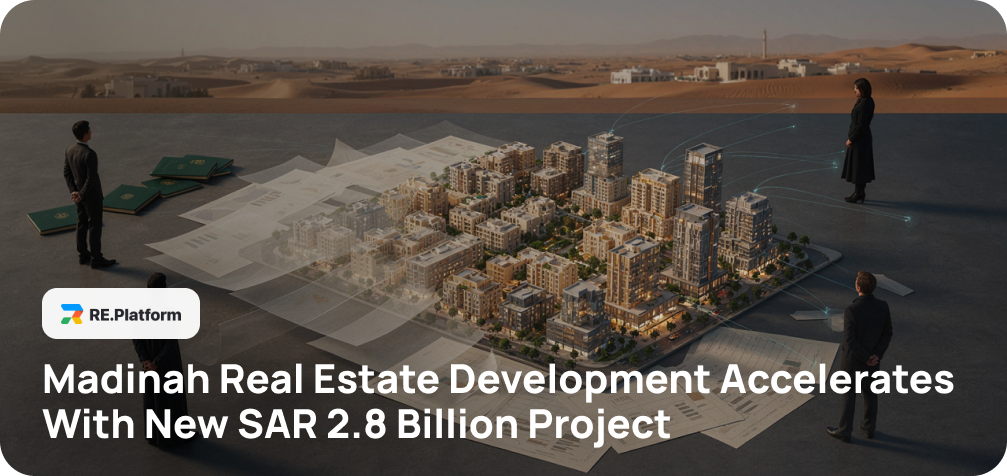
A new SAR 2.8 billion residential development is moving forward in Madinah, adding approximately 2,700 apartments to the growing pipeline inside Knowledge Economic City.
Knowledge Economic City Company, Dar Al Majed Real Estate Company, also known as Al Majdiah, and Capital Hill signed a memorandum of understanding on September 14, 2026, establishing the initial investment and development framework for the project.
The development is planned on approximately 97,000 square meters of developable land and will combine residential apartments for sale with ground-floor commercial space.
More importantly for the direction of the Madinah property market, Knowledge Economic City says the project is expected to primarily target non-Saudi Muslim buyers under Saudi Arabia’s recently introduced framework for real estate ownership by non-Saudis. Saudi Exchange
That gives the project relevance far beyond its SAR 2.8 billion development cost.
It provides an early indication of how large Saudi developers may begin adapting new housing projects to the opening of the Kingdom’s property market to international buyers.
Table of Contents
What Is the New SAR 2.8 Billion Madinah Project?
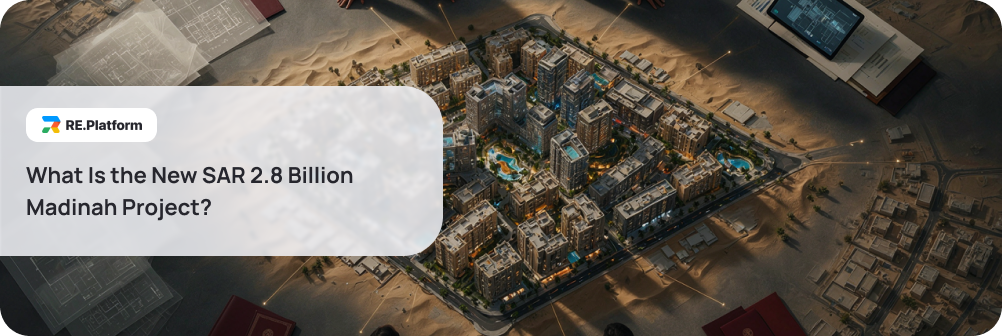
The proposed Knowledge Economic City project is a SAR 2.8 billion mixed-use residential development in Madinah with around 2,700 apartments, 8,000 square meters of commercial space and more than 3,500 parking spaces. Knowledge Economic City expects revenues from the development to exceed SAR 4 billion. Saudi Exchange
The project is located within Knowledge Economic City and adjacent to the Multaqa AlMadinah development. According to the preliminary plan, most of the scheme will consist of apartments intended for sale. A ground-floor commercial component will provide approximately 8,000 square meters of net leasable area. That commercial space is expected to be leased and operated until stabilization before being sold as part of the planned investment exit strategy.
Key Project Figures
| Project Detail | Planned Scale |
|---|---|
| Preliminary development cost | Approx. SAR 2.8 billion |
| Expected revenue | More than SAR 4 billion |
| Developable land | Approx. 97,000 sqm |
| Residential apartments | Approx. 2,700 |
| Commercial NLA | Approx. 8,000 sqm |
| Parking spaces | More than 3,500 |
| KEC fund ownership | Approx. 80% |
| Al Majdiah fund ownership | Approx. 20% |
| Initial land value | Approx. SAR 875.4 million |
The development remains at the MoU stage, meaning the announced structure is preliminary and final commercial obligations depend on definitive agreements and regulatory approvals.
That distinction matters: this is a planned project moving through formal structuring, not a completed investment transaction.
The Project Will Use a Closed-Ended Real Estate Fund
The financing structure is one of the most interesting parts of the announcement.
Rather than developing the project directly through a conventional bilateral partnership, the three parties intend to establish a closed-ended real estate investment fund regulated under Saudi Capital Market Authority rules. Knowledge Economic City will contribute the development land as an in-kind investment. Al Majdiah will provide cash, participate as an investor and serve as development manager. Capital Hill will establish and manage the proposed investment fund.
Under the preliminary structure, Knowledge Economic City is expected to hold approximately 80% of the fund units, while Al Majdiah will own around 20%. The project land has initially been valued at approximately SAR 875.4 million.
KEC is expected to receive SAR 89 million in cash from Al Majdiah against part of its interest in the land, with the remaining approximately SAR 786.4 million represented by units in the new fund. This institutional structure is notable because it shows how Saudi developers are increasingly combining land contributions, private development expertise and capital-market financing.
As the scale of Saudi Arabia’s real estate pipeline grows, projects are becoming more complex not only architecturally, but financially.
2,700 New Apartments Are Planned for Madinah
The residential component is significant even by the standards of the Kingdom’s current development cycle. Approximately 2,700 apartments are included in the preliminary program.
Rather than a single housing type, the project is expected to offer apartments across different sizes and room configurations. Saudi Exchange
That variety will be important if the developers intend to target both local demand and international Muslim buyers. Madinah has a very different residential profile from Riyadh. The city combines conventional local housing demand with religious tourism, hospitality, investment property and demand connected to visitors who maintain a long-term relationship with the city. For years, that international demand could not translate freely into direct residential ownership.
Changes to Saudi property ownership rules are beginning to alter that equation.
The Project Is Expected to Target Non-Saudi Muslim Buyers
This is perhaps the most important detail in the entire announcement.
Knowledge Economic City explicitly stated that the project is expected to primarily target non-Saudi Muslim buyers, in line with the recently issued Law of Real Estate Ownership by Non-Saudis.
For Madinah, that creates a distinct real estate opportunity. The city is one of the most globally recognized destinations in Saudi Arabia, but its property market operates under different sensitivities and restrictions from ordinary residential markets. International Muslim demand is potentially very large, but actual access depends on the designated geographic areas, implementation rules and applicable ownership restrictions.
This means investors should not interpret the project announcement as permission for unrestricted foreign property ownership across Madinah. Instead, it shows how developers are preparing projects specifically around the new regulatory framework. That is a meaningful change.
Foreign ownership is moving from theoretical legislation into actual development planning.
Madinah Is Becoming a Larger Real Estate Development Market
The new project also arrives during a broader expansion of development activity in Madinah.
Knowledge Economic City has been advancing several residential, hospitality and mixed-use developments rather than relying on a single project. The company describes the latest agreement as part of its strategy to accelerate the development and monetization of its land bank through partnerships with specialist developers and institutional investment structures.
The SAR 2.8 billion project will sit close to Multaqa AlMadinah and connect with other planned components of Knowledge Economic City. Earlier in September, KEC also signed a memorandum with Kaden Investment to develop Multaqa AlMadinah 2, an extension of the existing mixed-use destination. Taken together, the announcements show development beginning to form at district scale.
Rather than isolated apartment buildings or hotels, Knowledge Economic City is assembling residential, hospitality, retail, commercial and public-use components within a larger urban destination.
The Development Connects With a Much Larger KEC Pipeline
The new residential project is only one component of Knowledge Economic City’s current development strategy.
KEC’s existing and planned portfolio includes Al-Alyaa 1, which the company says will contain 630 hospitality units, including Hyatt Centric hotel keys and Hyatt House serviced apartments. The same development also includes around 1,420 residential apartments, 70 connected villas, approximately 29,000 square meters of commercial space, a central park, a mosque and educational facilities.
This wider pipeline matters because it changes the context of the new 2,700-unit project. The apartments are not being proposed in an undeveloped location with no surrounding ecosystem. They are intended to become part of an increasingly dense mixed-use district with hospitality, retail, education and other residential supply nearby.
For buyers, that kind of integration can be more relevant than the size of an individual building.
Why the SAR 4 Billion Revenue Target Matters
Knowledge Economic City estimates that the project could generate more than SAR 4 billion in revenue against a preliminary development cost of approximately SAR 2.8 billion. Saudi Exchange
Those figures should not be interpreted as guaranteed profitability. The SAR 2.8 billion figure is preliminary and excludes fund fees and related expenses, while eventual revenue will depend on execution, pricing, absorption and the final product mix. Still, the scale gives an indication of how the developers are positioning the scheme.
This is not intended as affordable mass housing alone. A revenue expectation above SAR 4 billion across approximately 2,700 apartments plus the commercial component suggests a project designed around meaningful residential sales value.
The potential participation of international Muslim buyers could become an important part of achieving that sales volume.
Foreign Ownership Could Change Madinah’s Residential Market
Saudi Arabia’s foreign property ownership reforms have been discussed largely through the lens of Riyadh, Jeddah and international investment. Madinah may ultimately develop a different model. Demand in the city is closely linked to religious significance rather than only employment, lifestyle or conventional investment return.
That creates a potential group of international buyers whose motivation differs from buyers considering a Riyadh apartment or a Jeddah waterfront property. Some may be looking for long-term personal access to the city.
Others may be considering residential property as part of a family or investment strategy. The new Knowledge Economic City project appears to be designed with that international demand explicitly in mind.
If successful, it could become an early example of how Saudi Arabia’s new ownership framework translates into actual residential product.
Why Knowledge Economic City Is Important for Madinah
Knowledge Economic City is strategically located within Madinah and was conceived as a large mixed-use urban development rather than a single real estate project.
Its current direction increasingly combines residential property with hotels, serviced apartments, retail, offices, education and public space. This model gives developers several sources of demand. Residents support retail and services. Visitors create hospitality demand. Commercial uses generate daytime activity.
And international property buyers can potentially add a new source of residential demand as ownership rules evolve. The result is closer to an integrated urban district than a conventional housing compound.
For Madinah, projects of this scale could gradually expand the property market beyond traditional local housing and hospitality.
What Happens Next?
The parties now need to move from the memorandum of understanding to definitive agreements. The proposed investment fund must also satisfy the applicable regulatory requirements.
Until those steps are completed, the current project structure should be treated as preliminary. Detailed information on apartment prices, unit mix, construction schedule, sales launch and completion dates has not yet been announced. Those details will ultimately determine how accessible the project is to local and international buyers.
The most important signal is already visible, however. A major Saudi developer and a listed Madinah master developer are preparing approximately 2,700 apartments within a project explicitly expected to target non-Saudi Muslim buyers.
That connects three of the most significant changes taking place in Saudi real estate today: large-scale urban development, institutional investment structures and the opening of selected parts of the property market to international ownership.
Madinah Real Estate Is Entering a New Phase
For much of the recent Saudi property cycle, Riyadh has attracted the largest share of attention.
The capital remains the Kingdom’s dominant commercial and residential growth market. Madinah is developing on a different trajectory. Its real estate expansion is increasingly tied to tourism growth, religious visitation, hospitality capacity, integrated developments and new forms of international property demand.
The proposed SAR 2.8 billion Knowledge Economic City project captures all of these trends within one development. If the final agreements proceed as planned, it will add thousands of apartments to Madinah’s supply while creating one of the clearest early tests of international Muslim demand under Saudi Arabia’s new foreign ownership regime.
That makes the development considerably more important than its unit count alone suggests.
FAQ
What is the new SAR 2.8 billion Madinah real estate project?
It is a proposed residential and commercial development inside Knowledge Economic City involving KEC, Dar Al Majed Real Estate Company and Capital Hill. The project is expected to cost approximately SAR 2.8 billion. Saudi Exchange
How many apartments are planned?
The preliminary plan includes approximately 2,700 apartments for sale in different sizes and configurations.
Where will the project be built?
It will be developed on around 97,000 square meters of land within Knowledge Economic City in Madinah, adjacent to the Multaqa AlMadinah development.
Can foreigners buy apartments in the project?
Knowledge Economic City says the development is expected to primarily target non-Saudi Muslim buyers under the recently issued Saudi real estate ownership framework for non-Saudis. Eligibility will still depend on the applicable regulations and designated ownership rules. Saudi Exchange
How much revenue is the project expected to generate?
Knowledge Economic City currently expects project revenue to exceed SAR 4 billion. The estimate is preliminary and the development remains subject to final agreements and regulatory requirements.
Who will develop the project?
Al Majdiah is expected to participate as investor and development manager. Knowledge Economic City will contribute the land, while Capital Hill is expected to establish and manage the closed-ended real estate investment fund.
Is construction already underway?
The disclosed agreement is currently a memorandum of understanding establishing the preliminary commercial and investment framework. Final binding agreements and regulatory requirements still need to be completed.