Browse by category


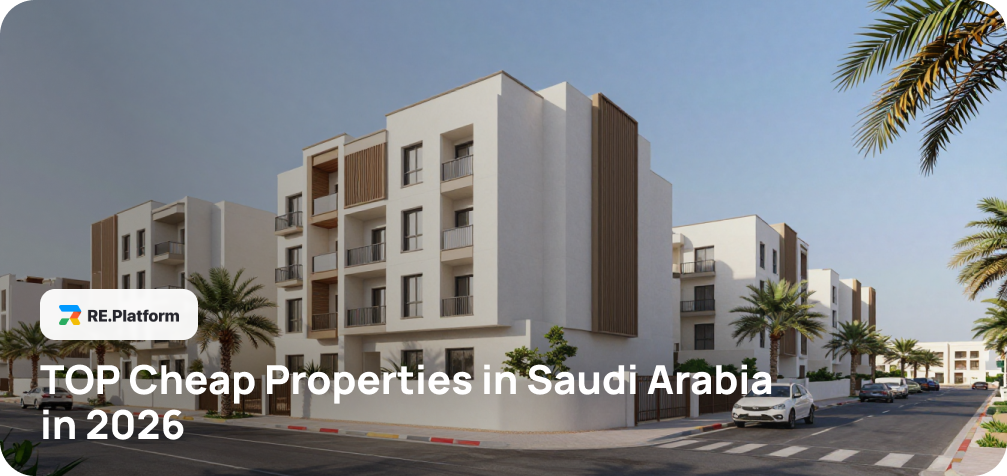
For years, Saudi Arabia’s property market was presented almost exclusively through the lens of luxury. International headlines focused on billion-dollar megaprojects, branded residences, futuristic towers in Riyadh, and ultra-premium developments tied to Vision 2030. From the outside, it created the impression that Saudi real estate had already become another high-priced Gulf market designed primarily for institutional capital and wealthy investors.
But the reality on the ground in 2026 is far more nuanced.
Saudi Arabia still remains one of the few rapidly growing economies where affordable real estate exists at scale across multiple major cities. Not “cheap” in the sense of distressed or collapsing markets, but genuinely accessible housing in cities with expanding infrastructure, rising populations, and long-term economic momentum.
That distinction matters.
Because the Kingdom is now entering a very unusual phase of urban development: premium districts in Riyadh are beginning to price like mature international markets, while entire secondary zones across the country still trade at valuations that feel disconnected from the scale of transformation taking place around them.
This creates a widening split inside the Saudi housing market.
One Saudi Arabia is selling branded penthouses to global investors.
The other is quietly offering apartments, villas, and townhouses at prices that no longer exist in comparable growth economies.
And increasingly, smart buyers are starting to notice the gap.
Table of Contents
Why Affordable Property Still Exists in Saudi Arabia
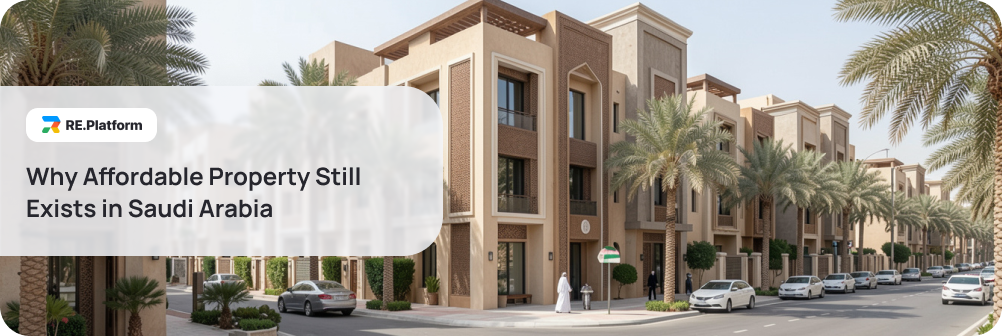
To understand where the cheapest real estate opportunities remain, it is important to understand why Saudi Arabia never developed the same structural pricing pressure seen in cities like Dubai, London, or Singapore.
The Kingdom still has enormous expansion capacity.
Riyadh alone continues pushing outward through new residential corridors, while secondary cities such as Dammam, Khobar, Medina, Abha, and parts of Jeddah are still actively growing into available land rather than competing over heavily constrained urban cores.
At the same time, the market historically remained dominated by domestic ownership rather than speculative international investment. That matters because pricing in many districts is still tied more closely to local purchasing power than to global capital flows.
But this balance is starting to change.
The arrival of regional headquarters into Riyadh, increasing foreign ownership discussions, infrastructure megaprojects, and rapid population growth are beginning to reshape pricing dynamics across the Kingdom.
The result is a market where affordable property still exists — but increasingly in selective pockets rather than everywhere.
And the cities where value remains strongest are not always the ones receiving the most international attention.
Riyadh: The Cheapest Housing Is No Longer in the “New Riyadh”
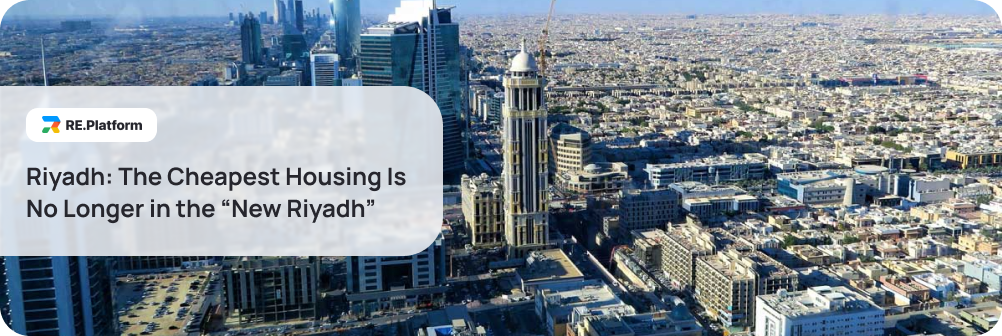
Riyadh dominates Saudi Arabia’s economic story, but it is also the clearest example of how quickly affordability can disappear once infrastructure, capital, and migration converge in the same city.
Five years ago, many northern districts still felt relatively accessible compared to Dubai or Doha. In 2026, that conversation has changed dramatically.
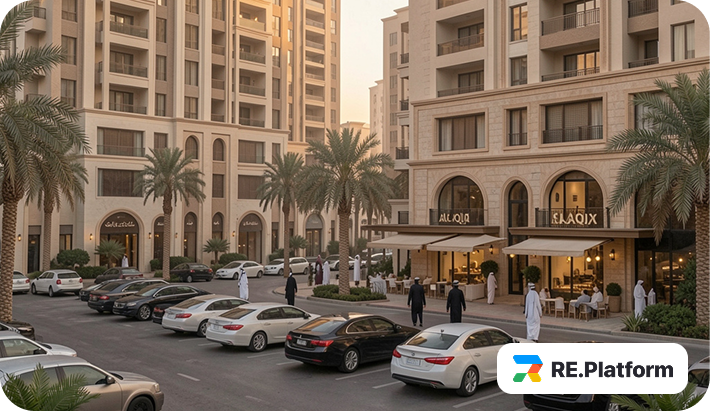
Areas such as Hittin, Al Nakheel, Al Malqa, and zones near KAFD have already moved firmly into premium territory. In some parts of North Riyadh, apartment prices increased faster than many analysts expected, driven by the influx of multinational companies and high-income professionals relocating into the capital.
But this does not mean Riyadh became universally expensive.
Affordable property still exists — just not in the image most international investors associate with Riyadh.
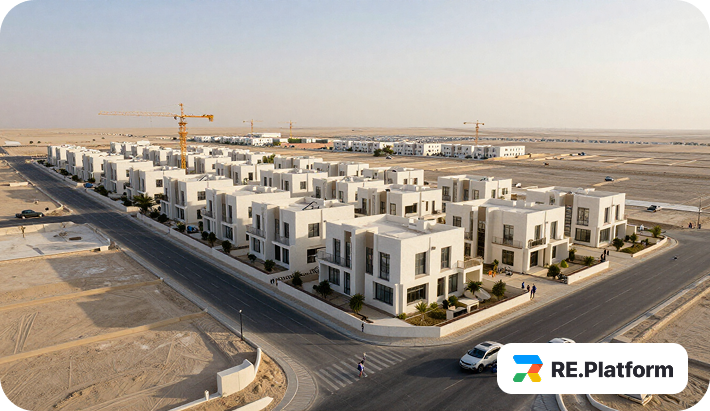
The cheapest opportunities increasingly appear in southern Riyadh, eastern districts, and suburban expansion corridors where developers continue building housing aimed at middle-income Saudi families rather than executive expats.
In these districts, buyers can still find modern apartments starting around SAR 250,000–500,000 depending on size and location. Older apartment inventory sometimes trades even lower, especially farther from metro-connected corridors.
What makes Riyadh unusual is that even its lower-cost districts still benefit from the city’s broader economic gravity. Population growth, government spending, and job creation continue supporting baseline housing demand across most of the capital.
That gives affordable Riyadh property a characteristic many cheap markets globally often lack: liquidity.
The challenge is timing. Affordable Riyadh is disappearing quickly.
Jeddah: Better Lifestyle Value, Slower Price Pressure
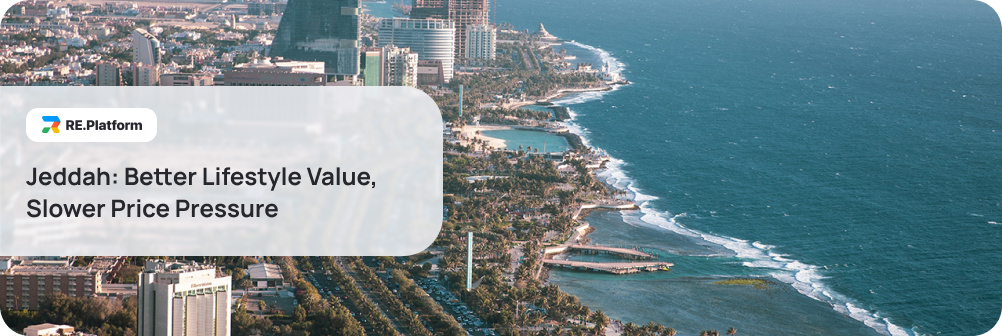
If Riyadh feels like Saudi Arabia’s financial engine, Jeddah operates more like its lifestyle capital.
The city moves differently. It is less corporate, less aggressive, more coastal, and psychologically more relaxed. That difference heavily affects the housing market.
While Jeddah has expensive waterfront zones and luxury districts, affordable housing remains significantly more accessible than many outsiders expect — especially outside the immediate Red Sea premium corridors.
And unlike Riyadh, where affordability often means sacrificing lifestyle infrastructure, lower-cost districts in Jeddah can still offer a relatively comfortable urban experience.
This is one reason many expatriates quietly prefer Jeddah despite Riyadh’s stronger salaries.
The city offers better lifestyle efficiency per dollar spent.
In several middle-market districts, modern apartments remain available between SAR 300,000 and SAR 650,000 depending on proximity to the coast, age of inventory, and infrastructure quality. Rental yields also remain attractive in selected areas because of steady population demand and lower acquisition costs.
But Jeddah’s affordability comes with its own tradeoff.
The market historically moves slower than Riyadh.
Price appreciation tends to be less explosive, and some districts remain highly fragmented in quality. Two neighborhoods located relatively close to each other can feel economically worlds apart.
That means buyers in Jeddah must pay closer attention to micro-location than headline city pricing.
Dammam and Al Khobar: The Most Underrated Affordable Markets in Saudi Arabia
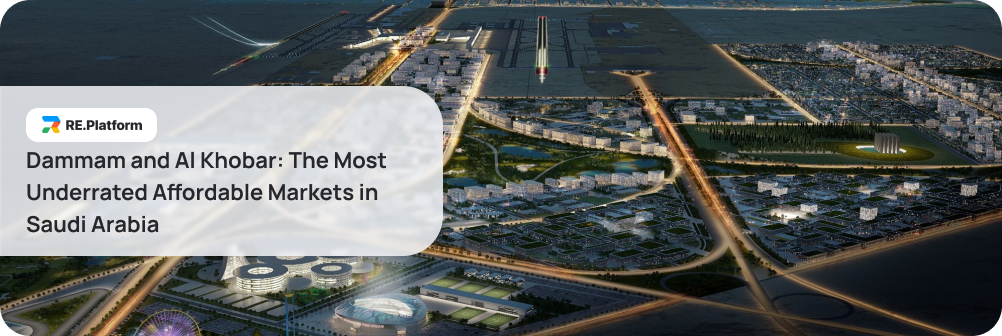
While Riyadh and Jeddah dominate international attention, the Eastern Province may quietly contain some of the strongest value opportunities in the Kingdom.
Dammam and Al Khobar operate under a different economic model than the western and central regions. Their housing markets are heavily connected to energy, logistics, engineering, and industrial sectors rather than purely government expansion and finance.
That creates more pricing stability — and in many cases, surprisingly reasonable property costs relative to infrastructure quality.
For buyers coming from major international cities, Al Khobar in particular often feels underpriced.
The city offers:
- modern infrastructure;
- strong road networks;
- relatively organized urban planning;
- proximity to Bahrain;
- coastal access;
- a large expat population;
- established retail and healthcare systems.
Yet apartment prices in many districts still remain below equivalent residential zones in Riyadh.
Well-positioned apartments can still be found in the SAR 350,000–700,000 range, while family villas in secondary districts remain dramatically cheaper than comparable northern Riyadh inventory.
More importantly, Eastern Province markets often behave more rationally than overheated capital-city markets.
Speculative volatility is lower. That matters for buyers prioritizing stability over hype.
Medina: One of the Most Misunderstood Property Markets in the Kingdom
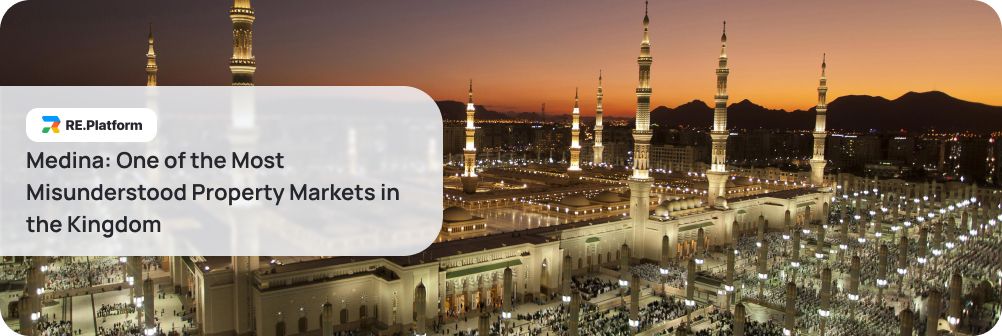
Medina rarely appears in conversations about affordable investment property.
That is precisely why it deserves attention.
The city’s real estate market operates differently from Riyadh, Jeddah, or the Eastern Province because religious tourism heavily influences pricing patterns. Premium areas surrounding the Prophet’s Mosque remain extremely expensive, but large sections of the broader residential market remain surprisingly accessible.
Outside ultra-central religious zones, buyers can still find apartments at price levels that increasingly feel impossible in larger economic hubs.
At the same time, Medina benefits from something many secondary Saudi cities lack: permanent global relevance.
The city will continue attracting infrastructure spending, transportation investment, and tourism growth for decades.
The market is not explosive. But it is structurally resilient. For conservative long-term buyers, that matters more than speculative upside.
Abha and Secondary Cities: Cheap for a Reason — But Not Always Bad Reasons
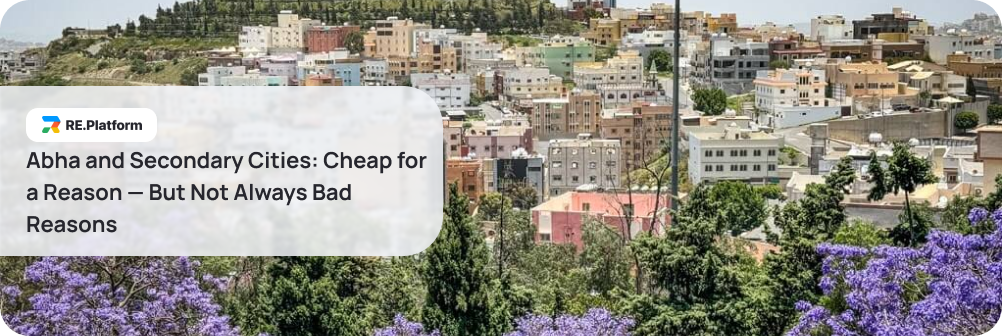
The cheapest property in Saudi Arabia often exists in secondary or less internationally recognized cities.
Abha, Tabuk, Hail, and parts of the southern regions can offer extremely low entry prices compared to Riyadh or Jeddah. In some areas, apartment pricing still resembles markets from a decade ago.
But buyers need to separate two completely different categories of “cheap.”
Some areas are cheap because they are underdeveloped, economically stagnant, or disconnected from long-term growth drivers. Others are cheap because global capital simply has not arrived yet.
That distinction is critical. Abha is a good example of the second category.
The city benefits from cooler climate conditions, growing domestic tourism, and increasing government attention toward regional diversification. Property remains inexpensive relative to larger Saudi cities, but the long-term development trajectory is far stronger than many outsiders assume.
Still, secondary-city investing in Saudi Arabia requires patience. These are not rapid-flip markets.
They are long-duration urban growth stories.
Describe what you are interested in and we will contact you.
Do you have a real estate question?
The Biggest Mistake Foreign Buyers Make
One of the most common mistakes foreign investors make when entering the Saudi property market is treating the Kingdom as if it were a simplified version of Dubai.
On the surface, the comparison seems logical. Both markets are tied to Gulf economies, large-scale urban development, foreign capital, and rapidly expanding infrastructure. But once buyers begin looking deeper, the differences become obvious — and expensive.
Saudi Arabia is not a single unified real estate market moving in one direction. It is a collection of entirely different urban economies, each evolving at its own speed and according to its own logic.
Affordable property in Riyadh behaves differently from affordable property in Jeddah. A low-cost apartment in Dammam serves a completely different type of demand than a budget villa in Medina or a speculative development in Abha. Even inside the same city, two districts with similar pricing can produce entirely different long-term outcomes depending on infrastructure, demographics, transportation access, and future development plans.
This is where many foreign buyers oversimplify the market.
They focus too heavily on headline pricing and not enough on why certain areas remain affordable in the first place.
In some cases, lower pricing reflects genuine long-term opportunity. Infrastructure has not fully arrived yet, international attention remains limited, and the area is still early in its growth cycle. In other cases, cheap pricing simply reflects weak economic activity, low liquidity, oversupply, or limited long-term demand.
Those are not the same thing.
The smartest investors entering Saudi Arabia in 2026 are no longer searching for the absolute cheapest square meter. They are searching for pricing inefficiencies — districts where current values still lag behind the scale of future transformation happening around them.
That requires looking beyond marketing brochures and glossy renderings.
- Is the district connected to future metro expansion?
- Are major employers moving nearby?
- Is the population growing?
- Are new schools, retail centers, and infrastructure projects being built around the area?
- Is the market attracting long-term residents or only speculative interest?
These questions matter far more than whether an apartment is SAR 100,000 cheaper today.
Because in Saudi Arabia’s current phase of urban development, the difference between “cheap because undervalued” and “cheap because stagnant” will define which properties actually perform over the next decade.
So Where Are Saudi Arabia’s Best Affordable Property Opportunities in 2026?
To better understand where real value still exists in the Saudi real estate market, the table below compares approximate entry-level residential pricing across the Kingdom’s main cities and emerging residential zones. These figures reflect average market conditions in early 2026 for modern apartments and entry-level family housing in livable districts rather than distressed or outdated inventory.
| City / Area | Entry-Level Apartment Prices | Affordable Villa Prices | What Buyers Typically Get |
|---|---|---|---|
| South Riyadh | SAR 250,000–500,000 | SAR 750,000–1.5M | Large suburban housing, growing infrastructure |
| East Riyadh | SAR 300,000–550,000 | SAR 850,000–1.8M | Mid-market residential communities |
| Jeddah (non-waterfront) | SAR 350,000–650,000 | SAR 1M–2.2M | Better lifestyle value near urban zones |
| Dammam | SAR 280,000–550,000 | SAR 700,000–1.6M | Stable market with lower entry costs |
| Al Khobar (secondary districts) | SAR 350,000–700,000 | SAR 1.2M–2M | Higher-quality Eastern Province housing |
| Medina (outside central zones) | SAR 250,000–500,000 | SAR 800,000–1.7M | Religious city with long-term stability |
| Abha | SAR 200,000–450,000 | SAR 650,000–1.3M | Cooler climate and emerging tourism demand |
| Hail / secondary cities | SAR 180,000–400,000 | SAR 500,000–1.1M | Lowest entry prices in major urban markets |
The most interesting part of Saudi Arabia’s real estate market in 2026 is not the luxury segment that dominates international headlines. Everyone already knows about Riyadh’s skyscrapers, branded residences, and billion-dollar megaprojects. The more important story is happening underneath that premium layer — in the parts of the market where affordability and long-term growth still exist at the same time.
That combination becomes increasingly rare once a country enters a full-scale economic transformation cycle.
Saudi Arabia is still at a stage where buyers can find modern apartments, family villas, and livable residential communities at prices that would feel almost impossible in comparable high-growth economies. In many districts across Riyadh, Jeddah, Dammam, Medina, and secondary cities, entry-level housing remains accessible not because the market is weak, but because the Kingdom is still early in its broader urban expansion story.
The more important question now is which cities and districts will still look undervalued five years from today — and which buyers entered before the market fully repriced around them.