Browse by category


For a long time, the Gulf real estate decision was simple. If an international investor wanted exposure to the region, Dubai was usually the first market on the list. It had the ownership structure, the liquidity, the rental market, the global branding, the tax environment and the practical familiarity that foreign buyers need before putting serious capital into property.
Dubai is better for liquidity, rental yields and foreign ownership. Saudi Arabia is better for lower entry prices and long-term appreciation. The better market depends on whether the investor wants income now or growth later.
Saudi Arabia was a different story. It was economically important, but not yet an obvious real estate destination for international buyers. The market was more domestic, the ownership rules were less straightforward, and Riyadh was not commonly compared with Dubai as an investment city.
That has changed.
Saudi Arabia is now being discussed as one of the most important long-term real estate stories in the Gulf. Riyadh is expanding, major infrastructure projects are reshaping the urban map, foreign ownership rules are gradually opening, and investors are trying to understand whether the next stage of regional growth may come from Saudi Arabia rather than the UAE. This is exactly why the question has become so common: is Saudi Arabia better than Dubai for property investment in 2026?
The honest answer is that Saudi Arabia is not universally better than Dubai. Dubai remains the stronger market for investors who want liquidity, clear ownership rules, stable rental income and a system already built around foreign capital. Saudi Arabia looks more interesting for investors who are willing to accept more uncertainty because they believe Riyadh and other Saudi cities are still early in their long-term growth cycle.
That difference is the whole story.
Table of Contents
Why investors are comparing Saudi Arabia and Dubai now
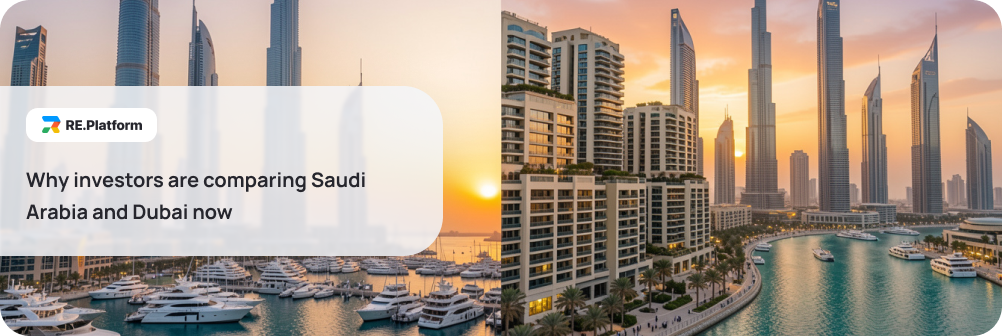
Dubai and Saudi Arabia are often compared as if they are two versions of the same market. They are not. Dubai is already a mature international real estate hub. Saudi Arabia is still becoming one.
A buyer looking at Dubai Marina, Downtown Dubai, Business Bay or Palm Jumeirah can understand the investment logic fairly quickly. There is a long history of transactions, an active resale market, a clear foreign ownership framework, a deep rental base and a large pool of international buyers. The system has been built around global capital for years.
Riyadh feels different. It is not yet as easy to read from the outside. The city is still changing physically and economically. New residential districts are expanding, transport infrastructure is developing, business activity is increasing, and the Saudi government continues to push reforms connected to Vision 2030, economic diversification and foreign investment. This is why Saudi Arabia is increasingly described as a growth market rather than a fully mature investment destination.
For some investors, that makes Riyadh less comfortable than Dubai. For others, that is exactly the attraction. Dubai already went through much of its global real estate transformation. Saudi Arabia may still be in the middle of it.
The price gap is the clearest reason Saudi Arabia is attracting attention
The easiest way to understand the investment difference is to look at pricing.
Dubai is much more expensive than Riyadh on a price-per-square-meter basis. According to the comparison data from Dxboffplan, the average price per square meter in central Riyadh is around 9,189 SAR, while central Dubai is around 26,276 SAR. Outside central areas, Riyadh is around 6,583 SAR per square meter, compared with roughly 14,118 SAR in Dubai.
| Price comparison | Riyadh | Dubai |
|---|---|---|
| Average price per sqm in city center | ~9,189 SAR | ~26,276 SAR |
| Average price per sqm outside center | ~6,583 SAR | ~14,118 SAR |
This gap does not automatically make Riyadh a better investment. A cheaper market can stay cheap if demand, liquidity and regulation do not improve. But in Saudi Arabia’s case, investors are paying attention because the lower entry point exists at the same time as large-scale urban transformation.
That combination is powerful. In Dubai, many investors are buying into a market that has already been heavily repriced. In Riyadh, they are buying into a city where some districts still appear to be catching up with infrastructure, population movement and new business demand.
This is why Saudi Arabia appeals to growth-oriented investors. They are not simply looking for a lower price. They are looking for a lower price in a market that may still be moving into a new phase.
Dubai still looks stronger for rental income
If the question is only about rental yield, Dubai still has the stronger case.
Dubai benefits from a rental ecosystem that Saudi Arabia does not yet fully match. The city has tourism, expatriate demand, short-term rentals, remote workers, business travelers and a large base of foreign residents. That creates several layers of rental demand at the same time.
Dxboffplan’s comparison notes that rental yields in Dubai often range between 6% and 8%, with some locations exceeding 9%. Saudi Arabia’s residential yields are described as lower, often closer to 3% to 5%. Habitare gives a broader range, describing Saudi Arabia’s average annual returns at roughly 5% to 9% depending on city and project, and the UAE at roughly 6% to 11%, particularly in Dubai.
| Return metric | Saudi Arabia | Dubai / UAE |
|---|---|---|
| Residential rental yield, conservative comparison | ~3%–5% | ~6%–8%, sometimes above 9% |
| Broader annual return range by market and project | ~5%–9% | ~6%–11% |
The ranges differ because they are not always measuring the same thing. Some comparisons focus on residential rental yield, while others use broader annual return estimates that may include capital growth expectations. This is important because investors often confuse rental yield with total return.
Dubai usually has the advantage on current income. Saudi Arabia’s case is more about long-term appreciation. A Riyadh apartment may not beat a Dubai apartment on rent today, but investors may still choose Riyadh if they believe the district will appreciate faster over the next several years.
That is why the Saudi thesis is not purely a yield story. It is a growth story.
The real decision is income now or appreciation later
Most investors do not actually ask the question clearly enough. “Is Saudi Arabia better than Dubai?” is too broad. The more useful question is: do you want income now, or are you willing to wait for appreciation?
Dubai is better suited to investors who want a property to start working quickly. The rental market is established, tenant demand is easier to understand, and many areas already have a proven performance history. If a buyer wants relatively predictable cash flow, Dubai is usually easier to underwrite.
Saudi Arabia asks for more patience. Riyadh’s strongest investment argument is not that every property will immediately generate Dubai-level rental yields. The argument is that the city itself may continue repricing as business activity, infrastructure and foreign participation expand.
This distinction matters because it changes how an investor should judge the asset. A Dubai property can often be evaluated through rent, comparable transactions and resale liquidity. A Riyadh property needs to be evaluated through district-level growth, infrastructure timing, future supply, developer quality and the possibility that today’s pricing does not fully reflect tomorrow’s demand.
That is a harder investment decision. But it can also be a more interesting one.
Foreign ownership is still easier in Dubai
Dubai remains ahead when it comes to foreign buyer accessibility.
The UAE has had well-established freehold ownership areas for years. Foreign investors understand where they can buy, how ownership works, how title transfer is handled and what costs are involved. The buying process is relatively familiar, especially for international investors who have already purchased property abroad.
Saudi Arabia is opening, but it is not yet as straightforward. Foreign investors can access approved projects and designated areas, and the direction of reform is clearly toward broader participation. However, the process may still involve more approvals, more administrative complexity and less certainty than Dubai.
This does not make Saudi Arabia unattractive. It simply means the investor experience is different. Dubai is already optimized for foreign ownership. Saudi Arabia is still building that framework.
For a first-time foreign buyer, Dubai will usually feel easier. For a long-term investor who is comfortable with a developing regulatory environment, Saudi Arabia may still be worth the added complexity.
Taxes, fees and hidden costs are not identical
Both markets remain attractive compared with many Western real estate systems, especially because neither is built around heavy recurring annual property taxation in the way investors might see in Europe or North America.
Dubai is generally easier to understand from a cost perspective. The market is known for no recurring annual property tax in most cases, while buyers typically need to account for registration fees and administrative charges connected to the transaction. Dxboffplan describes Dubai as one of the more transparent and lower-cost markets for international investors because key costs are usually disclosed upfront.
Saudi Arabia has a different cost structure. The competitor comparison describes a 5% tax-related transaction mechanism on property sales and purchases, along with possible administrative or approval-related costs depending on the transaction.
The main difference is not only the amount paid. It is predictability. Dubai’s costs are easier for foreign buyers to model before entering a deal. Saudi Arabia’s process can still feel more variable depending on the project, ownership structure and approval path.
For ROI calculations, this matters a lot. A property that looks attractive on headline price can become less compelling once acquisition costs, furnishing, service charges, vacancy and administrative expenses are included.
Residency is another reason Dubai still wins for many foreign buyers
Dubai’s residency proposition is one of its strongest advantages.
Property investment in Dubai can be linked to residency options, including longer-term visas for qualifying investors. Dxboffplan notes that foreign investors can access residency pathways through real estate purchases that meet the required value thresholds.
Saudi Arabia has introduced Premium Residency and other investor-oriented pathways, but the process is less established internationally and generally less simple than the UAE model.
This is not a small issue. Many foreign buyers are not just buying property. They are buying regional flexibility, banking access, relocation optionality, business presence and personal mobility. Dubai has already packaged those benefits into a familiar international product. Saudi Arabia may get there, but it is still earlier in the process.
For investors who want real estate and residency together, Dubai remains the cleaner route.
Liquidity is where Dubai’s maturity really matters
The most underrated part of this comparison is liquidity.
When the market is rising, liquidity does not feel urgent. Every investor talks about appreciation, rental demand and future upside. But when sentiment changes or an investor needs to exit quickly, liquidity becomes one of the most important parts of the deal.
Dubai has a much deeper resale market. A well-located apartment in a recognized district has a larger pool of potential buyers, stronger price benchmarks and more international demand. Investors can still lose money in Dubai, and the market can still correct, but the exit path is more visible.
Riyadh is improving, but it does not yet offer the same level of international resale depth. The market is growing quickly, but many districts are still being defined. Pricing can move fast, but comparable data and buyer behavior are not always as transparent as in Dubai.
This is why Dubai remains safer for investors who may need flexibility. Saudi Arabia may offer more upside, but the exit can be less predictable.
What type of investor is better suited to Dubai?
Dubai is the better fit for an investor who wants the property market to feel familiar from day one. The rules are clearer, the foreign ownership structure is more established, the rental market is deeper, and the connection between real estate and residency is stronger.
It is especially suitable for buyers who care about cash flow and liquidity. A Dubai apartment in a strong district can be easier to rent, easier to benchmark and easier to resell than a comparable investment in a still-evolving Saudi district.
The tradeoff is price. Dubai is no longer an early-stage market. Many of the obvious locations are already expensive, competition between investors is high, and the best areas often require a larger entry budget. The market still works, but it is harder to find mispriced opportunities than it was years ago.
Dubai is not necessarily where investors go to discover the next untapped Gulf market. It is where they go when they want a tested one.
What type of investor is better suited to Saudi Arabia?
Saudi Arabia is better suited to investors who are not afraid of a market still changing shape.
The strongest Saudi argument is long-term repricing. Riyadh is not just adding buildings; it is changing its role in the regional economy. Corporate activity, infrastructure, population movement and government-backed development are all contributing to a new real estate cycle.
This makes Saudi Arabia attractive for investors who missed Dubai’s earlier growth phase and are now looking for a market that still has room to institutionalize. But that opportunity comes with more uncertainty. Foreign ownership rules are less simple, rental yields may be lower, resale liquidity is not as deep, and the market requires more local understanding.
Saudi Arabia is not the easier investment. It is the more speculative long-term one.
For the right investor, that can be a strength.
Saudi Arabia vs Dubai: which is better in 2026?
The best answer is not that one market wins completely. The better answer is that Dubai and Saudi Arabia now serve different investment goals.
Dubai remains stronger for income, liquidity, foreign ownership clarity, residency access and operational simplicity. Saudi Arabia is stronger for lower entry pricing, long-term growth potential and exposure to a market that may still be early in its transformation.
| Investor question | More convincing answer in 2026 |
|---|---|
| Where is it easier for foreigners to buy? | Dubai |
| Where are property prices lower? | Saudi Arabia, especially Riyadh |
| Where are rental yields generally stronger? | Dubai |
| Where is long-term appreciation potential more interesting? | Saudi Arabia |
| Where is resale liquidity deeper? | Dubai |
| Where is the market still earlier in its growth cycle? | Saudi Arabia |
| Where is residency through property clearer? | Dubai |
| Where does the investment require more local understanding? | Saudi Arabia |
So, is Saudi Arabia better than Dubai for property investment?
For stable rental income and lower operational friction, no. Dubai is still ahead.
For long-term growth exposure and a potentially earlier-stage market, Saudi Arabia is becoming one of the most interesting alternatives in the Gulf.
That is why the comparison is no longer one-sided. Dubai remains the safer and more proven market. Saudi Arabia is the market investors are watching because it may still be in the part of the cycle where the biggest repricing has not fully happened yet.