Browse by category


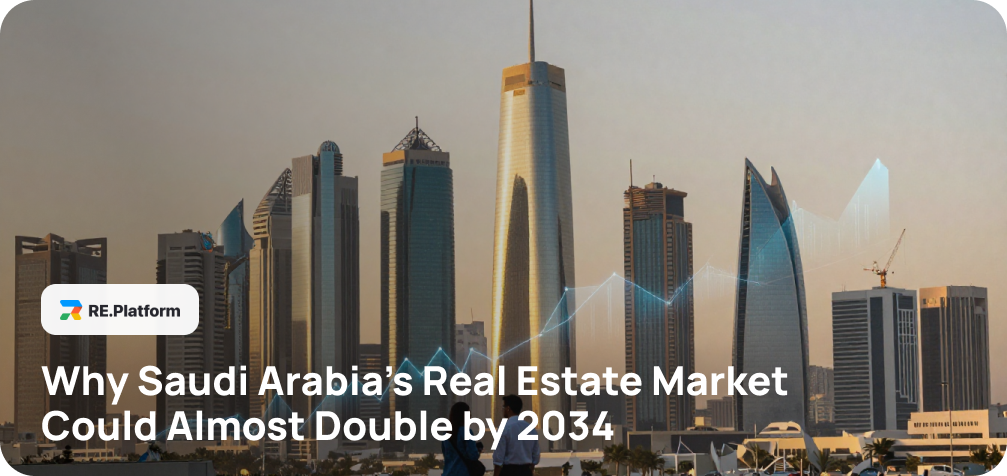
Saudi Arabia’s real estate market is no longer just a domestic housing story. It is becoming one of the most closely watched property markets in the Gulf, not because of a single mega-project or a short-term price rally, but because several structural forces are moving at the same time.
The numbers explain why investors are paying attention. The Saudi Arabia real estate market was valued at approximately USD 77.2 billion in 2025 and is forecast to reach USD 141.6 billion by 2034, implying a compound annual growth rate of 6.73% between 2026 and 2034. In a region where Dubai has long dominated international real estate conversations, Saudi Arabia is now building a very different kind of growth case.
The market is expanding through housing demand, infrastructure spending, tourism, logistics, corporate relocation, foreign ownership reforms and digital real estate infrastructure. That combination makes the Saudi market more complex than a typical “emerging real estate opportunity.” It is not one market moving in one direction. It is several real estate cycles happening inside the same country at once.
For investors, buyers and developers, the more important question is not whether Saudi Arabia’s real estate market will grow. The real question is where that growth will concentrate, which segments will absorb demand first, and which risks could slow the market down before the forecast becomes reality.
Table of Contents
The headline forecast: from $77.2B to $141.6B
A projected rise from USD 77.2 billion in 2025 to USD 141.6 billion by 2034 is not a small expansion. It suggests that Saudi Arabia is moving from a housing-led market into a broader real estate economy where residential, commercial, hospitality, logistics and mixed-use development all become part of the same investment story.
| Market indicator | Figure |
|---|---|
| Saudi real estate market size in 2025 | USD 77.2B |
| Forecast market size by 2034 | USD 141.6B |
| Forecast CAGR, 2026–2034 | 6.73% |
| Residential real estate share in 2025 | 60.5% |
| Northern and Central region share in 2025 | 35.0% |
| Saudi population in 2024 | 35.3M |
| Urban population concentration in 2024 | 85% |
| Projected urban population by 2030 | 86.3% |
What makes the forecast interesting is not only the final number. It is the source of the growth. Saudi Arabia is not relying on one investment theme. The residential sector is being pushed by demographics and government housing initiatives. Office demand is being supported by the Regional Headquarters Programme and rising corporate activity in Riyadh. Tourism is creating hospitality and leisure demand. Logistics expansion is increasing the need for warehouses and industrial real estate. Foreign ownership reform may add a new layer of international demand.
This is why Saudi Arabia’s property market cannot be read through the same lens as a single-city investment market. Riyadh, Jeddah, NEOM, Makkah, Madinah, Dammam, Khobar and emerging logistics corridors all respond to different demand drivers.
Residential real estate is still the center of gravity
Residential real estate accounted for 60.5% of the Saudi market in 2025, making it the leading property type by a wide margin. That is not surprising. Saudi Arabia’s population reached 35.3 million in 2024, rising 4.7% year over year, while urban concentration continues moving higher. As household structures change and cities absorb more residents, housing demand becomes the foundation of the market.
But the residential story is not only about population growth. It is also about affordability, supply and government intervention. The Sakani program, subsidized financing and accelerated development approvals have helped push homeownership and support new supply. The source material notes that Sakani supported 62,023 Saudi families from the beginning of the year through the end of August 2023, which gives a sense of how directly policy is tied to residential demand.
This matters because Saudi Arabia still faces a difficult balance. The market needs more housing, but it also needs the right kind of housing. Luxury towers and branded residences attract attention, but the deeper demand sits in mid-market apartments, family housing and well-connected communities that serve actual residents rather than only investors.
For developers, this is where the opportunity becomes practical. Saudi Arabia does not only need landmark projects. It needs large volumes of livable, financeable and well-located housing in cities where demand is already outpacing supply.
Riyadh is becoming the market’s corporate engine
Riyadh is central to the Saudi real estate story because it sits at the intersection of government policy, business relocation, infrastructure and population growth.
The Regional Headquarters Programme has already changed how multinational companies think about Saudi Arabia. As corporate presence increases, demand does not stop at office space. It moves into apartments, serviced residences, schools, retail, transport, healthcare and lifestyle infrastructure. This is how a corporate policy becomes a real estate demand engine.
The source material points to strong premium office occupancy in Riyadh and Grade A office supply reaching 6.4 million square meters, with financial services growth adding another layer of business demand. In practical terms, this means Riyadh is not only adding buildings. It is adding the kind of employment base that supports residential and commercial absorption.
That is why North Riyadh has become such an important part of the investment conversation. Districts connected to new business activity, transport upgrades and modern residential supply are increasingly being viewed not just as places to live, but as assets inside a larger urban growth cycle.
Dubai built its investment appeal around global liquidity, tourism and expatriate demand. Riyadh is building a different model: corporate concentration first, then residential and lifestyle demand around it.
Foreign ownership could change the demand curve
Foreign ownership liberalization is one of the most important variables in Saudi real estate because it can change who participates in the market.
Historically, Saudi Arabia was more difficult for foreign buyers to access than Dubai. That limited international participation and kept much of the market domestically oriented. The new property law direction, expected to become effective in January 2026 according to the source material, is positioned as a way to open access in major cities and attract more global capital.
The impact could be significant, but it should not be exaggerated. Foreign ownership reform does not automatically create demand everywhere. International buyers will still look for clear rules, title security, transparent pricing, financing options, liquidity and reliable project delivery. Markets open gradually, then credibility decides how much capital actually arrives.
Still, the potential is real. If foreign buyers gain easier access to selected residential and commercial assets in Riyadh, Jeddah and other strategic locations, Saudi Arabia could add a new demand layer on top of domestic housing and institutional development activity. That is exactly the kind of structural shift that can support long-term market growth.
Tourism is creating a second real estate market inside the first
Saudi Arabia’s tourism ambitions are changing the role of real estate across the country. The government is targeting 150 million annual visitors by 2030, and that target has direct implications for hotels, resorts, branded residences, serviced apartments, retail districts and mixed-use destinations.
The Red Sea development pipeline illustrates how tourism becomes real estate demand. The source material refers to Phase 1 infrastructure supporting 8,000 hotel rooms across islands, hotels and inland sites. In the Western region, Jeddah’s Red Sea location, religious tourism in Makkah and Madinah, and coastal development all create a different property logic from Riyadh’s corporate-led growth.
This is one reason Saudi Arabia’s market outlook is broader than a residential forecast. Hospitality and leisure real estate are becoming institutional sectors in their own right. Investors are no longer looking only at apartments and villas. They are watching hotel pipelines, resort communities, extended-stay demand, religious tourism, waterfront living and mixed-use urban destinations.
For buyers, this also changes the map. A property in Riyadh may be evaluated through employment growth and long-term residential demand. A property in Jeddah or the Red Sea corridor may be judged through tourism, lifestyle positioning and hospitality infrastructure. The same national market can produce very different investment theses depending on location.
Digital infrastructure is making the market easier to read
One of the less glamorous but important parts of Saudi Arabia’s real estate development is digital infrastructure.
The source material notes that Ejar recorded 8 million digital leases in December 2023. That matters because lease digitization improves transparency, institutional confidence and data availability. Real estate markets become easier to finance, analyze and regulate when transactions are visible and standardized.
For international investors, this is not a minor operational detail. Mature real estate markets depend on reliable data. If investors can better understand rental contracts, occupancy, pricing movement and tenant behavior, the market becomes less opaque.
Saudi Arabia is also seeing PropTech integration through platforms using satellite data, AI and real-time property insights. This fits naturally with the country’s broader digital transformation agenda and could help close the transparency gap between Saudi Arabia and more mature Gulf markets.
For RE.Platform’s audience, this is especially important. The next phase of Saudi real estate will not only be about who builds the most units. It will also be about who can organize market information clearly enough for buyers, developers and investors to make decisions.
The market is growing, but pressure is building
The forecast is strong, but the risks are not cosmetic.
Construction cost inflation is one of the most obvious constraints. Large-scale development creates enormous demand for materials, labor, contractors and project management capacity. When many mega-projects move at once, developers face higher costs and tighter execution risk. Smaller contractors can struggle, while larger contractors may require escalation clauses to protect against commodity volatility.
Supply-demand imbalance is another issue. Saudi Arabia is delivering new housing, but demand in major cities can still outpace supply, especially for mid-income households. This is one of the most important points for investors to understand: a growing market can still be difficult for end users if affordability does not improve.
Mega-project concentration also creates risk. Government-backed developments can accelerate infrastructure and attract global attention, but they may also concentrate land access, utilities and approvals around large entities. Traditional private developers can find it harder to compete if they do not have similar access to strategic sites or public-sector partnerships.
That does not weaken the long-term thesis. It makes it more realistic. Saudi Arabia’s real estate market is not simply “booming.” It is scaling under pressure.
Where the real opportunity may be
The strongest opportunity is unlikely to be spread evenly across the country.
Riyadh remains the clearest corporate and residential growth engine. The city benefits from business relocation, premium office demand, population growth and infrastructure expansion. For investors, the most interesting opportunities are likely to be in well-connected residential districts, mixed-use communities and assets tied to employment growth.
The Western region has a different profile. Jeddah, Makkah and Madinah are tied to tourism, religious travel, coastal development and hospitality. Residential stock in Jeddah is already significant, and new supply continues entering the market. Here, demand is less purely corporate and more connected to lifestyle, trade, tourism and pilgrimage-linked accommodation.
The Eastern region is more industrial. Dammam, Dhahran and Khobar benefit from logistics, ports, industrial development and commercial activity. This makes warehousing, logistics parks and business-linked real estate more important than luxury residential narratives.
NEOM and the northwestern corridor are more speculative. They attract global attention and long-term capital, but their investment logic depends heavily on delivery, infrastructure, population absorption and whether planned demand becomes real occupancy.
| Region / segment | Main demand driver | Investment logic |
| Riyadh / Central | Corporate relocation, offices, housing demand | Residential growth, Grade A offices, mixed-use districts |
| Jeddah / Western | Red Sea location, tourism, trade, religious access | Hospitality, waterfront living, serviced residences |
| Makkah & Madinah | Religious tourism, extended-stay demand | Hotels, residential supply, mixed-use pilgrimage infrastructure |
| Eastern Province | Logistics, ports, industrial activity | Warehousing, commercial, worker housing, business districts |
| NEOM / Northwest | Mega-project development, tourism, future urban models | High-upside, higher-execution-risk growth market |
The best opportunities will likely sit where demand is easiest to prove. That means housing near employment centers, hospitality near real visitor flows, logistics near infrastructure corridors and projects by developers capable of delivering at scale.
What investors should watch next
Saudi Arabia’s market forecast will not be decided only by announced projects. It will be decided by execution.
The first signal to watch is affordability. If prices rise faster than incomes and financing capacity, the residential market may face pressure even while headline demand remains strong. This is already a familiar pattern in fast-growing cities: housing demand is real, but not every household can afford what developers are building.
The second signal is foreign ownership implementation. The market does not need only reform headlines. It needs clear procedures, approved zones, predictable taxes, reliable title transfer and confidence among international buyers.
The third signal is project delivery. Saudi Arabia has no shortage of ambition. The question is whether housing, hospitality, offices and infrastructure are delivered on timelines that support real occupancy rather than only future expectations.
The fourth signal is data transparency. Digital leases, PropTech tools and organized project information will become increasingly important as more international investors enter the market. Capital moves faster when the market is easier to understand.
The bigger story: Saudi real estate is becoming institutional
The reason Saudi Arabia’s market could almost double by 2034 is not simply that more buildings are being built. It is that real estate is becoming a central part of the country’s economic transformation.
Residential demand is tied to population growth and urbanization. Office demand is tied to corporate relocation and economic diversification. Hospitality demand is tied to tourism. Logistics demand is tied to industrial development. Foreign ownership reform is tied to capital flows. Digital leasing is tied to transparency.
That is what makes the Saudi real estate story different from a normal construction cycle.
The market is still risky. It faces cost inflation, affordability pressure, supply gaps, execution challenges and regulatory transition. But the direction is clear: Saudi Arabia is building one of the most important real estate markets in the Gulf.
For investors, the opportunity is not to assume that every project will benefit equally. The opportunity is to understand which parts of the market are being supported by real demand — and which parts are still mostly narrative.
That distinction will matter more as the market gets larger.
Answers to frequently asked questions
How big is the Saudi Arabia real estate market?
The Saudi Arabia real estate market was valued at approximately USD 77.2 billion in 2025 and is forecast to reach USD 141.6 billion by 2034, according to the market data used in this analysis.
Why is Saudi Arabia’s real estate market growing?
The market is growing because several demand drivers are moving together: population growth, urbanization, housing programs, infrastructure development, tourism, logistics expansion, corporate relocation and foreign ownership reform.
Which real estate segment is the largest in Saudi Arabia?
Residential real estate is the largest segment, accounting for 60.5% of the market in 2025. This reflects strong housing demand, government support and demographic growth.
Is Riyadh the most important real estate market in Saudi Arabia?
Riyadh is one of the most important markets because it is the country’s corporate and administrative center. Business relocation, office demand, infrastructure expansion and residential growth make it central to Saudi Arabia’s real estate outlook.
Can foreigners invest in Saudi real estate?
Foreign ownership opportunities are expanding, especially in approved projects and designated areas. The direction of reform is toward greater international participation, although investors still need to evaluate rules, approvals and ownership conditions carefully.
What are the biggest risks in Saudi Arabia’s real estate market?
The main risks are construction cost inflation, affordability pressure, supply-demand imbalance, execution delays, regulatory complexity and overconcentration around large mega-projects.
Is Saudi Arabia a better real estate investment than Dubai?
Saudi Arabia and Dubai serve different investment goals. Dubai remains more mature, liquid and internationally familiar. Saudi Arabia may offer stronger long-term growth potential, especially in areas linked to infrastructure, housing demand and economic transformation.