Browse by category


For years, Saudi Arabia barely existed in the global real estate conversation.
When international buyers discussed overseas property investment, attention almost always went elsewhere — Dubai, Miami, London, Singapore. Riyadh was rarely part of that discussion. The Kingdom was viewed primarily as an oil economy with a relatively closed property market and little connection to mainstream international real estate capital.
That perception is changing extremely fast.
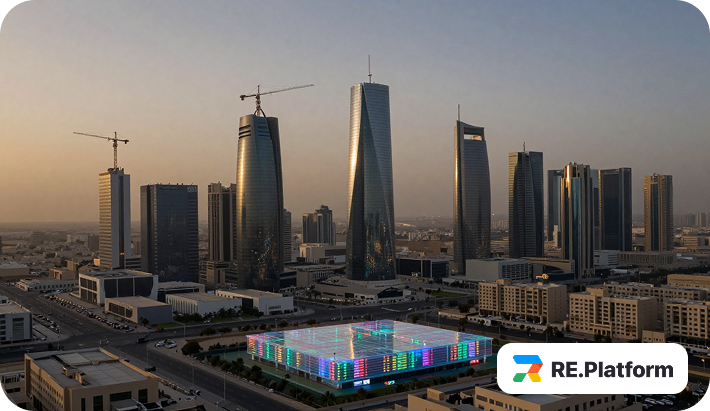
In 2026, Saudi Arabia has become one of the most aggressively discussed growth markets in the world. Vision 2030 is reshaping entire cities, billions of dollars are flowing into infrastructure and megaprojects, international companies are relocating regional headquarters into Riyadh, and luxury developers are entering the market at a pace that would have seemed unrealistic only a few years ago.
But one of the most interesting shifts is happening outside the Gulf itself. US buyers are starting to pay attention.
Not because Saudi Arabia suddenly became a traditional destination for American second homes. And not because Riyadh is simply trying to imitate Dubai. What attracts attention instead is the scale of transformation itself. Many investors increasingly view Saudi Arabia as one of the few major economies still positioned in the early stages of long-term urban and economic expansion.
At a time when several mature property markets in the United States are struggling with high prices, compressed yields, and slower growth expectations, Saudi Arabia offers a completely different narrative. Riyadh still feels early. Entire districts are being rebuilt. Infrastructure is expanding aggressively. International capital is entering the market. And real estate prices in key areas continue rising alongside broader economic transformation.
That does not mean the market is simple.
Foreign ownership rules are still evolving, the Saudi market operates very differently from both Dubai and the United States, and many international buyers continue underestimating how complex the Kingdom’s real estate sector can actually be.
In this article, we will examine why Saudi Arabia has suddenly entered the radar of US buyers, what is driving international demand toward Riyadh, how Vision 2030 is reshaping the property market, and why some investors believe the Kingdom may become one of the most important real estate growth stories of the next decade.
Table of Contents
Why International Diversification Is Becoming More Important for US Buyers
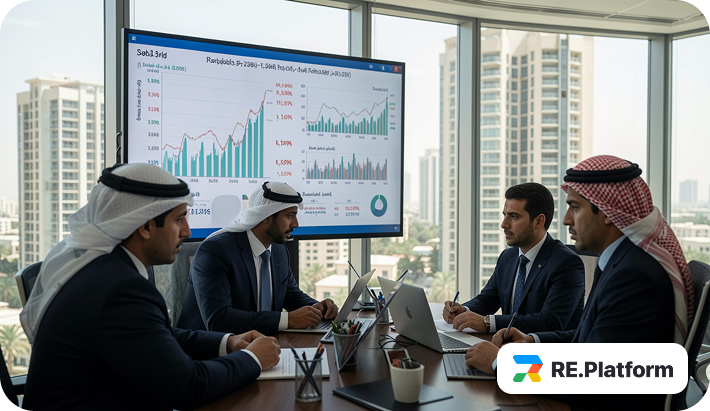
Over the past several years, the United States has experienced a period of elevated economic and political uncertainty. Inflation pressure, high interest rates, volatile financial markets, and growing concerns around long-term affordability in major US cities have forced many investors to rethink how they approach capital preservation and real estate diversification.
For high-net-worth buyers especially, concentrating too heavily on a single domestic market is increasingly viewed as a strategic risk rather than a safe long-term approach.
As a result, international real estate diversification has become significantly more attractive among US buyers looking for:
- exposure to faster-growing economies,
- alternative investment markets,
- and regions undergoing large-scale transformation.
Traditionally, destinations like London, Dubai, Lisbon, or parts of Southern Europe dominated this conversation. But in 2026, Saudi Arabia is increasingly entering that global investment discussion.
Riyadh, in particular, has started attracting attention from international buyers who view the Kingdom not simply as another emerging market, but as one of the few major economies currently undergoing aggressive long-term economic and urban expansion simultaneously.
And unlike many mature Western property markets where growth expectations have already compressed, Saudi Arabia still appears “early” to many investors.
Why Saudi Arabia Is Starting to Attract US Buyers
Over the past several years, many US buyers have started rethinking how they approach real estate diversification.
Rising property prices across major American cities, compressed rental yields, inflation pressure, and growing uncertainty around long-term market performance have pushed more investors to explore opportunities outside traditional domestic markets. For high-net-worth buyers especially, relying too heavily on a single market increasingly looks less like a safe strategy and more like a concentration risk.
Historically, international real estate diversification mostly flowed toward destinations like London, Southern Europe, Dubai, or Singapore. But in 2026, Saudi Arabia is increasingly entering that global conversation.
The shift is not happening because Riyadh suddenly became a traditional second-home destination for Americans. The interest is far more strategic. Many buyers see Saudi Arabia as one of the few major economies still positioned in the relatively early stages of long-term urban and economic expansion.
Vision 2030, infrastructure megaprojects, foreign ownership reforms, and the rapid transformation of Riyadh have collectively changed how global investors perceive the Kingdom. At the same time, several mature Western real estate markets are already facing slower growth expectations and significantly higher entry prices.
To better understand why Saudi Arabia is increasingly appearing on the radar of US buyers, we compiled key market and macroeconomic trends shaping investor attention in 2026.
| Market Factor | Saudi Arabia | Why It Matters for US Buyers |
|---|---|---|
| Foreign ownership reforms | New regulations launched in 2026 allowing foreign ownership in approved zones | Opens access to a previously restricted market |
| Vision 2030 investment | Hundreds of billions directed into infrastructure and urban development | Signals long-term government-backed expansion |
| Riyadh growth narrative | One of the fastest-transforming cities in the GCC | Creates “early market” investment psychology |
| Property market maturity | Still developing compared to Dubai or major US cities | Higher perceived upside potential |
| Luxury real estate expansion | Rapid growth of branded residences and mixed-use projects | Attracts globally oriented buyers |
| Institutional attention | Rising interest from global funds and developers | Increases international market credibility |
| US market conditions | Higher prices and compressed yields in many US cities | Pushes investors toward alternative markets |
| Economic diversification | Saudi Arabia expanding beyond oil through tourism, finance, tech, and entertainment | Supports long-term urban demand growth |
Saudi Arabia’s real estate transformation is no longer viewed purely as a regional story. Increasingly, it is becoming part of a broader global investment narrative centered around economic diversification, infrastructure expansion, and the search for higher-growth markets outside traditional Western real estate hubs.
That does not mean Riyadh is replacing markets like New York, Miami, or Dubai overnight. But it does explain why more US buyers are starting to monitor Saudi Arabia far more seriously than they did only a few years ago.
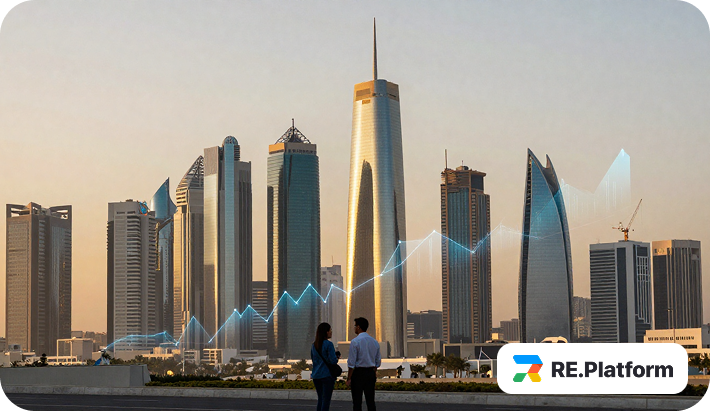
Search Interest From the US Toward Saudi Arabia Real Estate Has Increased Sharply
Just a few years ago, searches related to buying property in Saudi Arabia were almost nonexistent across the US market. Most international real estate attention from American buyers remained concentrated around destinations like Dubai, London, Portugal, or Southern Europe.
That trend is beginning to shift.
As Saudi Arabia continues opening its property market to foreign buyers and Vision 2030 accelerates the transformation of Riyadh and other major cities, US-based interest in Saudi real estate has started growing much more aggressively — especially around investment-related and relocation-oriented queries.
Search behavior itself increasingly reflects that change.
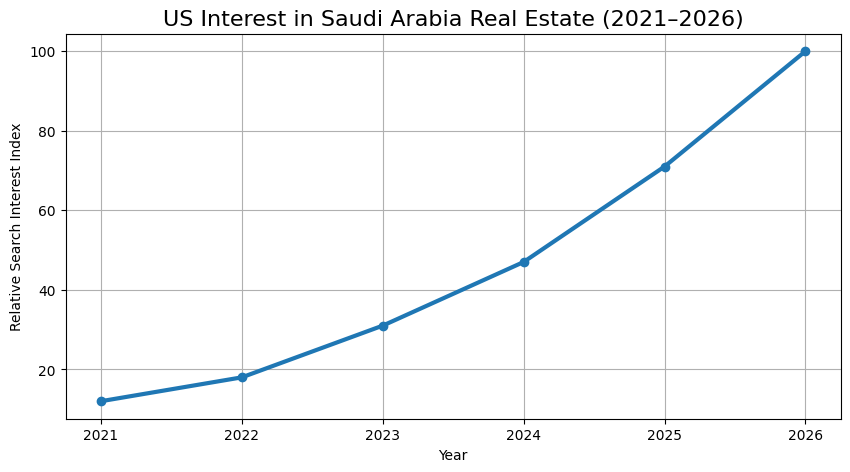
The growth itself is important, but the nature of the searches may matter even more.
Several years ago, most US-based searches around Saudi Arabia were heavily concentrated around oil, geopolitics, or business news. Today, real estate, investment opportunities, foreign ownership rules, Riyadh development, and luxury property projects are increasingly becoming part of that conversation.
That does not automatically mean large numbers of Americans are already purchasing property inside the Kingdom.
But it clearly shows that Saudi Arabia is entering the radar of internationally minded buyers far more aggressively than it did only a few years ago — especially as Riyadh positions itself as one of the world’s fastest-transforming urban markets.
Which Cities in Saudi Arabia Are Attracting the Most Attention From US Buyers?
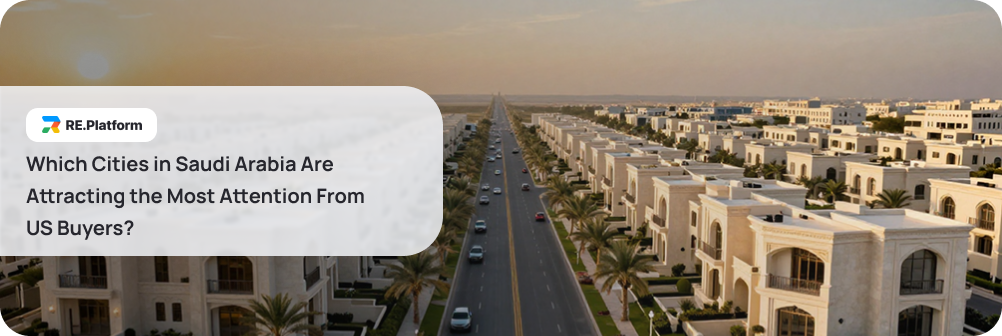
As international interest toward Saudi Arabia continues growing, not all cities are attracting attention for the same reasons.
For many US buyers, the decision is no longer simply about purchasing property in the Kingdom. It is increasingly about understanding which Saudi cities align best with different investment strategies, business opportunities, and lifestyle expectations.
Some locations are attracting buyers searching for long-term economic growth. Others appeal more to luxury lifestyle investors, religious tourism exposure, or future infrastructure-driven appreciation.
And while Riyadh currently dominates most international real estate discussions, it is no longer the only city appearing on the radar of foreign buyers.
Saudi Cities Drawing the Most Attention From US Buyers in 2026
| City | Why US Buyers Are Interested | Primary Real Estate Narrative |
|---|---|---|
| Riyadh | Economic transformation, business expansion, Vision 2030 growth | Long-term capital appreciation |
| Jeddah | Red Sea lifestyle, tourism growth, luxury waterfront projects | Lifestyle + investment mix |
| NEOM | Global megaproject attention and speculative future growth | High-risk / high-upside narrative |
| Mecca | Religious tourism and hospitality-driven demand | Pilgrimage economy exposure |
| Medina | Long-term religious and residential stability | Conservative long-term positioning |
| Eastern Province (Khobar/Dammam) | Energy sector, expat demand, business infrastructure | Corporate and expat housing demand |
Riyadh remains the primary focus for most internationally oriented buyers.
The city is increasingly viewed as the economic center of Saudi Arabia’s transformation strategy, with infrastructure expansion, financial sector growth, luxury residential development, and large-scale business relocation all reshaping the local property market simultaneously.
For many US buyers, Riyadh represents the clearest “growth story” inside the Kingdom.
Jeddah, however, appeals to a different profile of investor.
Its Red Sea coastline, tourism positioning, luxury waterfront developments, and more relaxed lifestyle atmosphere make the city feel significantly different from Riyadh’s business-driven environment. Many buyers view Jeddah as the Saudi market’s closest equivalent to a traditional international lifestyle destination.
Then there is NEOM.
For some investors, NEOM represents one of the world’s most ambitious long-term urban development projects. For others, it remains a highly speculative bet tied to execution timelines and future demand assumptions. Either way, the project has already become globally recognizable — including among US investors exploring exposure to Saudi Arabia’s future growth narrative.
Meanwhile, cities like Mecca and Medina continue attracting attention for entirely different reasons. Religious tourism, hospitality infrastructure, and long-term pilgrimage demand create a much more specialized real estate dynamic compared to Riyadh or Jeddah.
This diversification is one of the biggest reasons Saudi Arabia’s property market is becoming more globally relevant.
International buyers are no longer looking at the Kingdom as a single real estate story. Increasingly, they are evaluating multiple Saudi cities through completely different investment lenses.
What Types of Property Are Foreign Buyers Actually Purchasing in Saudi Arabia?
More detailed market signals are now beginning to show which residential segments are attracting the strongest international demand inside Saudi Arabia.
According to Knight Frank and regional real estate surveys, foreign buyers and expatriates are currently focusing far more heavily on apartments, integrated residential communities, and premium villas than on traditional standalone housing in older districts. Interest is also shifting toward branded residences, mixed-use developments, and large master-planned communities in Riyadh and Jeddah.
Property Types Generating the Highest Foreign Buyer Demand in Saudi Arabia
| Property Type | Estimated Share of Foreign Buyer Demand |
|---|---|
| Apartments | ~45–50% |
| Villas & Townhouses | ~30–35% |
| Residential Compounds | ~10–15% |
| Branded Residences | ~5–10% |
| Off-Plan Mega Projects | Fastest-growing segment |
Riyadh Is No Longer Just a Business Destination
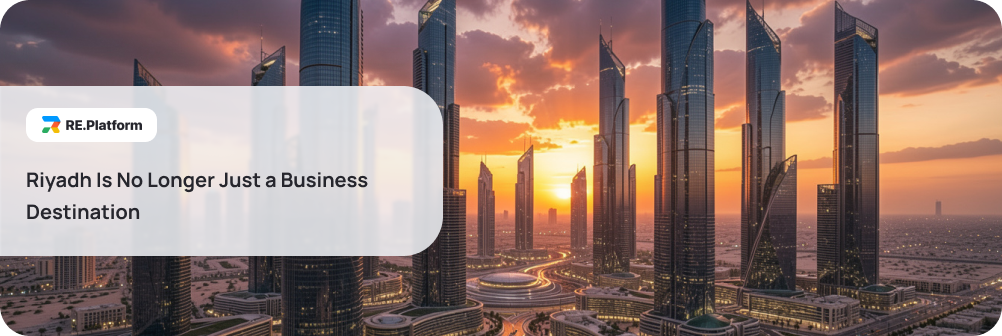
For many years, Riyadh was viewed primarily as a business and government capital rather than a city associated with international lifestyle appeal.
That perception is changing rapidly.
As Vision 2030 continues reshaping the Saudi economy, Riyadh is evolving into a far more globalized urban environment. Large-scale investments in entertainment, hospitality, infrastructure, retail, dining, and mixed-use districts are changing how both residents and international professionals experience the city.
For many US buyers exploring Saudi Arabia today, this transformation matters almost as much as the real estate market itself.
In global property markets, long-term demand is rarely driven by investment potential alone. Cities attract sustainable international capital when they gradually become places where professionals, entrepreneurs, and globally mobile residents genuinely want to live and work.
Riyadh is increasingly trying to position itself in exactly that category.
This shift is especially visible in northern Riyadh, where modern business districts, luxury residential compounds, international schools, premium retail projects, and new lifestyle-oriented developments continue expanding at an aggressive pace.
Areas near KAFD and emerging mixed-use corridors increasingly resemble the type of integrated urban environments international professionals are already familiar with in cities like Dubai or Singapore.
For Americans relocating to Saudi Arabia for business, consulting, finance, technology, or investment-related opportunities, daily life inside Riyadh looks very different today compared to only a decade ago.
Global brands continue entering the market, the restaurant and hospitality sector is expanding rapidly, entertainment infrastructure is improving, and the city itself is becoming noticeably more internationally oriented.
That does not mean Riyadh is trying to become “another Dubai” or replicate a Western city model.
| Urban Shift | What Is Changing in Riyadh |
|---|---|
| Business Infrastructure | Expansion of financial districts, international offices, and regional HQ relocations |
| Residential Development | Growth of luxury compounds, branded residences, and mixed-use communities |
| International Lifestyle | Rapid expansion of restaurants, retail, hospitality, and entertainment sectors |
| Expat Environment | Increasing number of international professionals relocating to Riyadh |
| Education | Expansion of international schools and private education infrastructure |
| Transportation | Major investment into metro systems, highways, and urban mobility |
| Tourism & Events | Growth of global events, sports investments, and entertainment initiatives |
| Global Positioning | Riyadh increasingly positioned as a future global business hub |
Saudi Arabia still operates within its own cultural framework, and adapting to life in the Kingdom requires a different mindset compared to the United States or Europe. But this is also one of the reasons international perceptions around Riyadh have started shifting so dramatically.
For many foreign buyers, Saudi Arabia is no longer viewed only as an oil-driven economy. Increasingly, it is being seen as a rapidly transforming global business environment where economic expansion and urban development are happening simultaneously.
Americans Already Living in Saudi Arabia: A Growing International Presence
One of the biggest misconceptions about Saudi Arabia’s real estate market is that international interest in the Kingdom appeared “overnight.”
In reality, Saudi Arabia has hosted a sizable international professional community for decades — including a large American presence connected to energy, finance, consulting, construction, technology, defense, and multinational business operations.
Today, that ecosystem is becoming significantly larger and more internationally visible as Riyadh continues positioning itself as a global business hub under Vision 2030.
According to multiple international estimates, roughly 80,000 Americans currently live in Saudi Arabia, making it one of the largest American communities anywhere in the Arab world. Most are concentrated in Riyadh, Jeddah, Dhahran, and other major business centers across the Kingdom.
What is changing in 2026 is not simply the number of Americans inside Saudi Arabia — but the type of long-term interest surrounding the country itself.
| Indicator | Estimated Data |
|---|---|
| Americans currently living in Saudi Arabia | ~80,000 |
| Main cities with American communities | Riyadh, Jeddah, Dhahran, Khobar |
| Key industries employing US professionals | Energy, finance, consulting, construction, technology |
| Foreign ownership reform launch | January 2026 |
| Foreign residents in Saudi Arabia overall | ~13.4 million |
| Share of foreign residents in Saudi population | ~41% |
For many international buyers, these numbers matter because they reflect something larger than short-term investment hype.
Buying Property in Saudi Arabia Is Still More Complicated Than Many US Buyers Expect
Saudi Arabia officially opened parts of its real estate market to foreign buyers in 2026, significantly increasing international interest toward Riyadh and other major cities.
But despite the headlines, the process is still far more nuanced than many foreign buyers initially assume.
The Kingdom did not create a completely unrestricted real estate market overnight. Ownership rules still depend on factors like approved investment zones, residency status, property type, and the purpose of the purchase itself. Some areas remain restricted, while certain projects are specifically structured for international investors.
For many US buyers, this becomes one of the first major realities they encounter when exploring the Saudi market.
Understanding how foreign ownership actually works — including legal requirements, approved zones, financing limitations, and investment structures — remains critically important before entering the market.
What Foreign Buyers Still Need to Understand in 2026
| Area | Key Reality |
|---|---|
| Ownership Rules | Foreign ownership is still regulated and zone-dependent |
| Approved Projects | Not every project is automatically available to foreign buyers |
| Residency Status | Certain ownership pathways may depend on residency or investment status |
| Financing | Mortgage access for foreigners remains limited |
| Legal Process | Registration and compliance procedures are mandatory |
| Restricted Areas | Some locations remain partially restricted for foreign ownership |
For a deeper breakdown of foreign ownership rules, legal requirements, and how international buyers can purchase property in Saudi Arabia in 2026, explore our detailed guides:
Buying Property in Saudi Arabia as a Foreigner: What You Need to Know
How to Check Property Documents and Avoid Risky Real Estate Deals in Saudi Arabia
Property Taxes, Fees, and Ownership Costs in Saudi Arabia in 2026
Answers to Common Questions About Buying and Owning Property in Saudi Arabia
TOP Mistakes Buyers Make When Purchasing Property in Saudi Arabia in 2026
Saudi Arabia Is No Longer Ignored by Global Buyers
Just a few years ago, the idea of US buyers actively exploring Saudi Arabia real estate would have sounded unrealistic to most international investors.
Today, the situation looks very different.
Riyadh has become one of the fastest-transforming urban markets in the world, Vision 2030 continues reshaping the Kingdom’s economy at an enormous scale, and foreign ownership reforms have pushed Saudi Arabia into the global real estate conversation far more aggressively than ever before.
That does not mean Saudi Arabia has suddenly become a simple or fully mature international property market.
The Kingdom still operates under a more regulated and evolving framework than markets like Dubai or the United States. Foreign ownership rules remain nuanced, investment structures vary by project and location, and many international buyers still underestimate how different the Saudi market can be in practice.
At the same time, this complexity is also part of what attracts attention.
Many globally minded investors increasingly view Saudi Arabia as one of the few remaining large-scale markets that still feels relatively “early” in its long-term growth cycle. Rising international interest, expanding infrastructure, luxury residential development, and the transformation of Riyadh into a global business hub are all contributing to that perception.
Whether Saudi Arabia ultimately becomes one of the defining global real estate growth stories of the next decade remains to be seen.
But one thing is already clear:
The Kingdom is no longer being viewed only through the lens of oil or geopolitics. Increasingly, it is becoming part of the global conversation around real estate, urban transformation, and long-term international investment opportunities.
Describe what you are interested in and we will contact you.
Looking to buy property in Riyadh?