Browse by category


Saudi Arabia’s property market is no longer attracting attention quietly.
Over the past two years, Riyadh has become one of the most aggressively discussed real estate markets anywhere in the world. Apartment prices in several districts have surged. Luxury launches are accelerating. International investors are entering the market earlier than before. Developers continue announcing large-scale residential and mixed-use projects tied to Vision 2030.
At the same time, a different conversation has started appearing behind the optimism.
Are prices rising too fast?
For many investors, Saudi Arabia still looks like an early-stage growth opportunity. For others, the market increasingly resembles the beginning of a speculative cycle fueled by hype, FOMO, and aggressive expectations around future demand.
The truth sits somewhere in between.
Saudi Arabia is not experiencing a traditional real estate boom driven only by speculation. Much of the growth is tied to genuine economic transformation, infrastructure spending, population expansion, and structural demand shifts. But that does not automatically mean every project is reasonably priced — or that every district will continue growing at the same pace indefinitely.
This is exactly why the “overpriced” debate matters in 2026.
The Saudi market is entering a far more complicated stage where investors can no longer rely only on the broad Vision 2030 narrative. Location quality, rental fundamentals, supply pipelines, infrastructure maturity, and buyer psychology are starting to matter much more than they did several years ago.
And that shift changes the market completely.
Table of Contents
Why Saudi Real Estate Prices Are Rising So Fast
The speed of price growth in Saudi Arabia has surprised even experienced regional investors.
In Riyadh especially, several factors began accelerating simultaneously:
- population growth,
- corporate relocation into the Kingdom,
- rapid infrastructure development,
- mortgage expansion,
- rising international attention,
- and increasing pressure on premium residential supply.
The government’s push to transform Riyadh into one of the world’s largest business capitals has created enormous demand for housing close to financial districts, infrastructure corridors, and emerging mixed-use zones.
This is particularly visible in northern Riyadh, where apartment prices and land valuations have increased sharply in recent years.
But unlike some overheated global property markets, Saudi Arabia’s growth is not happening in a vacuum.
The Kingdom is deploying extraordinary levels of capital into:
- transportation,
- tourism,
- finance,
- entertainment,
- logistics,
- and urban expansion.
That investment creates real economic activity — and real housing demand.
This distinction is important.
In purely speculative markets, prices often rise far faster than underlying demand. In Saudi Arabia, especially in Riyadh, a large part of the market expansion is connected to actual structural transformation inside the economy.
That does not eliminate risk.
But it does explain why many investors still believe current price growth may continue longer than skeptics expect.
Is Riyadh Becoming Too Expensive for Local Buyers?
This is where the conversation becomes more complicated.
While international investors increasingly focus on Saudi Arabia’s upside potential, many local buyers are starting to feel the pressure of rapidly rising housing costs — especially in high-demand areas of Riyadh.
Apartments that looked relatively affordable several years ago now sit at dramatically different price points. Premium districts in northern Riyadh have experienced particularly aggressive appreciation as infrastructure, business activity, and luxury development continue concentrating in those areas.
For middle-income buyers, affordability is becoming a more serious issue.
This matters because sustainable real estate growth ultimately depends on more than investor sentiment alone. Markets that become disconnected from local purchasing power often begin facing longer-term pressure, especially once speculative demand slows.
At the same time, Saudi Arabia’s housing market still differs from many global cities where affordability crises are driven almost entirely by investor speculation.
The Kingdom continues expanding mortgage access, housing initiatives, and large-scale residential supply. That may help reduce pressure over time — but the pace of price growth in some districts has clearly outperformed salary growth.
And investors are watching that gap carefully.
Describe what you are interested in and we will contact you.
Looking to buy property in Riyadh?
The “Next Dubai” Effect and Investor Speculation
Few narratives have influenced Saudi real estate more than the phrase:
“The next Dubai.”
Over the past two years, social media, investment influencers, YouTube channels, and real estate marketing campaigns have aggressively pushed the idea that Riyadh is entering the same explosive growth cycle Dubai experienced in previous decades.
That narrative has created enormous investor FOMO.
For many international buyers, the logic appears straightforward:
- Dubai already became expensive,
- Riyadh still feels early,
- therefore entering now may produce outsized long-term returns.
This mentality is driving increasingly speculative behavior in certain parts of the market.
Off-plan flipping, aggressive pre-launch pricing, luxury project speculation, and short-term appreciation expectations are becoming more common — especially in projects heavily marketed toward international investors.
But there is an important nuance often ignored in the hype.
Riyadh is not Dubai.
The Saudi market operates under a very different economic structure, regulatory environment, demographic model, and buyer profile. Comparing the two markets too simplistically can create unrealistic expectations about pricing growth and liquidity. This does not mean Riyadh lacks upside.
It means investors need to separate genuine long-term fundamentals from short-term speculative excitement. And in 2026, that line is becoming increasingly important.
Which Areas of Riyadh Are Rising the Fastest?
Not all parts of Riyadh are growing equally.
The strongest appreciation continues concentrating around areas connected to:
- business expansion,
- new infrastructure,
- luxury mixed-use development,
- and premium residential demand.
North Riyadh remains the center of investor attention.
Districts near:
- King Abdullah Financial District (KAFD),
- Diriyah development zones,
- new commercial corridors,
- and major infrastructure projects
have experienced some of the strongest pricing momentum in the city.
This is partly why the market still attracts bullish sentiment.
Many investors believe Riyadh is only beginning a long-term urban transformation cycle that could continue reshaping land values and residential demand for years.
But rapid appreciation also creates risk.
Historically, the areas that rise fastest during aggressive growth phases often become the most vulnerable to speculative overheating later in the cycle — especially if future supply begins catching up with demand.
That is one of the biggest questions investors are debating right now.
Are Rental Yields Still Strong Enough to Justify Prices?
Rental yield remains one of the strongest arguments supporting Saudi Arabia’s property market.
In several Riyadh districts, rental growth has accelerated significantly due to rising demand from professionals, corporate relocations, and limited premium housing supply.
This is exactly why some investors still believe the market is not overpriced.
As long as rents continue rising alongside prices, valuations can remain relatively supported.
However, there are early signs that expectations may be moving faster than fundamentals in certain luxury and speculative segments.
Some projects are already being marketed using extremely optimistic ROI assumptions that depend on:
- continued aggressive price appreciation,
- high occupancy,
- premium rental pricing,
- and uninterrupted demand growth.
That does not automatically make those assumptions unrealistic.
But it does increase investment sensitivity if market conditions begin stabilizing.
This is where market maturity becomes important.
Dubai’s rental ecosystem is more established and historically tested. Riyadh may currently offer stronger upside potential in selected districts, but future yield sustainability remains one of the key variables investors continue monitoring.
What Could Slow the Saudi Real Estate Market Down?
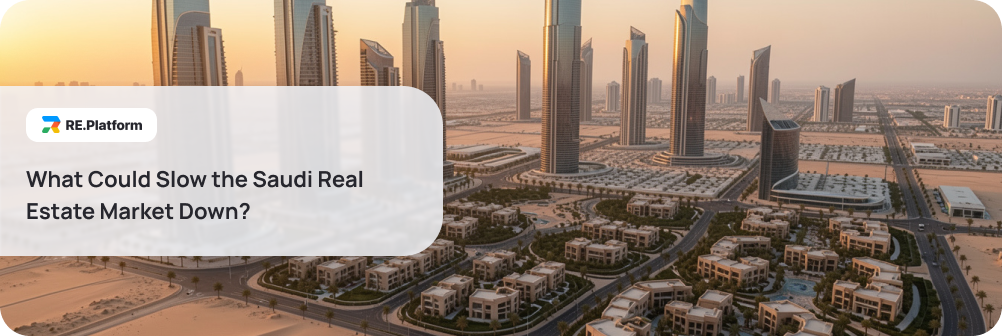
The biggest mistake investors make during fast growth cycles is assuming momentum alone guarantees future performance.
Several factors could eventually slow parts of the Saudi market:
- oversupply in luxury segments,
- speculative investor activity,
- mortgage pressure,
- rising construction costs,
- global economic slowdown,
- or unrealistic pricing expectations.
Execution risk also matters.
Saudi Arabia’s development pipeline is enormous. But large-scale urban transformation takes time, infrastructure coordination, and sustained economic momentum.
Not every project launched during a boom cycle ultimately performs equally well.
This is particularly relevant for investors entering purely because of hype rather than long-term fundamentals.
The Kingdom’s macroeconomic trajectory may remain strong while individual districts, projects, or speculative segments still experience slower growth or pricing corrections.
That distinction becomes critical in maturing markets.
Why Many Investors Still Believe the Market Has Huge Upside
Despite growing concerns around pricing, bullish sentiment toward Saudi Arabia remains extremely strong.
And there are understandable reasons for that.
Saudi Arabia still represents:
- the largest economy in the Arab world,
- one of the region’s fastest urban transformation stories,
- a market with rising international exposure,
- and a country deploying enormous sovereign capital into long-term economic expansion.
Unlike mature global cities where growth has already largely stabilized, Riyadh still feels early to many institutional investors.
This is why the market continues attracting:
- global developers,
- international funds,
- regional family offices,
- and high-net-worth investors seeking long-term positioning.
For many of them, the core thesis is simple:
Saudi Arabia is not merely experiencing a short-term property cycle. It is rebuilding entire urban and economic systems simultaneously.
If that transformation continues successfully over the next decade, today’s pricing levels may eventually look far less aggressive than they appear now.
That is the bet many investors are making.
So, Is Saudi Real Estate Actually Overpriced?
The answer depends entirely on which part of the market investors are looking at.
| Segment | Risk Level in 2026 |
|---|---|
| Prime Riyadh apartments | Medium |
| Luxury speculative launches | High |
| Established residential districts | Lower |
| Early-stage mega developments | Higher |
| Mid-market housing | More stable |
| Institutional-grade projects | Moderate |
Saudi Arabia is not a uniformly overheated market.
Some areas still appear supported by strong long-term fundamentals and genuine housing demand. Others increasingly depend on future expectations, speculative capital, and continued momentum.
That distinction matters enormously in 2026.
The market is becoming more selective.
And investors who continue treating all Saudi real estate as a guaranteed growth story may eventually discover that not every part of the boom performs the same way.