Browse by category


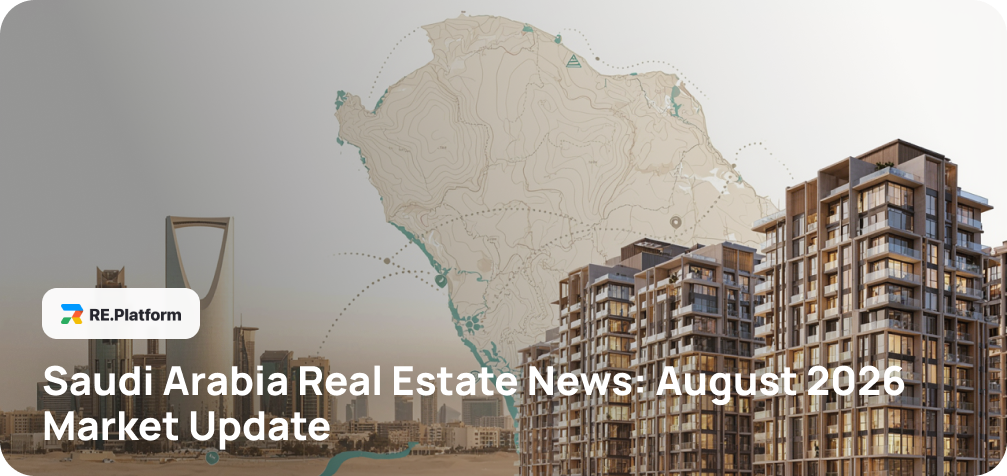
Saudi Arabia’s real estate market entered August 2026 with a very different regulatory landscape from the one investors were looking at at the beginning of the year.
Foreign property ownership is no longer simply a reform scheduled for implementation. The geographic zones are live, applications are moving through the official Saudi Properties platform, and the first practical questions are shifting from whether international buyers will be allowed into the market to where that demand will concentrate.
At the same time, Riyadh is taking further steps to address residential affordability and land supply, while developers continue to lean more heavily on off-plan sales. Current transaction data also shows that activity remains substantial despite the sharp slowdown recorded in the residential market earlier in 2026.
Here are the main Saudi Arabia real estate developments that mattered in August 2026 — and what they tell us about where the market is heading.
Table of Contents
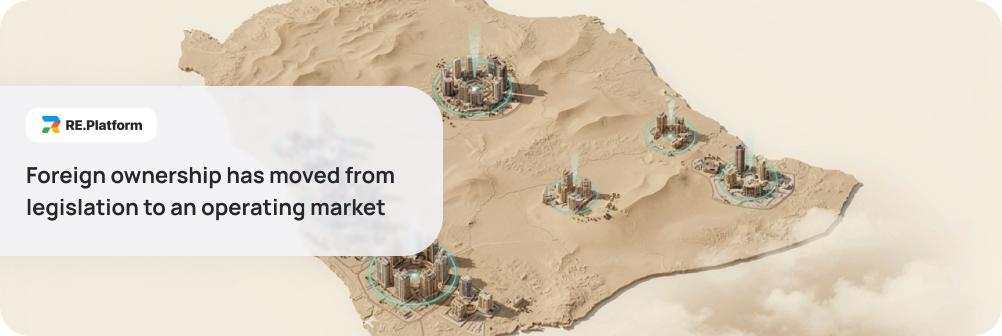
Foreign ownership has moved from legislation to an operating market
The biggest structural real estate story of 2026 continues to develop.
Saudi Arabia’s updated foreign property ownership law came into force on January 22, but the decisive practical step arrived in June, when the geographic ownership zones and executive regulations were approved. By August, this was no longer simply a regulatory announcement: REGA confirmed that the zones are live and applications are being processed through Saudi Properties.
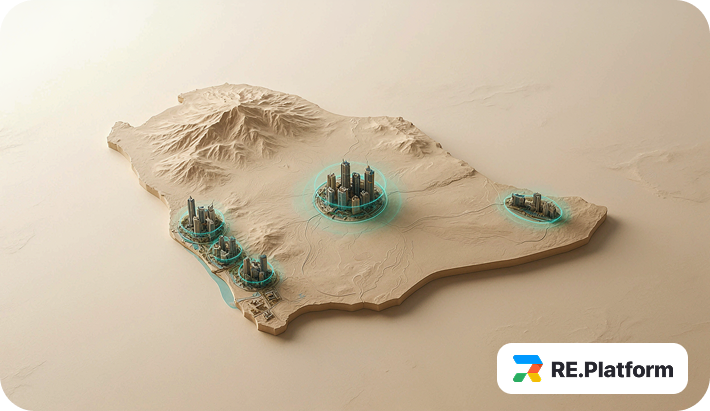
The scale of the initial map is already significant. According to the published geographic framework, Riyadh has nine designated areas, AlUla has 17, while Makkah and Madinah have their own defined zones subject to additional restrictions. Jeddah has the broadest geographic coverage, with dozens of designated areas across the governorate.
The areas involved are also important. This is not a foreign ownership framework limited to isolated residential districts. In Riyadh, approved locations include major development areas such as Qiddiya, New Murabba, Diriyah Gate, King Salman Park, SEDRA and KAFD. The wider framework also covers major destinations including NEOM, The Red Sea and AMAALA.
For investors, this fundamentally changes property search in Saudi Arabia. The relevant question is no longer simply whether a foreigner can buy property in the Kingdom. It is whether a particular project falls inside an approved zone and what ownership rights apply there.
REGA’s official platform now provides interactive geographic maps showing the permitted areas as well as information on ownership percentages, types of rights, duration limits and applicable controls.
That gives international buyers something the market lacked at the beginning of 2026: a government-backed reference point against which individual projects can be checked.
The current foreign ownership map may not be the final one
August also brought an important signal about what happens next.
In comments reported on August 13, REGA left open the possibility that additional foreign ownership zones could be introduced in the future. The regulator did not provide a timetable or identify locations under consideration, but its position indicates that the current map should be viewed as the starting framework rather than necessarily the final geographic footprint.
This matters for both investors and developers.
For investors, properties immediately outside the current zones should not be treated as if future inclusion were guaranteed. Speculating on a future regulatory change is very different from buying within an already approved area.
For developers, however, expansion of the framework could materially change the addressable market for projects that are currently aimed primarily at Saudi buyers.
The distinction will become increasingly important as international marketing of Saudi developments expands. “Available in Saudi Arabia” and “available for foreign ownership” are now two separate things, and the official Saudi Properties map is the reference that separates them.
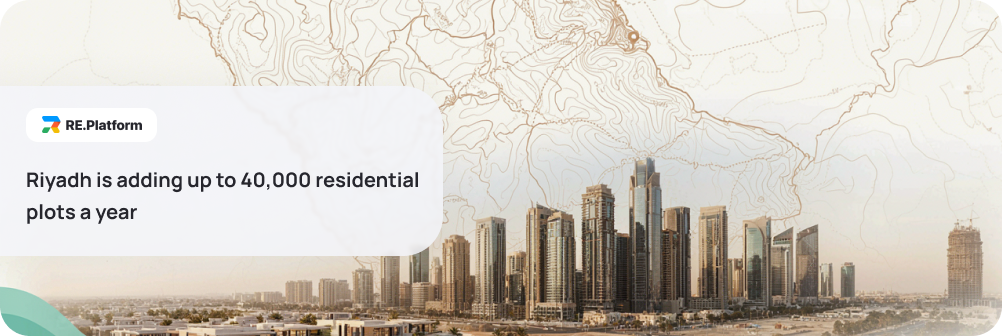
Riyadh is adding up to 40,000 residential plots a year
While foreign ownership is expanding access to the market, Riyadh is dealing with another problem: housing affordability and the availability of residential land.
On August 12, details of the second edition of the Real Estate Balance Program were announced, with applications opening on August 16.
The program is designed to make between 10,000 and 40,000 developed residential plots available annually over the next five years, with prices capped at SAR 1,500 per square meter for eligible beneficiaries.
This is a substantial supply-side intervention.
Riyadh has experienced some of Saudi Arabia’s strongest property price growth over recent years as population growth, corporate relocation, major infrastructure investment and new development have increased demand for housing.
The Real Estate Balance Program is designed to increase planned land supply and improve the balance between demand and available residential stock. Allocation is not immediate: eligible applicants are identified first, followed by a lottery, plot allocation, off-plan sale procedures and ultimately ownership.
For the broader market, the program matters beyond the plots themselves.
Additional serviced land can influence development activity, particularly in expanding residential areas, while the SAR 1,500 per square meter ceiling creates a policy-led affordability benchmark for part of the Riyadh land market.
It does not mean private land prices across the capital will suddenly reset to that level. But it does show that housing supply and affordability remain active policy priorities rather than issues being left entirely to market forces.
Off-plan sales are becoming more important to Saudi developers
August financial disclosures from Saudi real estate companies provide another useful signal: off-plan development is becoming increasingly important to developer revenue models.
Al Ramz Real Estate disclosed that its off-plan sales reached SAR 94.2 million in Q2 2026, up from SAR 45.5 million in the previous quarter. On a year-on-year basis, the company said off-plan sales had increased 5.3 times. Its quarterly revenue rose 52.8% from Q1, supported by off-plan sales, completed-unit sales and other development activity.
The numbers relate to one company and should not be treated as a proxy for the entire Saudi market. But they fit a broader development model that is becoming increasingly visible across the Kingdom.
Rather than financing projects almost entirely through completed inventory, developers can use regulated off-plan sales to bring buyers into projects earlier in the construction cycle.
Another Saudi developer, Al Majdiah, reported in early August that its first-half performance was supported by its continued shift toward off-plan sales and a contracted sales pipeline across projects under development.
For buyers, this creates more choice at earlier project stages. For developers, it changes the sales operation itself: inventory management, payment schedules, lead conversion and project-level data become increasingly important when units are sold across multiple construction phases.
It also makes project due diligence more important. A lower entry price at launch is not enough on its own; investors need to understand the developer, regulatory status, construction timeline and the actual demand profile around the project.
The Saudi residential market is still working through an affordability reset
The August headlines should not obscure what happened earlier in the year.
Saudi Arabia’s residential market entered 2026 with a significant slowdown in transaction activity. Knight Frank reported that national residential transaction volumes fell 50% year on year in Q1 2026, while transaction values declined 57% to SAR 22 billion. Riyadh recorded an even sharper decline, with both volumes and values down 82% year on year during the quarter.
Affordability pressure, weaker mortgage demand and regional uncertainty were among the factors behind the slowdown.
That context makes the August developments more meaningful.
The government is increasing access to residential land in Riyadh. Developers are relying more heavily on off-plan structures. Foreign ownership has introduced a new buyer pool in selected zones. Together, these are not signs of a market simply returning to the conditions of 2024 or 2025. They point toward a different structure of demand and supply.
Current REGA data also shows that the market remains active in absolute terms. On August 24 alone, the official Real Estate Indicators platform recorded 839 transactions worth SAR 581.5 million, covering around 10 million square meters.
That daily figure should not be used to claim that the earlier residential slowdown has reversed — one day of transactions cannot establish a trend. What it does show is that the Saudi property market continues to process meaningful volumes of activity while the composition of demand changes.
Riyadh residential land remains central to market activity
Another detail in REGA’s current indicators is worth watching.
The platform identifies Ar Rimal in Riyadh as the most active district in the displayed transaction dataset, while residential land is the most active property type.
This fits the broader direction of the capital.
Riyadh’s real estate story is not only about high-profile towers, branded residences or projects around KAFD. A large part of the underlying market remains tied to land, suburban expansion and the creation of new residential communities.
That is also why the Real Estate Balance Program matters. Land availability affects the pipeline long before a new apartment or villa reaches the market.
For developers evaluating future projects, tracking land transactions alongside completed residential prices can provide an earlier indication of where new supply may emerge.
Saudi Arabia is also tightening market supervision
The regulatory opening of the property market is happening alongside stronger oversight.
REGA has continued inspection and digital monitoring activity across the sector, with a particular focus on compliance with the Real Estate Brokerage Law and rules governing property advertising.
Its August activity included joint inspections of real estate establishments in Riyadh, the Eastern Region, Makkah and Al-Qassim, while the regulator also continued electronic scanning of online platforms and property websites.
This may sound less significant than a new giga-project announcement, but it is an important part of the market’s development.
Saudi Arabia is trying to attract more institutional and international capital at the same time as property marketing becomes increasingly digital. That requires a market where developers, brokers and online platforms operate within clearer rules.
For foreign buyers in particular, this matters. As more projects begin advertising internationally, the ability to distinguish licensed activity and verified projects from unsubstantiated marketing claims will become increasingly important.
Housing policy is moving beyond construction alone
On August 16, Sakani launched “Sakani Season” in Jeddah, bringing together 16 participating developers and key partners. The initiative is designed around housing ownership and integrated residential solutions rather than simply presenting individual units for sale.
In isolation, this is a relatively small news item. In the wider context of Saudi housing policy, however, it reflects a continuing shift toward connecting property supply, financing and the purchase process.
That direction can already be seen in Sakani’s digital services, where eligible buyers can select or reserve a property and request financing offers from participating institutions through the same ecosystem.
For the residential market, access to supply is only one part of affordability. Financing availability and the ability to move efficiently from property discovery to mortgage approval matter just as much.
This becomes particularly relevant in a higher-priced market such as Riyadh, where affordability pressures have already contributed to weaker transaction volumes.
What August 2026 tells us about Saudi real estate
The most important development this month is not one isolated project or transaction.
It is that several pieces of Saudi Arabia’s next real estate cycle are beginning to operate at the same time.
| Market area | August 2026 signal | Why it matters |
|---|---|---|
| Foreign ownership | Approved zones are live | International demand can enter defined areas |
| Riyadh housing | Up to 40,000 plots annually | Direct response to land supply and affordability |
| Off-plan market | Stronger developer sales | Earlier-stage project sales are gaining importance |
| Transactions | Active daily deal flow | Market remains liquid despite the Q1 slowdown |
| Regulation | Continued REGA supervision | Greater emphasis on transparency and compliance |
| Homeownership | New Sakani initiatives | Financing and purchase access remain policy priorities |
The market is therefore becoming more complex, not simply larger.
International buyers now have a legal route into selected projects. Saudi buyers are being supported through new land and homeownership initiatives. Developers are increasingly selling inventory before completion. Regulators are simultaneously expanding market access and increasing oversight.
For anyone evaluating Saudi real estate, this makes project-level analysis more important than headline market averages.
What to watch next
The final months of 2026 should provide the first meaningful evidence of how the foreign ownership reform is affecting actual demand.
The key question is not simply how many international buyers submit applications. What matters is where that demand concentrates: established Riyadh projects, Jeddah, Red Sea destinations, giga-projects or other approved areas.
The possible expansion of foreign ownership zones is another development to monitor. REGA has kept that option open but has not announced when or where additional areas could be introduced.
Riyadh’s land policy will also deserve attention. If the Real Estate Balance Program consistently brings substantial volumes of developed plots to market, it could affect the economics of residential development over a much longer horizon.
And finally, off-plan sales should be watched closely. The August corporate disclosures are not enough to establish a market-wide trend on their own, but they reinforce the growing importance of project-stage sales in Saudi development.
For investors and developers, the Saudi real estate market at the end of August looks markedly different from the one that entered 2026. The market has not simply “opened to foreigners.” It is simultaneously becoming more regulated, more project-driven and more transparent — while policymakers continue to address the affordability constraints created by years of rapid growth.