Browse by category


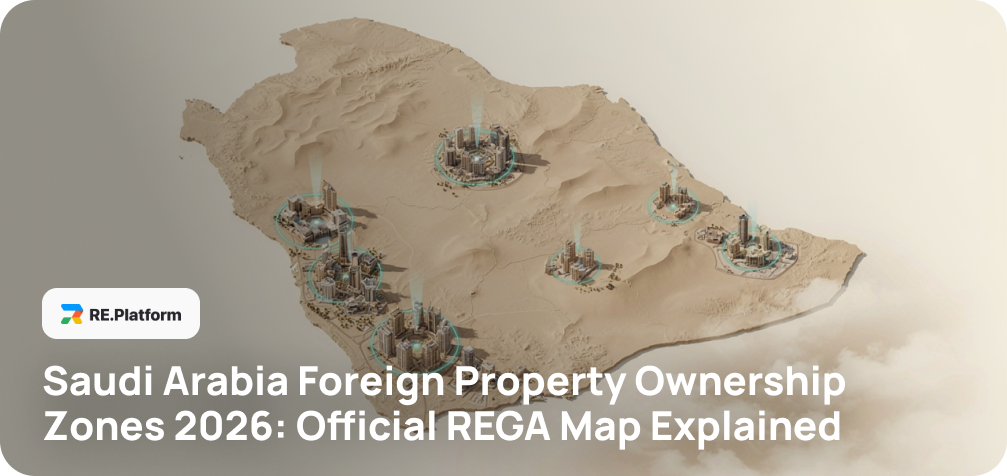
Saudi Arabia has now published the geographic framework that determines where non-Saudis can own real estate under the Kingdom’s new foreign ownership regime.
This is a major practical development for the market. The updated real estate ownership law entered into force on January 22, 2026, but for several months one of the most important questions remained unresolved: which areas would actually be open to foreign property ownership?
That question now has a much clearer answer.
Following approval of the executive regulations and geographic zones in June 2026, the Saudi Properties platform now provides an official interactive map showing the areas covered by the new framework.
For international investors, developers and buyers, this is arguably more important than the law taking effect on its own. The market now has a geographic reference that can be used to determine whether a project sits within an area where foreign ownership is permitted.
Table of Contents
What the Saudi Properties Zones Map Actually Shows
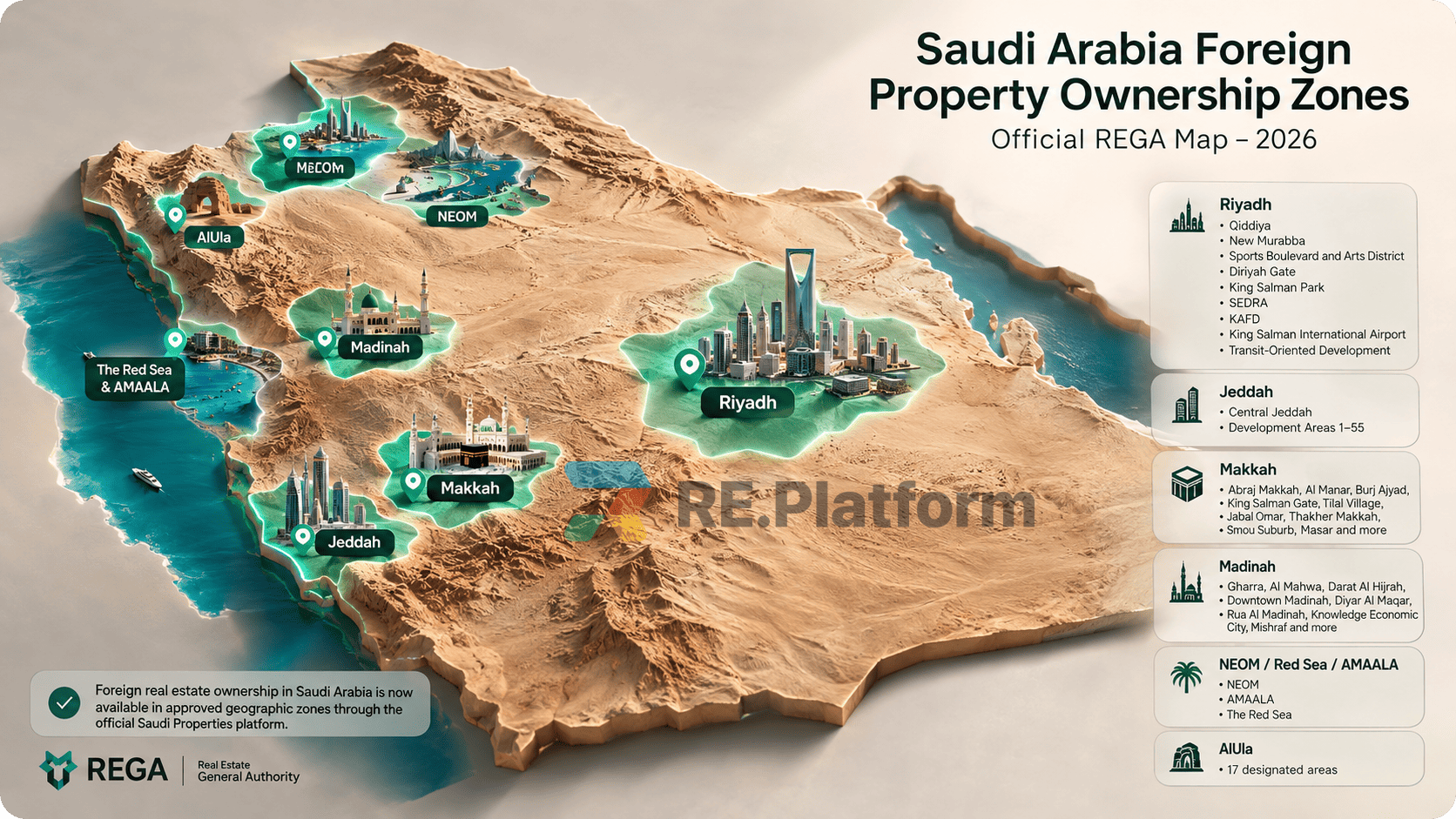
The new Saudi Properties map is not simply a list of cities where foreigners can buy property.
Saudi Arabia has adopted a more granular approach. Foreign ownership is structured around individual geographic zones, major developments and designated territories rather than giving non-Saudis unrestricted access to an entire city or region.
Depending on the zone, the regulatory framework may define:
- which real estate rights non-Saudis can acquire;
- the maximum permitted level of foreign ownership;
- applicable ownership or usufruct periods;
- additional conditions attached to the geographic area.
This means that two projects located in the same city may not necessarily have the same foreign ownership status.
For buyers, the correct starting point is therefore no longer simply “Can foreigners buy in Riyadh?” or “Can foreigners buy in Jeddah?”
The more relevant question is:
Is this particular development located within an approved foreign ownership zone?
Foreign Property Ownership Zones in Riyadh
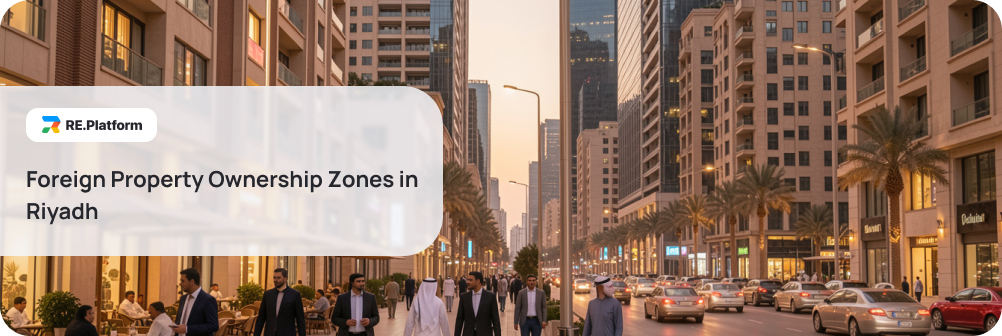
Riyadh contains some of the most strategically important areas included in the new ownership framework.
The approved geographic areas include:
| Riyadh zone | Development profile |
|---|---|
| Qiddiya | Large-scale entertainment and lifestyle development |
| New Murabba | Major new urban district |
| Sports Boulevard and Arts District | Urban development corridor |
| Diriyah Gate | Heritage-led mixed-use development |
| King Salman Park | Major urban regeneration project |
| SEDRA | Large residential community |
| KAFD | Business and mixed-use district |
| King Salman International Airport | Strategic development area |
| Transit-Oriented Development | Transport-linked urban zones |
The composition of this list is important.
Foreign ownership in Riyadh has not been concentrated only in existing residential neighborhoods. Instead, many of the approved areas are connected directly to the capital’s future urban expansion.
That creates a different investment environment from simply opening established housing stock to international buyers.
Projects around new business districts, major infrastructure corridors and large master-planned communities may now become part of the international property market as those areas mature.
At the same time, a development being marketed as “North Riyadh” or “near KAFD” should not automatically be assumed to qualify. Buyers still need to compare the exact location with the official Saudi Properties map.
Jeddah Foreign Ownership Zones
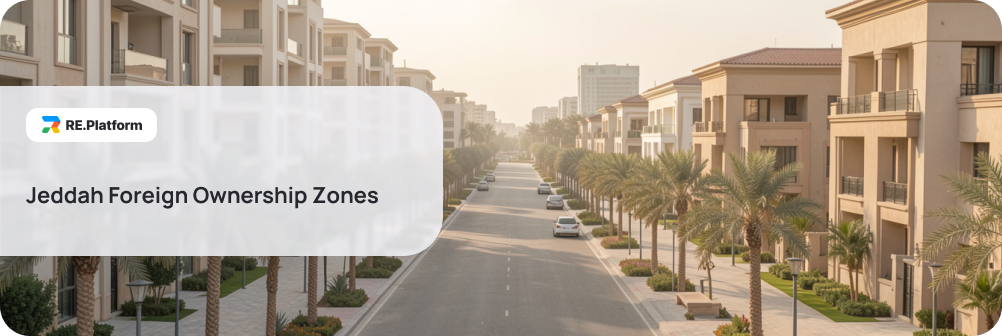
Jeddah has a broader geographic structure under the new framework.
The approved areas include Central Jeddah together with Development Areas 1 through 55 across Jeddah Governorate.
This potentially gives international buyers exposure to a wide variety of property formats.
Jeddah already combines established residential districts with new waterfront projects, apartments, villas, townhouses and large mixed-use developments. Its extensive geographic framework could therefore make the city one of the most diverse markets for foreign property ownership in the Kingdom.
The key distinction remains the same: foreign ownership is based on the approved geographic boundary, not simply on being located somewhere within Jeddah. For anyone evaluating property there, checking the official map should come before comparing prices or contacting developers.
Makkah Has Approved Zones — But Special Rules Still Apply
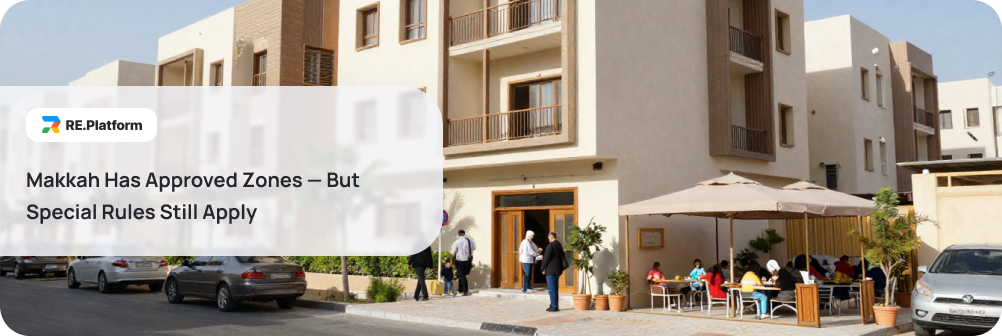
Makkah is also included on the foreign ownership map.
Designated areas include:
Abraj Makkah, Al Manar, Burj Ajyad, King Salman Gate, Tilal Village, Jabal Omar, Thakher Makkah, Smou Suburb, Masar and additional approved zones.
This is a significant development because it provides a clearly defined geographic structure for a market that has historically been subject to particularly strict ownership restrictions.
However, the existence of approved zones does not mean Makkah is generally open to all international buyers. Foreign natural persons can acquire permitted real estate rights in Makkah only if they are Muslim.
For that reason, Makkah needs to be treated separately from markets such as Riyadh and Jeddah when evaluating the scope of foreign ownership.
Foreign Ownership Zones in Madinah
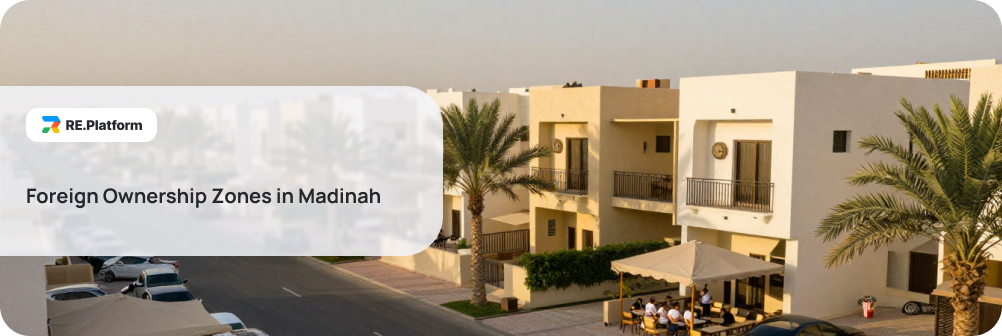
Madinah follows a similar model.
The published areas include locations such as:
- Gharra;
- Al Mahwa;
- Darat Al Hijrah;
- Downtown Madinah;
- Diyar Al Maqar;
- Rua Al Madinah;
- Knowledge Economic City;
- Mishraf;
- additional designated zones.
For foreign individuals, the same core restriction applies as in Makkah: the buyer must be Muslim.
The publication of these zones nevertheless creates much greater clarity around where eligible international ownership can take place.
Projects such as Rua Al Madinah and Knowledge Economic City can now be evaluated within a formal geographic ownership framework rather than through general assumptions about access to the Madinah property market.
NEOM, The Red Sea and AMAALA Are Also Included
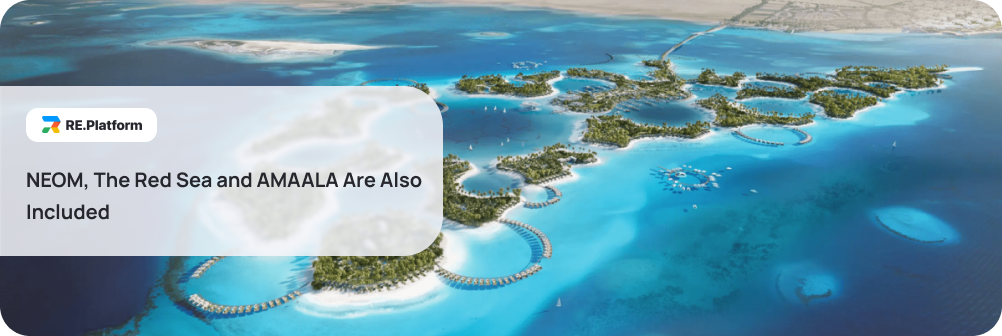
The new map extends well beyond Saudi Arabia’s traditional major cities.
The approved framework includes some of the Kingdom’s highest-profile development destinations, including:
NEOM, AMAALA and The Red Sea.
This is particularly relevant for international investors because these projects have been marketed globally for years.
Until now, international interest in many Saudi giga-projects developed faster than the legal framework for direct property ownership by overseas individuals.
The publication of approved geographic zones brings the regulatory structure closer to the scale of international demand already surrounding these developments.
It also means that the future foreign property market in Saudi Arabia is likely to look very different from a conventional city-based real estate market.
International ownership may be concentrated around a combination of major urban districts, lifestyle developments, tourism destinations and government-backed master plans.
AlUla and Other Designated Territories
AlUla has also been included in the new framework, with multiple designated geographic areas.
This adds another important category to the foreign property market: destination-driven real estate linked to tourism, hospitality and heritage development.
Special economic areas are included as well, among them:
- King Abdullah Economic City;
- Jazan Special Economic Zone;
- Ras Al Khair Special Economic Zone.
Taken together, the published zones show that Saudi Arabia is not opening its market through one uniform nationwide rule.
Instead, foreign ownership is being integrated into specific parts of the country according to broader development priorities.
Foreign Ownership Is Now a Zone-Level Question
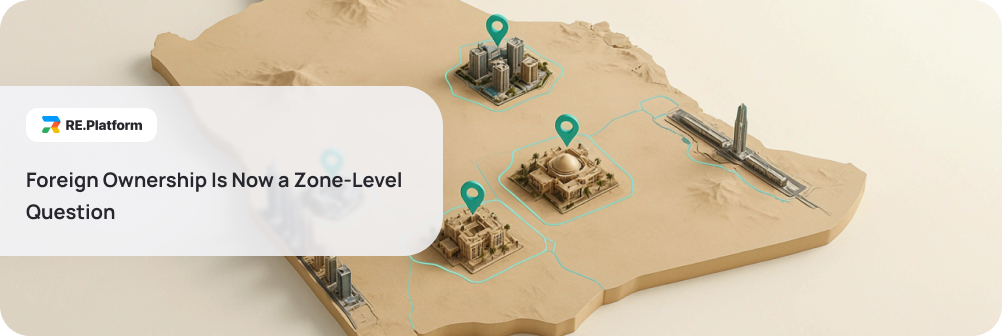
This is the most important change for investors to understand.
Previously, international buyers often approached the Saudi market through broad questions:
- “Can I buy property in Riyadh?”
- “Can foreigners buy in Jeddah?”
- “Is NEOM available to international investors?”
The new framework makes these questions too broad.
The Saudi market now needs to be analysed at a much more precise level:
city → geographic zone → development → property → permitted ownership right.
That distinction will become increasingly important as more projects begin marketing directly to international buyers.
A project being located in Riyadh is not enough.A project being located near an approved area is not enough. And a developer advertising internationally is not, by itself, proof that a particular property is eligible for foreign ownership.
The Saudi Properties map is now the primary geographic reference.
How the Main Areas Compare
| Location | Foreign ownership framework | Key characteristic |
| Riyadh | Selected strategic zones | Major urban and giga-project corridors |
| Jeddah | Central Jeddah + Development Areas | Broad metropolitan coverage |
| Makkah | Selected zones | Muslim foreign individuals only |
| Madinah | Selected zones | Muslim foreign individuals only |
| NEOM | Included | Giga-project development |
| The Red Sea | Included | Tourism and lifestyle real estate |
| AMAALA | Included | Premium tourism development |
| AlUla | Multiple designated areas | Heritage and destination development |
This makes it easier to see how different the structure is from a conventional foreign ownership model.
Saudi Arabia has not simply marked several cities as “open.”
It has created a controlled network of investment territories with different development profiles and regulatory characteristics.
Why the Map Matters for Off-Plan Property
The new geographic framework is particularly important for off-plan real estate.
Saudi Arabia’s new residential supply is heavily concentrated in large developer-led projects. Many units are marketed before completion, particularly within new master-planned communities and giga-projects.
For foreign buyers, that creates two separate layers of due diligence.
The first question is geographic:
Is the project located within an approved foreign ownership zone?
The second is project-specific:
Is the development itself properly authorised, and does the particular property fall within the rights available to the buyer?
These checks should not be confused.
A project can be situated within an internationally marketed development area without every individual unit automatically being available to every category of foreign purchaser.
That is why the Saudi Properties map should be treated as the beginning of the verification process rather than the end of it.
What the New Zones Mean for Developers
The changes matter just as much to Saudi developers as they do to buyers.
International marketing used to face an obvious limitation: generating foreign demand was relatively easy, but converting that demand into ownership was far more complicated. The new geographic framework gives developers operating within approved zones a much clearer foundation for international sales.
That could influence everything from project positioning and payment structures to multilingual marketing and international broker networks. It may also change which projects compete most aggressively for foreign capital.
Developments located inside approved areas now have a regulatory advantage over otherwise comparable projects outside the foreign ownership geography.
The Map Does Not Mean the Entire Saudi Market Is Open
The publication of the ownership zones is a genuine market opening, but it should be described accurately.
Saudi Arabia has not introduced unrestricted foreign ownership across the entire country. Ownership remains subject to designated areas, buyer eligibility and the specific rights permitted under the applicable rules.
Makkah and Madinah have additional restrictions. Foreign residents also operate under a somewhat different framework from non-resident international investors.
These distinctions matter because inaccurate claims such as “foreigners can now buy anywhere in Saudi Arabia” could lead buyers to evaluate projects that are not actually available to them.
The more accurate description is:
Saudi Arabia now has an operational, geographically defined foreign property ownership market.
That is the real significance of the Saudi Properties map.
What Changed in June 2026?
The timing is worth clarifying.
The updated Law of Real Estate Ownership by Non-Saudis became effective on January 22, 2026.
At that point, the legal framework had changed, but investors were still waiting for the geographic areas that would determine where many foreign ownership rights could actually be exercised.
On June 23, 2026, the Council of Ministers approved the executive regulations and geographic zones. That second step converted what had largely been a legal framework into a much more practical market structure.
For anyone tracking Saudi real estate, this is why the publication of the zones is arguably one of the most important property-market developments of 2026.
A New Way to Analyse Saudi Real Estate
The impact of the new framework will become clearer over time, but one immediate change is already obvious.
Foreign investors can now incorporate regulatory geography directly into project analysis. Instead of starting with every project available in Riyadh or Jeddah and filtering later, buyers can first identify approved territories and then compare developments operating inside those zones.
That makes project discovery more structured.
It also increases the value of platforms that organize Saudi real estate at the project level rather than relying solely on individual property listings.
As international access expands, understanding where development is happening and whether that development sits inside an eligible ownership zone will become one of the basic filters for evaluating Saudi real estate.
FAQ
Has Saudi Arabia officially published foreign property ownership zones?
Yes. Geographic zones have now been approved under the 2026 non-Saudi real estate ownership framework and are displayed through the Saudi Properties platform.
Where can foreigners own property in Riyadh?
The designated Riyadh areas include Qiddiya, New Murabba, Diriyah Gate, King Salman Park, SEDRA, KAFD, Sports Boulevard and several other strategic development zones.
Is all of Riyadh open to foreign property buyers?
No. Foreign ownership is structured around approved geographic areas rather than unrestricted access to the entire city.
Where can foreigners buy property in Jeddah?
The framework includes Central Jeddah and Development Areas 1 through 55 within Jeddah Governorate. Individual developments should still be checked against the official map and applicable ownership conditions.
Is Makkah included on the Saudi foreign ownership map?
Yes. Multiple Makkah zones have been designated, but foreign natural persons must be Muslim to acquire the relevant real estate rights there.
Is Madinah open to foreign buyers?
Designated areas in Madinah are included in the framework. Foreign natural persons must be Muslim.
Is NEOM included in the new foreign ownership zones?
Yes. NEOM is included within the approved geographic framework, alongside The Red Sea and AMAALA.
Does being inside an approved zone automatically mean a foreigner can buy any property there?
Not necessarily. The applicable ownership right, buyer category, project status and any zone-specific conditions still need to be verified.
Where should investors check the latest zones?
The official Saudi Properties geographic map should be used as the primary source for determining whether a location falls within the foreign ownership framework.