Browse by category


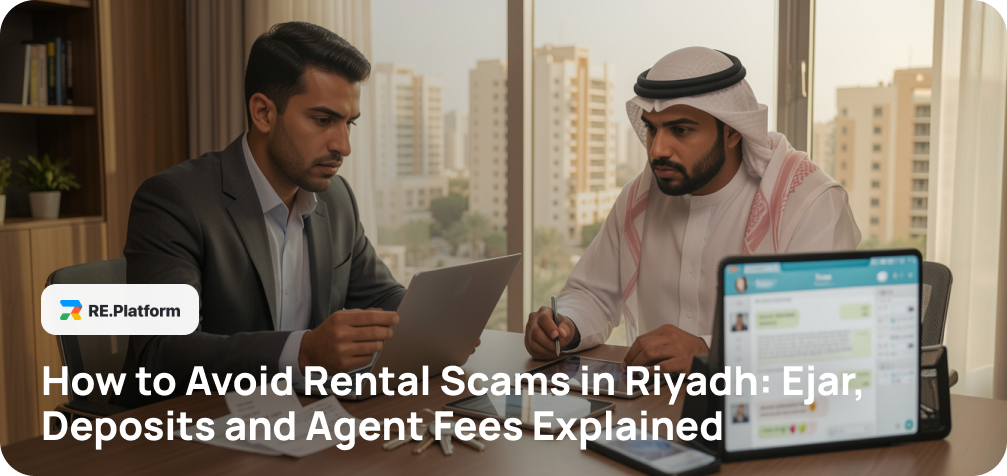
The safest way to avoid rental scams in Riyadh is not to trust speed. Do not send large payments before the property, broker, landlord, contract terms, deposit, payment schedule and payment channel are clear. A legitimate rental process should make every important detail traceable before money changes hands.
For newcomers, this can feel uncomfortable. Riyadh moves fast. Good apartments can disappear quickly. Brokers often communicate through WhatsApp. Some landlords prefer large upfront payments. Expats may be trying to find a home before a new job starts, before a family arrives or before temporary accommodation runs out.
That pressure is exactly where mistakes happen.
A safe rental decision in Riyadh is not built on listing photos, verbal promises or a “send deposit now” message. It is built on verification, Ejar documentation, clear payment terms and written evidence of the apartment’s condition before move-in. If the process becomes more confusing as you move closer to payment, that is not a small inconvenience. It is a warning sign.
Table of Contents
Quick Answer: How Do You Avoid Rental Scams in Riyadh?
To avoid rental scams in Riyadh, verify the property and broker, review the Ejar contract before approval, confirm the rent, deposit, payment method and agent fee in writing, avoid urgent transfers to unclear personal accounts, and document the apartment condition at handover.
The safest tenant is not the one who finds the cheapest listing. It is the one who slows down at the right moment. Before paying anything meaningful, the tenant should know who is receiving the money, why it is being paid, whether the contract is visible in the proper documentation process, and whether the payment method matches the agreed rental terms.
| Safe step | Why it matters |
|---|---|
| Verify the property | Reduces fake listing and bait-and-switch risk |
| Verify the broker or landlord | Confirms who has authority to offer the unit |
| Review the Ejar contract | Confirms the parties, rent, deposit, dates and payment method |
| Clarify the agent fee | Prevents surprise charges before signing |
| Avoid unclear upfront transfers | Reduces loss risk before documentation |
| Record handover condition | Protects the deposit at move-out |
| Keep all evidence | Helps if a dispute appears later |
This does not mean tenants should be paranoid. It means they should treat renting in Riyadh as a formal financial decision, not as a casual chat-based transaction.
Why Rental Scams Happen in Riyadh
Rental scams and rental disputes happen in Riyadh because the market combines high demand, fast relocation, large payments and uneven tenant knowledge. A newcomer may understand the rent amount but not the local process. They may know the district they want but not how Ejar works. They may have a housing allowance but not know whether rent is paid monthly, semi-annually or annually.
The risk is not always a sophisticated fake identity scheme. Many losses come from simple process failures. A tenant sends a deposit before seeing the real unit. A broker gives vague payment instructions. A listing uses old photos. A landlord promises maintenance but the contract does not mention it. A furnished apartment is handed over without inventory. A tenant moves out and then discovers that the deposit is being disputed because the move-in condition was never documented.
In a fast market, weak documentation can become as damaging as fraud.
Riyadh’s rental market is also highly fragmented. A premium district name does not guarantee a professional rental process. A beautiful apartment does not guarantee proper parking. A friendly broker does not guarantee clear paperwork. A cheap listing does not guarantee a bargain. Tenants need to separate the appeal of the property from the safety of the transaction.
The Most Common Rental Scam Scenarios in Riyadh
The most common risk pattern is the fake or unavailable listing. The apartment looks attractive, the price is slightly below market, and the broker says demand is high. The tenant is asked to send a deposit quickly to hold the unit. Later, the apartment is suddenly unavailable, the terms change, or the person stops responding.
Another common scenario is copied listing photos. The property may not exist, may not be in the advertised district, or may belong to another listing entirely. This is easier to miss when the tenant searches remotely and relies on photos, location pins and short videos.
A third scenario is the “real apartment, different terms” problem. The apartment exists, but the rent, deposit, move-in date, furnishing, maintenance responsibility or payment schedule changes after the tenant has emotionally committed. This is not always fraud, but it is still a risk. A tenant who has already sent money has less leverage.
A fourth scenario involves an unclear broker. The person showing the apartment may not have authority to represent the landlord, or the fee arrangement may be hidden until late in the process. Sometimes the agent fee is presented as normal only after the tenant has spent time viewing and negotiating.
A fifth scenario is deposit confusion. The tenant thinks the payment is refundable if the deal does not proceed. The broker says it was a booking fee. The landlord says they did not receive it. Without proper documentation, the tenant is left with screenshots instead of protection.
| Scenario | What usually happens | How to reduce the risk |
| Fake listing | Photos and price attract the tenant, but the unit is not real or available | Request a viewing, live video and clear property details |
| Urgent deposit | Tenant is pressured to transfer money before verification | Refuse large payments before documentation |
| Copied photos | Listing images belong to another unit or district | Ask for a live walkthrough showing building and surroundings |
| Real unit, changed terms | Price or conditions change after viewing | Put commercial terms in writing before approval |
| Unclear broker | Agent role and fee are not transparent | Confirm broker details and fee upfront |
| Deposit dispute | Move-in condition was never recorded | Use photos, videos and inventory at handover |
The pattern is consistent: the scam or dispute works because the tenant moves faster than the documentation.
What a Legitimate Rental Process Should Look Like
A legitimate rental process in Riyadh should feel structured. It can still move quickly, but each step should make the deal clearer, not more vague.
First, the tenant identifies a property and requests basic details: exact location, unit type, size, rent, payment schedule, deposit, furnishing, maintenance responsibility and move-in date. If the tenant is outside Riyadh, a live video call is better than a pre-recorded clip. The video should show the building entrance, street, parking, elevator, apartment number area, kitchen, bathrooms, AC units, windows and any visible defects.
Second, the tenant verifies who is involved. Is the person a licensed broker, the landlord, the landlord’s representative or just a listing contact? The tenant should know who will prepare the contract, who receives payment, and who handles handover.
Third, the commercial terms should be agreed before payment. This includes rent, deposit, payment frequency, agent fee, utilities, maintenance obligations, furnishing inventory and cancellation or early termination terms. If the property is furnished, the tenant should request a written inventory before move-in.
Fourth, the contract should be documented and reviewed. The tenant should not treat the contract as something that appears after the deposit. The contract is the central protection layer.
Fifth, payment should follow the documented process. If payment instructions do not match the contract structure, the tenant should pause and ask questions.
A safe rental process is not about trusting nobody. It is about making sure trust is backed by documents, traceable payments and clear responsibilities.
What Must Be Clear Before You Pay Anything
Before paying a deposit, booking fee, agent fee or first rent installment, several things should already be clear. If they are not clear, the tenant is not ready to pay.
| Before payment | What should be clear |
| Property identity | Exact unit, building, location and availability |
| Landlord or representative | Who owns or legally represents the property |
| Broker role | Whether a broker is involved and what they do |
| Rent | Annual rent and whether any discounts or conditions apply |
| Payment schedule | Monthly, quarterly, semi-annual or annual payment terms |
| Deposit | Amount, purpose, holding method and return conditions |
| Agent fee | Amount, timing and who pays it |
| Maintenance | Who handles AC, plumbing, appliances and building issues |
| Furnishing | What is included and in what condition |
| Contract process | How the lease will be documented through Ejar |
| Payment method | Where the money goes and how it is recorded |
| Move-in date | When keys are handed over and in what condition |
The most dangerous phrase is “pay now and we will sort the details later.” In a safe rental transaction, the details come before the money.
What Is Ejar and Why Does It Matter?
Ejar is the official rental services network used in Saudi Arabia to regulate and document rental relationships. For tenants in Riyadh, it matters because it creates a formal structure around the landlord, tenant, broker, contract, rent, deposit and payment method.
A properly documented rental contract should include the personal information and address of the landlord, tenant and real estate broker, the contract start and end dates, rent, security deposit amount, payment method and the general obligations of both landlord and tenant.
This is important because many rental problems begin where documentation is weak. A tenant may have a WhatsApp message saying the landlord will fix the AC. A broker may verbally promise the deposit is fully refundable. A landlord may say that parking is included. If those terms are not documented clearly, they become harder to enforce later.
Ejar should not be treated as a box to tick after the real deal is done. It should be part of the deal itself. The tenant should review the contract details carefully before approving anything or making major payments.
For expats, the practical rule is straightforward: if someone wants serious money but avoids explaining the Ejar process, the risk is too high.
How Ejar Helps — and What It Does Not Solve
Ejar helps by formalizing the rental relationship. It makes the contract more transparent, records key commercial terms and supports a more regulated payment and deposit process. That is a major improvement over informal rental arrangements.
But Ejar does not replace due diligence.
Ejar will not tell the tenant whether the apartment is noisy at night. It will not guarantee that the parking is convenient. It will not inspect the AC. It will not decide whether the furniture is worn out. It will not automatically make a poor building good. It will not fix a bad commute.
This distinction matters. Tenants sometimes think that once a contract is documented, every practical risk disappears. That is not true. Documentation protects the legal and financial structure of the lease. The tenant still has to inspect the property, understand the building, test the commute, document the handover condition and make sure every important promise appears in writing.
Ejar is a protection layer. It is not a substitute for judgment.
Rent Payments: Why the Payment Channel Matters
For new residential lease contracts, rent payments in Saudi Arabia have been increasingly directed through Ejar’s digital channels. REGA has stated that rent payments made outside Ejar’s designated digital channels for new residential lease contracts are not recognized as valid proof of payment.
For tenants, the lesson is simple: payment should be documented and aligned with the contract. A request to transfer rent to an unrelated personal account before contract documentation should be treated as a red flag.
This does not mean every personal bank transfer in every situation is automatically fraud. It means the tenant should ask why the requested payment method does not match the formal process. Who receives the money? Is the recipient the landlord registered in the contract? Is the payment reflected in Ejar? What proof will the tenant have if the payment is disputed?
In Riyadh, a payment without traceability is not just inconvenient. It can become expensive.
Security Deposits: What Tenants Should Check
The security deposit is one of the most sensitive parts of a rental agreement. Tenants often treat it as a routine payment, but deposit disputes are common when the move-in condition is not documented or the return rules are vague.
A deposit should not feel like an informal transfer to “reserve” the apartment. It should be tied to the contract and clearly described: how much it is, when it is paid, how it is held, what it can be used for and when it can be returned.
Ejar’s security deposit holding service is designed to reserve the deposit through the tenant’s Ejar wallet after the broker registers the contract and enters the deposit amount. If a deposit is specified, it should be registered and held through Ejar. The system relies on the Move-in/Move-out form to process refunds and settlements after contract termination or cancellation.
That makes the handover form very important. The tenant should not treat handover as a quick key exchange. It is a financial record.
Before move-in, tenants should take clear photos and videos of walls, flooring, doors, windows, bathrooms, kitchen surfaces, appliances, air conditioning, furniture, lighting, parking access and any visible defects. If the apartment is furnished, every item should be recorded.
The goal is not to create conflict with the landlord. The goal is to prevent disagreement later.
Deposit Refund Disputes: How They Usually Start
Deposit disputes usually start with a mismatch between memory and evidence. The tenant says a scratch was already there. The landlord says it was new. The tenant says the AC was weak from day one. The landlord says it was working. The tenant says the sofa was already damaged. The landlord says it was handed over in good condition.
Without move-in evidence, the dispute becomes harder to resolve.
This is especially important in furnished apartments. A furnished unit may include appliances, sofas, beds, mattresses, curtains, televisions, kitchen equipment, dining tables and decorative items. Each item can become a source of disagreement if it is missing, damaged or poorly recorded.
A tenant should ask for an inventory and review it carefully. If something is missing, damaged or different from the list, it should be documented immediately. The same applies to cleanliness. If the apartment is handed over with stains, broken items or maintenance issues, the tenant should record them before occupying the unit fully.
At move-out, the tenant should try to make the return process equally clear: cleaning, photos, videos, handover appointment and written confirmation of any deductions or refund amount.
The strongest deposit protection is not arguing well later. It is documenting well early.
Agent Fees: What Should Be Agreed Upfront
Agent fees are not automatically suspicious. Brokers are part of Riyadh’s rental market, and a professional broker can help coordinate viewings, explain terms, document the lease and support handover.
The issue is not the existence of a fee. The issue is uncertainty.
The tenant should ask early: how much is the fee, who charges it, when is it due, what service does it cover and is it payable only if the lease is completed? If the broker avoids a clear answer, that is a problem.
A late agent fee creates pressure. The tenant may already like the apartment, have negotiated with family, planned the move, arranged funds and rejected other options. At that point, a surprise fee feels harder to challenge.
A professional broker should be able to explain their role. Are they representing the landlord? Are they only introducing the unit? Will they prepare or support Ejar documentation? Will they attend handover? Will they help resolve early maintenance issues? The answer affects whether the fee feels justified.
Broker fee clarity should come before payment, not after commitment.
Payment Schedule and Upfront Rent
Riyadh tenants should not assume rent will be paid monthly. Depending on the property and agreement, landlords may request semi-annual or annual payments. This is one of the biggest surprises for expats arriving from markets where monthly rent is standard.
A tenant may be able to afford the annual rent but still struggle with cash flow if a large payment is due before move-in. Housing allowance can help, but expats should understand exactly how their employer handles it. Some companies pay a lump sum. Some reimburse after contract approval. Some pay monthly. Some provide temporary accommodation first and expect the employee to arrange a lease later.
This can change the rental decision. A slightly more expensive apartment with a manageable payment schedule may be safer than a cheaper unit requiring a large immediate transfer to an unclear recipient.
The right question is not only “How much is the rent?” It is “When is it paid, through which channel, and what proof of payment will I have?”
Payment timing should be visible in the contract. If the landlord, broker and contract all say different things, the tenant should not pay until the mismatch is resolved.
Furnished Apartments: Extra Risks Tenants Miss
Furnished apartments are popular with expats because they reduce the stress of moving. They can be practical for the first year, for short assignments, or for people who do not want to buy furniture immediately. But they also create extra risk.
The first risk is inventory. A furnished apartment should not be described only as “fully furnished.” The tenant should know what that means. Does it include beds, mattresses, kitchen appliances, washing machine, curtains, sofa, dining table, television, cookware, internet equipment and AC maintenance? Which items are new? Which are worn? Which are excluded?
The second risk is damage claims. A scratch on a table, a stain on a sofa, a broken appliance or a missing small item can become a deposit issue later. This does not mean furnished apartments are unsafe. It means the tenant needs stronger documentation.
The third risk is quality. Listing photos may show a clean, bright furnished apartment, but the real condition may be different: weak mattresses, old appliances, noisy AC, poor kitchen equipment or furniture that looks good but is not comfortable.
Before signing, tenants should inspect furnishings as carefully as the property itself. Open cabinets. Test appliances. Check air conditioning. Look under sinks. Test water pressure. Check the washing machine. Confirm what happens if a major appliance fails.
In furnished rentals, the contract should not only rent the apartment. It should make the condition and contents clear.
How to Verify the Property
Verifying the property starts with the obvious: the unit must exist, match the listing and be available. But a serious check goes deeper.
The tenant should confirm the building entrance, floor, apartment number area, parking access, elevator condition, street noise, nearby construction, AC units, bathrooms, kitchen, windows and natural light. If the listing says parking is included, ask where. If it says “new building,” check whether the common areas look maintained. If it says “quiet,” visit at a busy time if possible.
For remote tenants, a live video tour is useful because it is harder to fake than a pre-recorded clip. Ask the broker to start outside the building, show the street, walk through the entrance, take the elevator, enter the unit and show key areas continuously. If the broker refuses without a reasonable explanation, be careful.
Location should also be tested. A listing may say “near KAFD” or “close to Olaya,” but Riyadh commute patterns can vary heavily by road, time and traffic. Tenants should check the commute during working hours, not only late at night.
A good apartment is not just a good photo. It is a place that works at 7:30 a.m., when parking is tight, traffic is real and the AC needs to run all day.
How to Verify the Contract
Contract verification is where tenants should slow down. The tenant should compare the contract with everything previously agreed: property details, rent, deposit, payment schedule, agent fee, maintenance, furnishing, contract dates, move-in date and any special conditions.
The landlord, tenant and broker information should be correct. The rent amount should match the agreed number. The payment method should be clear. The security deposit should match what was discussed. The contract start and end dates should be correct. Maintenance obligations should not be left vague if they were a key part of the negotiation.
If the broker promised that the landlord would fix something before move-in, that promise should be written or otherwise clearly documented. If the apartment is furnished, the inventory should be attached or recorded. If utilities are included or excluded, the contract should make that clear.
A common mistake is approving a contract because the tenant is tired of searching. Fatigue is understandable, but it is a bad reason to accept unclear terms. Once payment is made and keys are handed over, leverage changes.
If the contract does not match the deal, do not assume it can be fixed later.
How to Check if the Contract Is Linked to You
Tenants can use official digital services to view lease contracts linked to their identity. This matters because a tenant should be able to see the contract associated with them, rather than relying only on screenshots sent by someone else.
When reviewing a lease record, the tenant should check whether the contract details match the actual property and agreed terms. If the property, landlord, dates, rent or deposit differ from what was discussed, the tenant should stop and resolve the issue before making further payments.
This is especially important for expats who may not be familiar with Saudi rental systems. A screenshot can be edited. A real contract record is harder to fake.
The tenant should also make sure that any payment request follows the documented contract structure. If the contract says one thing and the payment request says another, the inconsistency needs to be explained before money moves.
What to Do If Something Feels Wrong Before Payment
If something feels wrong before payment, stop. Do not send money “just to keep the unit” while waiting for clarification. A legitimate rental process can survive reasonable questions. A scam often depends on making the tenant feel that questions will cost them the apartment.
Ask for the Ejar process to be clarified. Ask for broker details. Ask why the payment recipient is different from the landlord or documented party. Ask for a live video tour. Ask for the deposit and agent fee terms in writing. Ask for the exact payment schedule.
If answers are clear and consistent, the deal may still be fine. If answers become defensive, rushed or contradictory, the tenant should move on.
Tenants should also avoid sharing sensitive access information. No broker or landlord should need access to personal accounts, one-time passwords, Absher, Nafath or bank authentication codes to “help” with a rental. If anyone asks for that, treat it as a serious digital safety risk.
A real apartment is not worth losing control of your identity or bank access.
What to Do If You Already Paid a Suspicious Deposit
If a tenant has already paid a suspicious deposit, the first step is to stop sending more money. Scams often escalate. A person may say the first payment is stuck, another amount is needed, or the unit will be lost unless the tenant completes the transfer immediately.
Do not keep paying to recover the first payment.
The second step is to preserve evidence. Save payment receipts, bank details, phone numbers, WhatsApp chats, listing screenshots, names, voice messages, contract drafts, location pins and any documents shared. Do not delete the conversation even if it is embarrassing or stressful.
The third step is to verify what can still be verified. Does the property exist? Does the landlord know about the transaction? Is there a broker with a real role? Is there any Ejar contract record? Did the payment recipient match any documented party?
The fourth step is to seek help through the right channels. Depending on the case, that may include employer support, legal advice, official Ejar or REGA support channels, the bank or relevant authorities. The tenant should avoid making accusations publicly before the facts are organized, but they should act quickly.
The key is to stop the loss from growing. One bad payment is painful. Several bad payments are worse.
Lease Safety Checklist for Riyadh Tenants
Before signing or paying, tenants should run through the lease like a risk review. This checklist is not only for first-time expats. It is useful for anyone renting in a high-demand market.
| Before you sign | What to check |
| Property exists | Visit in person or request a live video tour |
| Listing matches reality | Compare photos, size, location, parking and condition |
| Broker role is clear | Know who represents whom and what fee applies |
| Landlord details are clear | Make sure the property party is identifiable |
| Ejar contract is reviewed | Check names, rent, deposit, dates and payment method |
| Payment channel is clear | Avoid undocumented transfers to unrelated accounts |
| Deposit terms are written | Confirm amount, holding method and refund conditions |
| Agent fee is agreed | Confirm amount and timing before payment |
| Maintenance is defined | Clarify AC, plumbing, appliances and common areas |
| Furnishing inventory exists | Essential for furnished units |
| Handover condition is documented | Take photos and videos before moving in |
| Commute is tested | Check real travel time during normal hours |
| All promises are written | Do not rely only on verbal assurances |
A tenant does not need to turn every rental into an investigation. But if a landlord or broker resists basic checks, that resistance says something.
A Safe Rental Timeline for New Expats
The best way to reduce rental risk is to avoid making the permanent housing decision too early. Many expats arrive in Riyadh under time pressure and sign too quickly. A safer timeline is to use temporary accommodation, learn the city, then commit.
During the first days, the tenant should focus on commute, workplace location, school search if relevant, and understanding the difference between districts. During the first viewings, the tenant should compare not only rent but parking, building quality, maintenance and payment terms. Only after that should they begin serious negotiation.
A sensible process may look like this:
| Stage | What to do |
| Before arrival | Research districts, ask employer about housing allowance, understand payment expectations |
| First week | Use temporary housing if possible, test commutes and shortlist areas |
| First viewings | Inspect units, buildings, parking, AC and surrounding streets |
| Negotiation | Confirm rent, deposit, payment schedule, agent fee and maintenance |
| Contract review | Check Ejar details and make sure all terms match |
| Payment | Pay through a documented and agreed channel |
| Move-in | Record apartment condition, inventory and keys |
| First month | Report defects quickly and keep written records |
This timeline is slower than sending a deposit from abroad, but it is much safer. In Riyadh, the wrong apartment can cost more than rent. It can cost time, stress and leverage.
What Renters and Buyers Should Learn From Rental Scams
Rental scams reveal something important about Riyadh’s property market: housing quality is not only about district, price or size. It is also about documentation, management, parking, maintenance, payment structure and whether the property works in real life.
For tenants, this means a cheaper apartment is not always cheaper. A low rent can be offset by unclear terms, weak maintenance, poor parking or deposit disputes. For buyers and investors, it means a good-looking property may not be a good rental asset if it creates friction for tenants.
The most durable rental properties tend to solve practical problems. They are easy to access, easy to document, easy to maintain and easy to live in. They do not depend only on glossy photos or a famous district name.
This matters because Riyadh’s rental market is becoming more regulated and more selective. As documentation improves, weak assets and weak processes become easier to identify. Tenants are learning to ask better questions. Investors should pay attention to those questions.
Explore Riyadh Properties With RE.Platform
For buyers comparing residential projects in Riyadh, RE.Platform helps make the search more structured. Instead of looking only at isolated listings, buyers can compare locations, property types, project details and residential positioning across Riyadh and other Saudi markets.
The same logic that protects renters also helps buyers. A strong residential asset should not only look good in marketing photos. It should make sense for real residents: clear location, usable layout, parking, services, maintenance logic, access and long-term tenant demand.
Let's buy property in Riyadh right now!
Describe what you are interested in and we will contact you.
Send requestFor anyone moving from renting to buying, the safest approach is to learn from the rental market first. The problems tenants notice early are often the same problems that later affect resale, rental yield and occupancy.
The Bottom Line
Avoiding rental scams in Riyadh is not about assuming every broker or landlord is dishonest. It is about refusing to make a large financial decision without structure.
A safe rental process should be clear before payment: property, broker, landlord, contract, deposit, rent, payment method, agent fee and handover condition. If the process depends on urgency, vague promises or money moving before documentation, the tenant is carrying too much risk.
Ejar gives tenants a stronger documentation framework, but it only helps when tenants use it properly. The apartment still has to be inspected. The contract still has to be read. The payment still has to be traceable. The handover still has to be recorded.
In Riyadh, the safest rental decision is not the fastest one. It is the one where every important detail can be checked before money leaves the tenant’s account.
If You Still Have a Questions
How can I avoid rental scams in Riyadh?
You can avoid rental scams in Riyadh by verifying the property and broker, reviewing the Ejar contract before approval, confirming rent, deposit, payment method and agent fee in writing, avoiding urgent transfers to unclear accounts and documenting the handover condition before moving in.
Is Ejar required for renting in Saudi Arabia?
Ejar is the official rental services network used to document rental contracts in Saudi Arabia. Tenants should expect a proper residential rental process to involve Ejar documentation, especially when signing a formal lease.
Should I pay a deposit before Ejar?
Be very careful about paying a deposit before the contract process is clear. A deposit should be connected to documented rental terms, not treated as an informal transfer to reserve a unit through WhatsApp messages.
How does the Ejar security deposit work?
When a security deposit is specified and registered, the amount can be reserved through the tenant’s Ejar wallet during contract documentation. Refunds and deductions are processed based on the agreed handover process and the property condition at move-out.
How do I check if my Ejar contract is real?
Check that the contract details match the actual property, landlord, tenant, broker, rent, deposit, payment method and contract dates. Tenants can also use official digital services to view lease contracts linked to their identity.
Can rent be paid monthly in Riyadh?
Payment schedules vary. Some contracts may allow monthly payments, while others may require quarterly, semi-annual or annual payments. The schedule should be agreed clearly and reflected in the contract before signing.
Who pays the agent fee in Riyadh?
Agent fee arrangements should be clarified before payment. The tenant should ask who charges the fee, how much it is, when it is due and what service it covers. The main risk is not the fee itself, but unclear or late disclosure.
What should be included in a Riyadh rental contract?
A rental contract should clearly include the landlord, tenant, broker, property details, contract dates, rent, security deposit, payment method and the obligations of the landlord and tenant. Any special promises should be written into the agreement.
What are the biggest red flags in Riyadh apartment listings?
Major red flags include rent far below similar listings, urgent deposit pressure, no clear Ejar process, payment requests to unrelated personal accounts, reused photos, refusal to allow a viewing or live video, vague deposit terms and surprise agent fees.
What should I do if I already paid a suspicious deposit?
Stop sending additional money, preserve all evidence, verify the property and payment recipient, and seek help through employer support, official support channels, legal advice, the bank or relevant authorities depending on the case.
Are serviced apartments safer than regular rentals?
Serviced apartments can reduce some risks because they are often easier to inspect and move into, but they are not automatically risk-free. Tenants should still check the operator, payment terms, cancellation rules, deposit conditions and included services.
Is it safer to rent through a broker in Riyadh?
A professional broker can make the process easier, but a broker alone does not remove risk. Tenants should still verify the broker’s role, confirm fees in writing, review the contract and avoid unclear payments before documentation.
Can fake listings appear in premium Riyadh districts?
Yes. Fake or misleading listings can appear in any district, including premium areas. A strong location name does not guarantee that the listing is real, available or accurately described.
What should expats check before renting in Riyadh?
Expats should check Ejar documentation, payment schedule, deposit terms, agent fee, maintenance responsibility, parking, commute, building condition, furnishing inventory and whether all promises are written before signing.
Is WhatsApp enough to prove rental terms in Riyadh?
WhatsApp messages can help show what was discussed, but they should not replace proper contract documentation. Important terms should appear in the rental contract, especially rent, deposit, payment schedule, maintenance and move-in condition.
What is the safest way to pay rent in Riyadh?
The safest approach is to use the payment method documented in the contract and aligned with Ejar’s approved payment process. Tenants should avoid unclear transfers to unrelated personal accounts, especially before contract documentation is complete.
How can I protect my deposit when renting a furnished apartment?
Request an inventory, inspect every item, take photos and videos at move-in, report defects immediately and make sure the handover condition is documented. Furnished apartments require more evidence because furniture and appliances can become deposit dispute points.
Should I rent before buying property in Riyadh?
In many cases, yes. Renting first helps newcomers understand commute patterns, district differences, building quality, parking, maintenance and daily lifestyle before making a purchase decision.