Browse by category


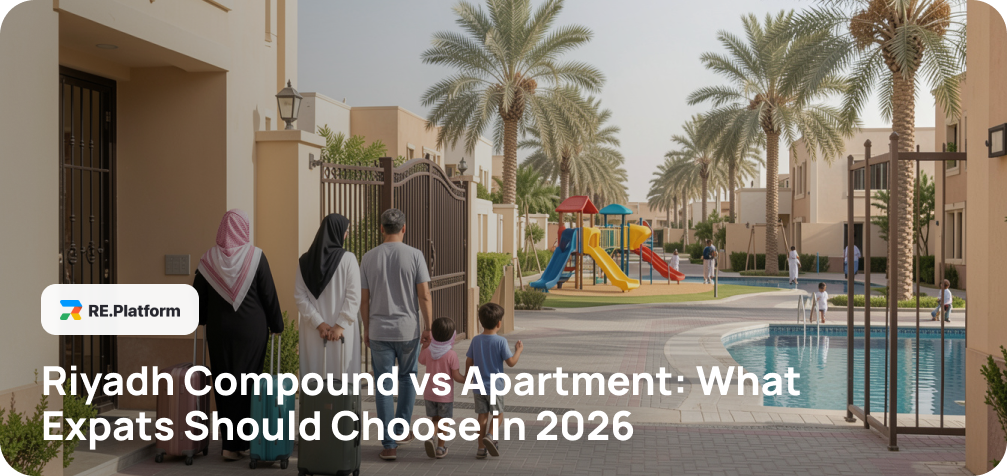
For most single professionals and couples moving to Riyadh, a regular apartment or serviced apartment is usually more practical than a compound. For families relocating to Saudi Arabia for the first time, a compound can be worth the premium because it makes the first year easier: security, amenities, children’s activities, social life and a more familiar residential environment are already built into the package.
That does not mean compounds are automatically better. They are often more expensive, harder to find in the best locations and less flexible than regular apartments. A compound can be a smart landing option, especially when the employer covers housing. A regular apartment can be the better long-term choice once an expat understands Riyadh’s districts, commute patterns, rental contracts and daily lifestyle.
The decision is not really “compound or apartment.” The real question is more specific: how much support do you need after arrival, how long will you stay, where do you work, do you have children, and who is paying the rent?
Table of Contents
Quick Answer: Compound, Apartment or Serviced Apartment?
The best housing format in Riyadh depends on lifestyle, budget and relocation stage. A compound is usually best for families, first-year relocation and people who want a softer landing. A regular apartment is better for expats who want more location choice, lower housing cost and stronger connection to the city. A serviced apartment sits in the middle: useful for the first few months, but often expensive as a long-term solution.
| Housing format | Best fit | Main advantage | Main downside |
|---|---|---|---|
| Compound | Families, first-year relocation, employer-paid housing | Security, amenities, community, easier adjustment | Higher cost, limited availability, less city integration |
| Regular apartment | Singles, couples, long-term residents, budget-conscious expats | More choice, better price flexibility, stronger city access | More due diligence, fewer built-in amenities |
| Serviced apartment | Consultants, executives, short stays, first 3–6 months | Easy move-in, furniture, services, flexible stay | Higher monthly cost, less “home” feeling |
For many expats, the smartest path is not choosing one format forever. It is using the first housing decision to reduce risk. A serviced apartment or compound can work during the first months, while a regular apartment may make more sense after the person understands commute, neighborhoods, schools, traffic and rental terms.
What Is a Compound in Riyadh?
A residential compound in Riyadh is usually a gated community with controlled access, security and shared amenities. Depending on the project, it may include villas, townhouses, apartments, gyms, swimming pools, sports courts, small retail, restaurants, children’s areas and community events.
For many expats, the attraction is not just the property itself. It is the system around the property. A good compound can reduce the number of things a newcomer has to solve in the first year. Security is clear. Maintenance is usually organized. Families can meet other families. Children have places to play. Facilities are inside the community, which matters in a car-based city.
But “compound” is not one single product. Riyadh has older compounds, newer compounds, premium compounds, business-focused compounds and family-oriented compounds. Some feel like resort-style communities. Others are more functional and less polished. Two compounds can have very different quality even if both use the same marketing language.
That is why expats should not compare “a compound” with “an apartment” in general. They should compare a specific compound with a specific apartment in a specific location, at a specific rent, with a specific commute.
What Is a Regular Apartment in Riyadh?
A regular apartment in Riyadh is a unit outside a compound, usually in a standalone residential building, apartment tower or mixed-use building. It may be furnished or unfurnished. It may be in a quiet residential district, near a business corridor, close to a mall, or inside a denser central area such as Al Olaya or Al Sulimaniyah.
The main advantage is choice. Regular apartments give expats more control over location, budget, size and lifestyle. Someone working near KAFD may prefer Al Aqiq, Al Sahafa or nearby North Riyadh districts. Someone working in the business core may look at Al Olaya or Al Sulimaniyah. A family wanting a quieter environment may prefer Al Nakhil, Al Malqa, Al Yasmin or Al Qirawan.
The trade-off is responsibility. In a regular apartment, the tenant must pay more attention to the building, parking, maintenance, contract terms, payment schedule, agent fee and neighborhood fit. The apartment may be cheaper than a compound, but the search process can be more demanding.
A regular apartment is not the “budget version” of expat housing. In many cases, it is the more rational long-term product. But it rewards people who do their homework.
Riyadh Housing Orientation Map for Expats
Compound vs Apartment Cost in Riyadh
There is no useful single average for compound or apartment rents in Riyadh. The market is too varied. A small apartment in an outer district, a furnished unit near a business hub, a family villa in a compound and a premium serviced apartment are different products with different economics.
In general, regular apartments offer the broadest price range. They can be more affordable than compounds, especially outside the most premium locations, but high-quality apartments in central or northern districts can still be expensive. Furnished apartments usually cost more than unfurnished units because the tenant pays for convenience, furniture and easier move-in. Compounds often carry a premium because the rent includes more than the unit: security, amenities, community and controlled infrastructure.
| Cost factor | Regular apartment | Compound |
| Entry price | Usually more flexible | Often higher |
| Amenities | Depends on building | Usually built into the community |
| Furniture | Furnished or unfurnished options | Depends on compound and unit |
| Utilities | Often separate | Depends on contract |
| Maintenance | Depends on landlord and building | Usually more organized |
| Social environment | Tenant creates it independently | Community is part of the product |
| Availability | Broader market | More limited, especially for popular compounds |
The important point is not that one format is always cheaper. The point is what the tenant is paying for. In a regular apartment, rent usually buys location, size and building quality. In a compound, rent also buys reduced friction: easier adjustment, more predictable services and a built-in residential environment.
For an expat whose employer pays a generous housing allowance, that premium may be justified. For someone paying out of pocket, the same premium may be difficult to defend.
Upfront Rent, Ejar and Agent Fees
Housing in Riyadh is not only about monthly affordability. Cash flow matters. Expats should ask early how rent is paid, how the contract is registered and what fees are due before move-in.
Many landlords prefer rent to be paid in large installments, often semi-annually or annually, although payment schedules can vary by landlord, property and negotiation. This can surprise newcomers who are used to monthly rent. A housing allowance from an employer can help, but the employee needs to understand whether the company pays the landlord directly, reimburses the employee, or provides a monthly allowance.
Ejar is also central to the rental process in Saudi Arabia. It is the official rental services network used to document rental contracts and organize the relationship between tenant, landlord and broker. A properly documented contract should state the rent, deposit, payment method, contract dates and key obligations of both sides.
Agent fees should be clarified before any payment is made. The same applies to deposit terms, maintenance responsibility, furnishing inventory and cancellation conditions. If an apartment is furnished, the tenant should ask for a written inventory and check the condition of appliances, air conditioning, furniture and kitchen equipment before signing.
A simple rule helps: do not treat a verbal agreement as enough. In Riyadh, the quality of the paperwork is part of the quality of the rental decision.
How Riyadh’s Rent Freeze Changes the Decision
Riyadh’s rent freeze makes the rental market more predictable in one way, but it does not remove the need for careful selection. From 25 September 2025, annual increases in total rental value were suspended for residential and commercial leases within Riyadh’s urban boundaries for five years. The measure applies to existing and new contracts, and vacant properties that were previously leased are generally tied to the last registered Ejar contract value.
For tenants, this can reduce anxiety around sudden rent increases. For landlords and investors, it changes the income model. A property has to make sense on realistic current rent rather than expected annual increases.
For expats choosing between a compound and an apartment, the rent freeze does not automatically make one format better. It makes the starting rent more important. If the initial rent is too high for the value delivered, the freeze does not fix that problem. If the property is well located, well managed and fairly priced, the freeze can make the decision feel more stable.
This is another reason to avoid rushing. A tenant should not choose a weak apartment just because it is cheaper, or an expensive compound just because it feels safe. The contract may lock in the decision for longer than expected.
Lifestyle: Privacy, Social Life and Daily Comfort
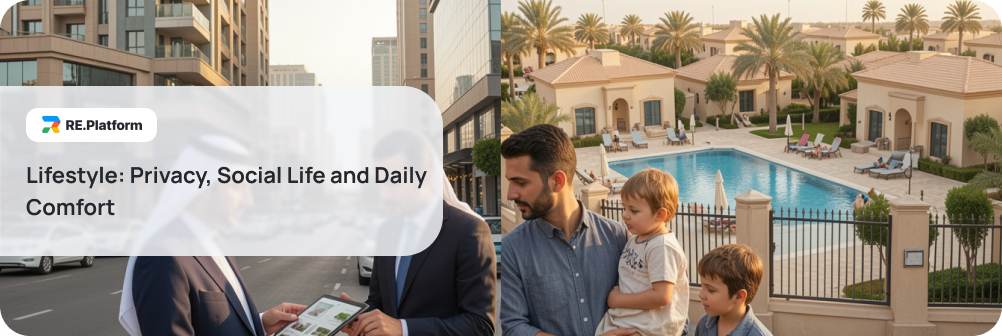
A compound is often less about getting the cheapest home and more about buying time, comfort and a softer landing. That is especially true for families. A newcomer with children may value a swimming pool, playground, sports facilities and other families nearby more than a slightly larger apartment outside the compound.
For a spouse who is not working immediately, compound life can also reduce isolation. Social life is easier when neighbors share similar relocation challenges. This is one reason compounds remain popular even when regular apartments offer more space for the same budget.
But the same structure can feel limiting. Some expats find compounds too separated from the city. The environment may be comfortable, but it can also slow integration. Residents who want to understand Riyadh, explore neighborhoods, meet people outside the expat circle and live closer to restaurants, offices or local services may prefer a regular apartment.
Privacy works differently as well. Compounds can feel secure, but they are also social by design. Regular apartments can feel more independent, but the experience depends heavily on the building, neighbors and neighborhood. Neither format is universally more private. It depends on the asset.
Families: When a Compound Is Worth the Premium
A compound can be worth the premium for families arriving in Riyadh for the first time, especially if the employer covers most of the housing cost. The first year in a new country is rarely only about rent. It is about school search, transport, routines, social adjustment, healthcare, documents and learning how the city works.
A family compound can reduce some of that pressure. Children may adapt faster when there are other children nearby. Parents may find it easier to build a social circle. Amenities reduce the need to drive for every activity. Maintenance and security are usually clearer than in a random standalone building.
This does not mean a compound is always the best family option. Some families prefer regular villas or apartments in mature Riyadh districts, especially after they understand school locations and commute patterns. Al Nakhil, Al Malqa, Al Yasmin, Al Qirawan and selected North Riyadh districts can make sense for families that want a more normal city lifestyle rather than a closed community.
A good way to think about it: a compound is often strongest as a landing product. A regular home may become more attractive once the family understands Riyadh.
Singles and Couples: When Apartments Make More Sense
For single professionals and couples, a regular apartment often makes more sense than a compound. The main reasons are flexibility, location and cost control.
A professional working near the business core may prefer Al Olaya or Al Sulimaniyah because the commute is shorter and the area has hotels, cafes, restaurants and services. Someone working around KAFD may prefer Al Aqiq, Al Sahafa or nearby northern districts. In these cases, paying a large premium for a compound may not improve daily life enough to justify the cost.
Apartments also make it easier to change strategy. A newcomer can start with a serviced apartment, learn the city, then rent a regular apartment near work. A long-term expat can upgrade or move districts when job location, relationship status or family plans change.
The risk is quality. Riyadh has many apartments, but not every apartment is easy to live in. Parking, elevators, noise, air conditioning, maintenance and access matter more than listing photos. A regular apartment is usually the better long-term choice only when the tenant selects carefully.
Serviced Apartments: The Middle Option Many Expats Ignore
The compound vs apartment debate often misses the third option: serviced apartments. For many expats, this can be the safest short-term format.
A serviced apartment is useful when someone has just arrived in Riyadh, does not know the districts yet, is still negotiating a long-term contract, or is waiting for family to move later. It can also suit consultants, executives and project-based workers who need a furnished place without committing to a full annual lease immediately.
The advantage is convenience. Furniture, utilities, cleaning or basic services may be included depending on the property. Move-in is easier. The tenant can test commute times, understand the city and avoid signing a long lease under pressure.
The disadvantage is cost. Serviced apartments can be expensive over a full year, and they may not feel like a permanent home. For a three-month transition, they can be rational. For a multi-year stay, a regular apartment or compound may offer better value.
How Location Changes the Decision
The best housing format in Riyadh depends heavily on where the expat works. Riyadh is large, traffic matters, and a property that looks convenient on a map may feel very different during peak hours.
If the job is near KAFD or North Riyadh’s office corridors, apartments in Al Aqiq, Al Sahafa, Al Malqa or nearby districts may be more practical than a compound farther away. If the job is in the business core, Al Olaya or Al Sulimaniyah can reduce commuting friction. If the main priority is family life, schools and quieter streets, Al Nakhil, Al Yasmin, Al Qirawan or selected compounds may be stronger options.
| Work or lifestyle anchor | Housing logic |
| KAFD / North Riyadh offices | Regular apartments or selected compounds near northern districts |
| Business core / central offices | Al Olaya, Al Sulimaniyah or serviced apartments |
| Family-first relocation | Compound, Al Nakhil, Al Yasmin, Al Malqa or Al Qirawan |
| Budget-sensitive move | Regular apartment outside the most premium pockets |
| First 3–6 months in Riyadh | Serviced apartment or short-term furnished unit |
| Long-term city living | Regular apartment with strong building quality and commute |
This is where district guides become useful, but they should not replace the format decision. A good district does not guarantee a good apartment. A strong compound does not guarantee a good commute. The right answer is always a combination of format, location, contract and daily routine.
What to Check Before Signing Any Lease in Riyadh
Before signing a lease in Riyadh, expats should inspect the property like future residents, not like online shoppers. Photos can hide the issues that define daily life.
Parking should be checked first. In many parts of Riyadh, poor parking can ruin an otherwise good apartment. Then come air conditioning, water pressure, drainage, noise, elevators, maintenance response and building security. If the unit is furnished, the tenant should check the furniture, appliances and inventory in writing.
The contract should be clear on rent, deposit, payment schedule, maintenance responsibility, utilities, termination terms and agent fee. The tenant should also confirm Ejar registration and avoid paying large sums before the paperwork and parties are clear.
| Check | Why it matters |
| Ejar registration | Confirms the rental contract is properly documented |
| Payment schedule | Large upfront payments can create cash-flow pressure |
| Deposit terms | Reduces disputes at move-out |
| Parking | Critical in Riyadh, especially for apartments |
| Maintenance responsibility | Clarifies who fixes AC, plumbing and appliances |
| Furnishing inventory | Essential for furnished and serviced units |
| Commute test | Traffic can change the real value of a location |
| Noise and building condition | Especially important in central areas |
| Agent fee | Should be agreed before any payment |
A tenant should also visit at different times if possible. A building that feels calm at noon may be noisy at night. A commute that looks easy on a weekend may be difficult on a weekday morning.
What Renters Can Teach Property Buyers and Investors
The compound vs apartment decision is not only useful for tenants. It also tells buyers and investors what makes residential property in Riyadh liquid.
Tenants do not pay only for square meters. They pay for reduced friction. A good apartment is not simply a new apartment; it is a unit with parking, access, natural light, working air conditioning, responsive maintenance and a location that fits daily life. A good compound is not just a gated address; it is a community that actually solves family, security and lifestyle needs.
This matters for investors. A property that looks attractive in a brochure may not rent well if it fails the daily-use test. A smaller apartment in a strong building can be more liquid than a larger unit with poor parking. A villa in a good area can still struggle if maintenance is weak or the rent is unrealistic.
In Riyadh’s next market phase, the most durable properties are likely to be those that work for real residents. That is the bridge between rental demand and long-term property value.
Final Answer: Which One Should Expats Choose?
Expats moving to Riyadh should choose a compound if they are relocating with family, want an easier first year, value amenities and community, and have a housing allowance that supports the premium. A compound is not the cheapest option, but it can reduce stress during the hardest stage of relocation.
They should choose a regular apartment if they are single, in a couple, more budget-conscious, comfortable doing due diligence and want stronger city access. A regular apartment is often the better long-term option once an expat understands Riyadh.
They should choose a serviced apartment if they are staying short term, arriving before family, working on a project, or still learning where they want to live. It can be expensive, but it buys flexibility.
The wrong question is whether compounds are better than apartments. The right question is which format fits the first year, the budget, the commute and the level of support the expat needs. In Riyadh, housing quality is not defined only by the address. It is defined by how well the property works in daily life.
Explore Riyadh Properties With RE.Platform
For buyers and long-term residents comparing housing options in Riyadh, RE.Platform helps make the search more structured. Instead of looking at listings in isolation, buyers can compare locations, project details, property types and residential positioning across Riyadh and other Saudi markets.
Let's buy property in Riyadh right now!
Describe what you are interested in and we will contact you.
Send requestThe compound vs apartment decision is especially useful for anyone thinking about future purchase or investment. It shows what tenants actually value: commute, parking, services, building quality, amenities and neighborhood fit. Those factors matter whether someone is renting for one year or buying for the long term.
If You Still Have a Questions
Is it better to live in a compound or apartment in Riyadh?
A compound is usually better for families relocating to Riyadh for the first time, especially if the employer covers housing. A regular apartment is usually better for single professionals, couples and long-term expats who want more location choice, lower cost and stronger connection to the city.
Are compounds in Riyadh worth it for expats?
Compounds can be worth it if the expat values security, amenities, community and easier adjustment. They are especially useful for families with children. They may be less attractive for expats who want to control costs, live near work or integrate more directly into the city.
Are compounds in Riyadh expensive?
Compounds are often more expensive than regular apartments because the rent includes more than the unit itself. Tenants are also paying for amenities, security, community, maintenance structure and a controlled residential environment. The premium varies widely by compound, unit type and location.
Can single expats live outside compounds in Riyadh?
Yes. Many single expats live in regular apartments or serviced apartments outside compounds. This can be more practical if they want to live near work, manage their budget or avoid paying for family-oriented amenities they do not need.
Is a compound better for families with children?
A compound can be better for families with children, especially during the first year in Riyadh. Children may have easier access to play areas, sports facilities and other families. Parents may also find the social environment and maintenance structure easier to manage after relocation.
What is the difference between a compound and a serviced apartment in Riyadh?
A compound is a gated residential community with shared amenities and a more community-oriented lifestyle. A serviced apartment is usually a furnished apartment with services such as cleaning, utilities or flexible stay options, depending on the property. Serviced apartments are often better for short-term stays, while compounds are better for family relocation and longer residential routines.
Do expats need Ejar for apartment rentals in Riyadh?
Expats should expect rental contracts to be documented through Ejar, the official rental services network in Saudi Arabia. Ejar helps formalize the relationship between tenant, landlord and broker, and the contract should clearly state rent, payment method, deposit and key obligations.
How much rent do expats pay upfront in Riyadh?
Payment schedules vary, but expats should be prepared for landlords to request large upfront payments, often semi-annual or annual. This is why housing allowance, cash flow and contract terms should be clarified before signing.
Which Riyadh districts are better for apartments?
For business-core apartment living, Al Olaya and Al Sulimaniyah are strong options. For KAFD-side demand, Al Aqiq and Al Sahafa can be relevant. For family-oriented apartment or villa living, Al Nakhil, Al Malqa, Al Yasmin and Al Qirawan may be better fits.
Should expats rent before buying property in Riyadh?
In many cases, yes. Renting first helps expats understand commute, districts, building quality, schools, traffic and lifestyle before committing to a purchase. This is especially useful in Riyadh, where two properties in the same district can feel very different in daily life.