Browse by category


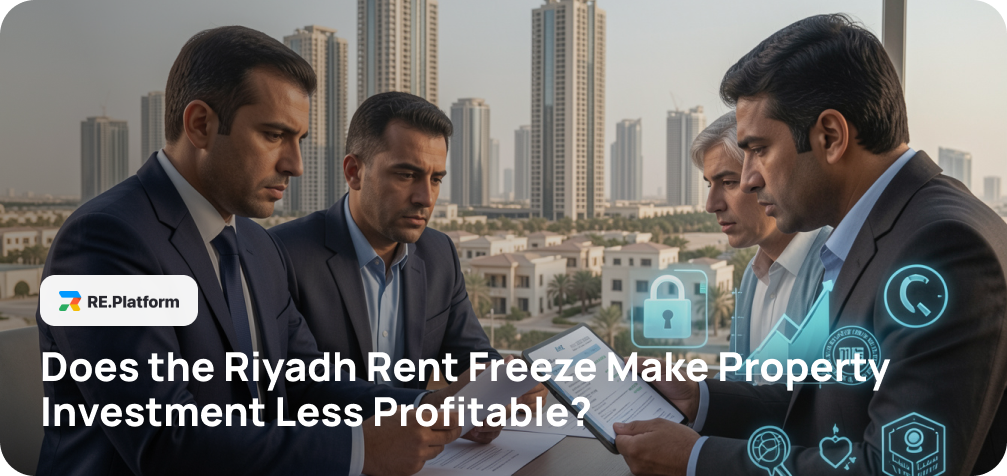
Riyadh’s five-year rent freeze has changed the way investors need to think about rental property in Saudi Arabia’s capital. It does not make property investment automatically unprofitable. But it does make one thing clear: investors can no longer rely on annual rent increases to make a weak deal look attractive.
The property has to work on today’s numbers.
That is the main shift. A rental apartment, villa or commercial unit in Riyadh now needs to be evaluated more carefully, with realistic assumptions about current rent, vacancy, maintenance, management costs and resale value. In a market where many investors were used to thinking about fast rent growth, that is a meaningful change.
The rule is especially important because it applies to both residential and commercial properties within Riyadh’s urban boundaries. According to the Real Estate General Authority, rents in Riyadh cannot be increased for five years from September 25, 2025. REGA also states that the suspension applies to existing and new contracts, and that vacant properties which were previously leased must be rented at the value of the last registered Ejar contract.
That detail matters more than many investors realize.
Table of Contents
Quick Answer: Does the Rent Freeze Hurt Investors?
The Riyadh rent freeze does not automatically make property investment less profitable. But it changes the investment model.
Before the rule, some investors could buy a property, accept a modest initial yield and assume that rent increases would improve returns over time. That strategy is now weaker. If rent cannot rise for five years, the investor needs to make sure the property already produces an acceptable return at the current achievable rent.
For a well-bought property in a strong district, the freeze can still be manageable. For an overpriced unit with weak rental income, it can expose the problem quickly.
In simple terms: the rent freeze does not kill investment demand. It punishes lazy yield calculations.
What Exactly Is Frozen?
The rule applies to rental increases for residential and commercial properties within the urban boundaries of Riyadh.
This includes existing rental contracts and new rental contracts. The key idea is that the total rental value cannot be increased during the five-year period. The measure started on September 25, 2025, and is designed to stabilize the relationship between landlords and tenants in the capital.
The most important part for investors is the treatment of vacant properties.
If a property is vacant but was previously leased, the rent is not simply reset at any price the landlord wants. It is tied to the last rent registered through Ejar. That means a landlord cannot always wait for a tenant to leave and then relist the same property at a much higher rent.
For properties that have never been leased before, the first rent can still be agreed between the parties. But once the rental value is established through the system, future increases are constrained by the freeze.
| Situation | How the rent freeze affects it |
|---|---|
| Existing residential lease in Riyadh | Rent cannot be increased during the five-year freeze period |
| Existing commercial lease in Riyadh | Rent cannot be increased during the five-year freeze period |
| New lease for a previously rented vacant property | Rent is tied to the last registered Ejar contract value |
| First lease for a property never rented before | Initial rent can be agreed between landlord and tenant |
| Property outside Riyadh’s urban boundaries | The Riyadh rent freeze does not automatically apply |
| Sale price of property | Not frozen; sale prices still depend on market conditions |
For investors, this creates a more transparent rental environment. It also limits the ability to build returns around future rent escalation.
Why Saudi Arabia Introduced the Freeze
The measure did not appear in a vacuum. Riyadh’s property market had been moving quickly, especially after the city became the center of Saudi Arabia’s corporate relocation story, government activity, major projects and long-term urban expansion.
More companies, more employees, more expatriates and more capital created real housing pressure. Rents in popular areas rose sharply, and affordability became a major issue for households and businesses.
A fast-rising rental market can look attractive to landlords in the short term. But if rents rise too quickly, the market becomes less stable. Tenants face pressure. Companies face higher operating costs. Housing becomes less accessible. Some landlords may hold properties or reprice aggressively instead of supporting a healthy rental market.
The rent freeze is a market-stabilization tool. It is designed to reduce sudden increases, give tenants predictability and force the market to move away from speculative rent jumps.
For investors, the message is direct: Riyadh still matters, but the government wants growth to be more controlled.
How the Rule Changes Yield Calculations
The biggest change is that investors must calculate yield based on the rent they can actually achieve now, not the rent they hope to achieve later.
This sounds obvious, but it is often where property investments go wrong. In a fast-growing market, buyers sometimes justify a high purchase price by assuming that rents will continue rising. If the first-year yield looks low, they expect the second or third year to fix the problem.
The Riyadh rent freeze makes that assumption much harder.
A property bought at SAR 1.5 million with annual rent of SAR 75,000 produces a gross yield of 5%. That may look acceptable before costs. But if the investor expected the rent to rise to SAR 90,000 within two or three years, that expectation now needs to be removed from the base case.
The deal should be evaluated at SAR 75,000, not at a future rent that may not be legally achievable during the freeze period.
| Before the freeze | After the freeze |
| Investors could assume rent growth in the base case | Investors should use current achievable rent |
| Underpriced leases could be raised more easily | Existing and many new leases are constrained |
| Vacant units could sometimes be repriced aggressively | Previously rented vacant units are tied to last Ejar rent |
| Gross yield often looked better after projected increases | Net yield must work without automatic rent growth |
| Weak entry prices could be hidden by future rent assumptions | Overpriced assets are easier to expose |
This does not mean investors should avoid Riyadh. It means they need to be more disciplined.
Gross Yield Is No Longer Enough
The rent freeze makes net yield more important.
Gross yield is simple: annual rent divided by purchase price. But it does not show the full picture. Investors still need to account for maintenance, vacancy, service charges, furnishing, property management, insurance, transaction costs and possible resale risk.
In a rising rental market, some of these costs can be psychologically ignored because future rent growth feels like a cushion. When rent growth is restricted, the cushion becomes smaller.
That is why the same 5% gross yield can mean different things depending on the property.
A modern apartment in a liquid district with strong tenant demand, good parking and low maintenance may be a solid investment. A similar-yield property in a weaker building, with poor access and higher vacancy risk, may not be worth the price.
The rent freeze pushes investors to look at the property itself, not just the market story.
Who Is Most Affected?
The rule affects different owners and investors in different ways.
Landlords with older, underpriced contracts may feel the impact most sharply. If their current rent is below market level, they cannot simply raise it to match recent asking prices during the freeze period.
Investors who bought at high prices expecting future rent growth may also be affected. If the purchase price only made sense because rent was expected to increase, the investment case becomes weaker.
Owners of previously rented vacant units also need to be careful. The last registered Ejar contract can become a key reference point. If the last rent was low, the landlord may not be able to relaunch the unit at a much higher price simply because market listings have moved upward.
Furnished-rental landlords may face a more complicated situation. Furnished units can sometimes achieve higher rents because they offer convenience, but they also carry higher operating costs. Furniture replacement, cleaning, maintenance and tenant turnover must be included in the net return.
Commercial landlords are also affected. The freeze is not only about residential tenants. It also applies to commercial properties inside Riyadh’s urban boundaries, which matters for offices, shops and businesses planning long-term costs.
Who Can Still Benefit?
The rent freeze does not remove investment opportunity from Riyadh. It changes who is best positioned to benefit.
Buyers who enter at reasonable prices can still make attractive long-term investments. If a property already has a realistic yield at today’s rent, the freeze may simply create more income stability.
Long-term holders may also benefit. A predictable rental environment can reduce conflict with tenants and support more stable occupancy. For investors who care about capital preservation and long-term exposure to Riyadh, this can still be appealing.
Owners of high-quality units in liquid districts are likely to remain better positioned. Tenants still care about location, building quality, parking, maintenance, access to roads and proximity to work, schools and services. The freeze does not make all properties equal.
Investors who focus on resale value may also find opportunities. The rent freeze affects rental increases, but it does not freeze sale prices. If an investor buys in a strong district at a reasonable price, long-term capital value may still matter.
What Investors Should Check Before Buying in Riyadh Now
The due diligence process needs to be sharper.
The first question is the current rent. Not the asking rent, not the expected rent, not what the seller says the property “could” rent for. Investors should verify the actual achievable rent and, where relevant, the last registered Ejar rent.
The second question is whether the property has been leased before. If it has, the last registered contract can affect the rental ceiling for a new lease.
The third question is net income. Investors should deduct realistic costs: maintenance, vacancy, service charges, management, furnishing, repairs and transaction expenses.
The fourth question is tenant demand. A property near KAFD, a strong family district or a well-connected apartment corridor may have different demand from a unit in a weaker micro-location.
The fifth question is liquidity. If rental upside is more limited, resale value becomes more important. Investors should ask whether the property will be easy to sell later.
The sixth question is regulation. Foreign investors also need to check ownership eligibility, approved areas and transaction procedures, especially under Saudi Arabia’s updated non-Saudi ownership framework.
How It Affects Different Riyadh Districts
The rent freeze affects the city-wide rental framework, but it does not make every district behave the same way.
In business-side areas such as Al Aqiq and Al Sahafa, the rule makes current rent evidence more important. These districts often attract professionals, consultants, executives and apartment renters who care about access to KAFD, main roads and services. Investors should focus on whether the unit is genuinely easy to rent at today’s price.
In family-oriented districts such as Al Malqa and Al Yasmin, the freeze may support stable long-term tenancy. Families often prefer predictability, especially when school routes, community infrastructure and daily services matter.
In premium villa districts such as Hittin, investors need to be careful with entry price. High capital values can reduce yield, and rent growth cannot be used as an easy fix.
In growth districts such as Al Arid and Al Narjis, investors should be conservative. These areas may have long-term potential, but current rent and infrastructure maturity matter more under a rent freeze.
The right question is not whether the freeze is good or bad for Riyadh. The better question is whether a specific district, building and unit still make sense under the new rental rules.
Does It Affect Property Prices?
The rent freeze does not directly cap property sale prices. Owners can still sell at market prices, and buyers can still negotiate based on supply, demand and location.
But the freeze can influence pricing indirectly.
If rental income is restricted, investors may become less willing to overpay for income-producing assets. A property that used to look attractive because of expected rent increases may now need a lower purchase price to produce the same return.
That can put pressure on overpriced rental assets, especially where the yield is already weak. At the same time, high-quality properties in strong locations may hold value better because they remain liquid and desirable.
This is another reason why the Riyadh market may become more selective. The freeze does not reduce the value of every property. It makes valuation more dependent on fundamentals.
Is Riyadh Still Attractive for Property Investment?
Yes, but the investment case is more demanding.
Riyadh remains the capital, the center of government activity, a major corporate destination and one of the most important real estate markets in Saudi Arabia. Long-term demand is supported by employment growth, business relocation, infrastructure, population growth and major events such as Expo 2030.
But strong city fundamentals do not guarantee that every property is a good investment.
The rent freeze makes disciplined buying more important. Investors need to avoid overpaying, check actual rent, understand the last Ejar contract, evaluate net yield and focus on districts with real demand.
Riyadh is still attractive. It is just not a market where investors should depend on automatic rent growth to rescue a weak purchase.
Final Takeaway
The Riyadh rent freeze does not make property investment unprofitable. It makes the market more serious.
For tenants, the rule offers more predictability. For landlords, it limits sudden rent increases. For investors, it changes the math.
A good property can still work. A well-located apartment, a family unit in a strong residential district or a quality asset with stable tenants can still be attractive. But the deal has to stand on today’s rent, not tomorrow’s imagined increase.
That is the real lesson.
Riyadh remains one of the most important property markets in Saudi Arabia. But under the new rental rules, investors need to buy with discipline, verify the numbers and choose assets that make sense without relying on aggressive rent growth.
The market is not closed. It is becoming more selective.