Browse by category


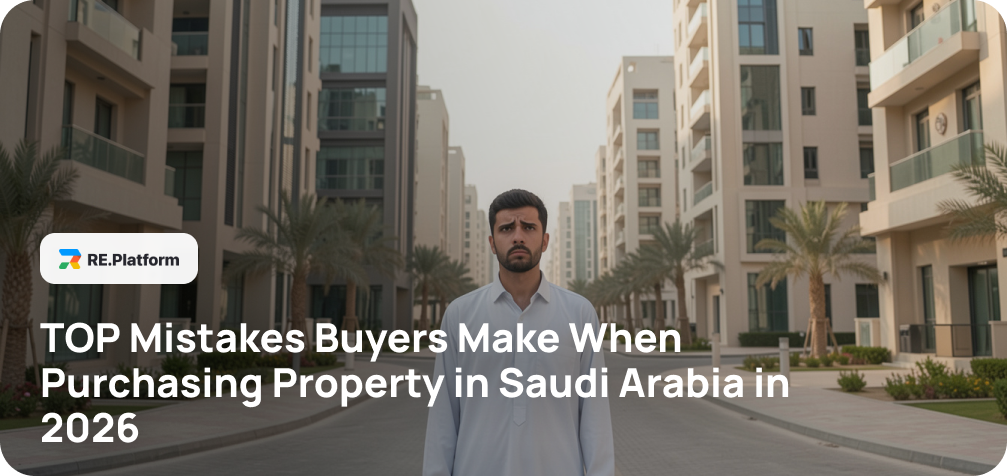
Saudi Arabia’s real estate market has become one of the most closely watched property sectors outside Europe and North America. Riyadh is expanding faster than many global capitals, new residential districts continue appearing across the city, and international investors who previously ignored the Kingdom are now actively entering the market.
At the same time, rapid growth has created a different problem: too many buyers are approaching Saudi Arabia’s property market superficially.
A large number of foreign investors still enter the market with a simple assumption — if the Saudi real estate market is growing, then almost any apartment purchase will eventually become profitable. That logic worked far better several years ago than it does today.
In 2026, Riyadh is no longer a simple emerging market where every property automatically benefits from overall momentum. The market has become far more segmented. Some districts continue attracting strong rental demand and long-term capital growth, while others are becoming increasingly dependent on hype, speculative off-plan activity, and aggressive developer marketing.
That is why many investment mistakes in Saudi Arabia today are no longer connected to paperwork or legal procedures. Most losses come from poor market analysis, unrealistic expectations, weak project selection, and misunderstanding how different areas of Riyadh are evolving.
We analyzed the most common mistakes property buyers continue making in Saudi Arabia’s residential market — from overpaying for “hot” districts to buying off-plan apartments without understanding future competition or long-term liquidity.
The problem is that most of these mistakes do not become obvious immediately after purchase. Investors usually notice them several years later when they attempt to resell the property, stabilize rental income, or discover that demand in their chosen segment is far weaker than expected.
Table of Contents
Mistake 1. Buying Property Simply Because It Is Located in Riyadh
One of the most expensive mistakes foreign buyers make is treating Riyadh as a single real estate market.
In reality, Riyadh already operates as several completely different residential markets at the same time.
Northern districts such as Al Narjis, Al Yasmin, and Qurtubah follow the logic of premium real estate markets. These areas attract international companies, high-income residents, modern mixed-use developments, and luxury apartment communities.
Eastern and southern districts operate very differently. Demand there is driven more by affordability, practical housing needs, and long-term local occupancy rather than prestige.
As a result, an apartment purchased “somewhere in Riyadh” may deliver average rental performance and weak long-term appreciation despite the city’s overall growth story.
In Saudi Arabia today, it is no longer enough to buy property in the “right city.” Investors need to understand how specific districts are developing and why demand is moving into those areas.
Mistake 2. Overpaying for the Hype Around North Riyadh
North Riyadh has become the symbolic center of Saudi Arabia’s modern property market. Most high-profile residential launches, premium apartment projects, and international real estate marketing campaigns are concentrated there.
The problem is that hype often pushes prices faster than real market fundamentals.
Many buyers now enter northern Riyadh believing they are purchasing guaranteed growth. In some cases, however, future expectations have already been priced into the market.
This is particularly visible in the apartment segment, where projects with similar construction quality may carry dramatically different prices simply because one district has stronger branding and investor attention.
Meanwhile, several eastern districts of Riyadh continue generating more stable rental yields with significantly lower entry budgets.
This is a common pattern in rapidly growing property markets. Once a district becomes fashionable, investors start paying for momentum itself rather than for actual long-term value.
Mistake 3. Buying Off-Plan Property Without Understanding Future Supply
Off-plan real estate remains one of the biggest drivers of Saudi Arabia’s housing market. Developers continue launching thousands of apartments before construction is completed, while flexible installment plans attract both local and international buyers.
Several years ago, buying early-stage projects and reselling later at a higher price was often an easy strategy.
In 2026, the situation is becoming more complicated.
Riyadh’s residential supply is expanding extremely quickly. In some districts, multiple developers are launching nearly identical apartment projects simultaneously, competing for the same tenant and buyer base.
This does not mean off-plan real estate is a bad investment. It simply means buyers now need to analyze projects far more carefully.
Today, investors should evaluate:
| What Buyers Should Analyze | Why It Matters |
|---|---|
| Number of competing projects nearby | Oversupply can pressure future prices |
| Developer reputation | Weak developers lose liquidity faster |
| Rental demand in the district | Not every area attracts stable tenants |
| Infrastructure readiness | Some locations still exist mostly on renderings |
| Apartment segment competition | Similar projects compete aggressively for tenants |
Without this analysis, many investors simply become one buyer among hundreds purchasing nearly identical apartments in oversupplied locations.
Mistake 4. Ignoring Building Quality
In Saudi Arabia’s property market, project quality is becoming almost as important as location itself.
This goes far beyond interior design or attractive lobbies.
Buyers increasingly pay attention to:
- Engineering quality
- Noise insulation
- Building management
- Maintenance standards
- Parking infrastructure
- Community amenities
- Public spaces
- Construction density
This is especially important in Riyadh, where a modern premium apartment complex and an aging residential building may stand only blocks apart while carrying dramatically different long-term investment potential.
During strong growth cycles, many investors ignore these details because they assume all property values will continue rising. In reality, building quality often determines which assets remain liquid once the market becomes more competitive.
Mistake 5. Buying Oversized Apartments
Saudi Arabia’s housing market is gradually changing alongside the lifestyle structure of its major cities.
Historically, many buyers focused primarily on large apartment sizes and maximum room counts. That trend is shifting.
Demand in Riyadh is increasingly moving toward:
- Functional layouts
- Modern apartment communities
- Properties near business districts
- Compact but efficient units
- Residential projects with integrated infrastructure
As a result, large apartments in older buildings sometimes underperform compared to smaller modern units located in stronger districts.
The Saudi market is slowly becoming more urbanized, and buyers are placing greater importance on convenience, mobility, and building quality rather than pure apartment size.
Mistake 6. Evaluating Property Only by Price per Square Meter
This remains one of the most common mistakes foreign investors make in Saudi Arabia.
A cheap price per square meter may appear attractive on paper, but low pricing often reflects deeper problems:
- Weak construction quality
- Aging projects
- Low rental demand
- Poor transportation access
- Limited surrounding infrastructure
In Riyadh, two apartments in the same district may differ in price by 30–50% despite having similar sizes. In many cases, the market is already signaling which project will remain more desirable over time.
Mistake 7. Assuming the Entire Market Will Continue Rising Equally
This is the classic psychological mistake of every fast-growing property market.
After several years of strong appreciation, many investors still believe all Saudi real estate will continue increasing in value at the same pace.
The market is already proving otherwise.
Some districts continue benefiting from infrastructure expansion and strong tenant demand. Others are approaching pricing levels that limit future upside. Certain apartment segments are beginning to face growing competition and potential oversupply.
That is why the strategy of “buy any apartment in Riyadh and wait” is becoming far less reliable than it once was.
Conclusion
The biggest mistake property buyers make in Saudi Arabia today is underestimating how sophisticated the market has become.
Riyadh is no longer a single high-growth city where every residential project automatically becomes a successful investment. The market is evolving into a competitive ecosystem where location quality, infrastructure, district positioning, developer reputation, and future supply all play critical roles.
Successful investors in 2026 are no longer analyzing only the apartment itself. They are analyzing the entire context surrounding the asset — the district, future development density, infrastructure expansion, tenant profile, and long-term liquidity potential.
Because in Saudi Arabia’s modern property market, long-term value is no longer driven by hype alone. It is driven by the quality of the asset itself.