Browse by category


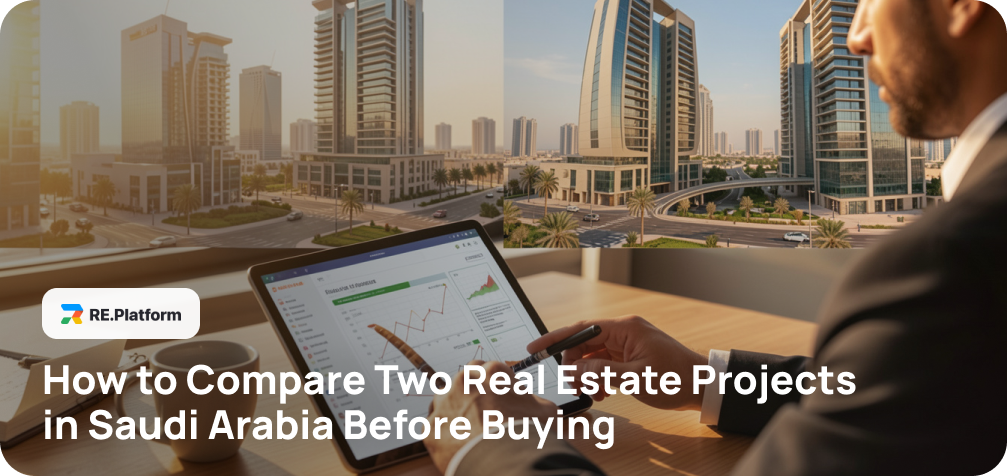
Two real estate projects in Saudi Arabia can look almost identical at first glance. Both may show modern architecture, landscaped courtyards, flexible payment plans, smart-home features and a sales brochure built around the same promise: a better lifestyle, a stronger location, a safer investment.
The real difference is usually hidden in the details buyers notice too late.
It may be the Wafi status of an off-plan project. It may be the developer’s delivery record. It may be the actual road access, not the map pin. It may be a payment plan that looks comfortable until the largest installment arrives before financing is ready. It may be a floor plan where 15 square meters are technically included in the unit size but add little practical value. Or it may be a resale clause that limits your ability to exit before handover.
That is why comparing two real estate projects in Saudi Arabia should never be a beauty contest between renders. It should be a structured decision based on legal clarity, location quality, developer risk, pricing discipline, rental logic and exit potential.
This guide explains how to compare two property projects before buying, whether you are looking at an off-plan apartment in Riyadh, a family villa in Jeddah, a coastal project, a townhouse community, or a unit in one of Saudi Arabia’s fast-growing urban districts.
Table of Contents
The 15-Minute Rule: What to Check Before You Fall in Love With a Project

A serious comparison starts before the viewing, before the sales call and definitely before the booking payment.
If you only have 15 minutes to screen two projects, focus on five questions:
| Question | Why it matters |
|---|---|
| Is the project ready, under construction or purely off-plan? | This defines your delivery risk and payment risk. |
| Is the developer licensed and credible? | A strong brochure does not replace a delivery record. |
| Is the project legally clear for your buyer profile? | This is especially important for non-Saudi buyers. |
| Is the price justified by the location and comparable projects? | A discount means little if the baseline price is inflated. |
| Who will want this unit after you? | Resale and rental demand protect your downside. |
If one project cannot answer these questions clearly, it should not be treated as equal to a project that can.
In Saudi Arabia, where major cities are changing quickly and new supply is entering the market, the best project is not always the most visually impressive one. It is the project where the risks are visible, documented and properly priced.
First, Define the Job of the Property
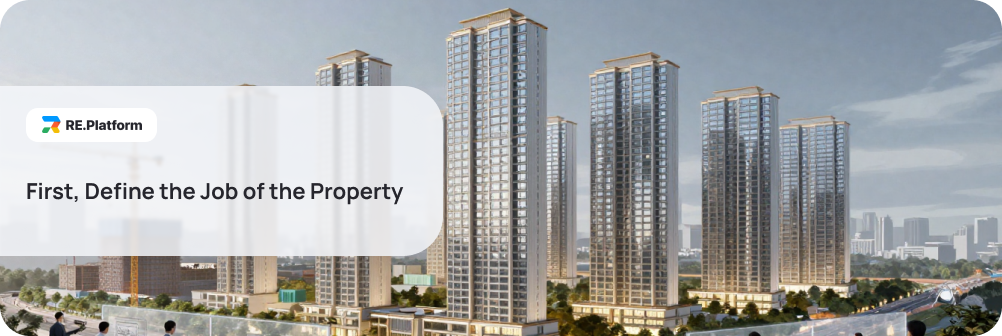
Most weak property decisions begin with a vague goal.
A buyer says they want “a good project in Riyadh” or “something with investment potential in Jeddah.” That is not enough. A property bought for family use should be judged differently from a property bought for rental income. A unit intended for long-term capital growth should not be compared in the same way as a ready apartment expected to generate rent within months.
Before comparing two real estate projects in Saudi Arabia, decide what the property must do.
| Buyer profile | What should matter most | What can be less important |
| End-user buying a home | Daily convenience, schools, road access, privacy, build quality | Short-term rental yield |
| Investor seeking rent | Tenant pool, unit efficiency, realistic rent, vacancy risk | Personal taste |
| Buyer seeking capital growth | District transformation, supply pipeline, infrastructure, future liquidity | Immediate rental income |
| Non-Saudi buyer | Ownership eligibility, legal clarity, registration process, exit options | Promotional discounts |
| Family buyer | Layout, parking, storage, community feel, nearby services | Trendy amenities |
| Premium buyer | Brand, management quality, privacy, long-term asset value | Lowest price per sqm |
This is where many buyers make the first mistake. They compare projects as if every property has the same purpose.
A larger apartment may be better for an owner-occupier but weaker for rental yield. A smaller apartment may be easier to rent but less comfortable for family use. A villa in a developing district may offer long-term upside, but an apartment in an established neighborhood may offer faster liquidity.
The right comparison starts with the buyer, not the project.
Compare the Location at Street Level, Not City Level
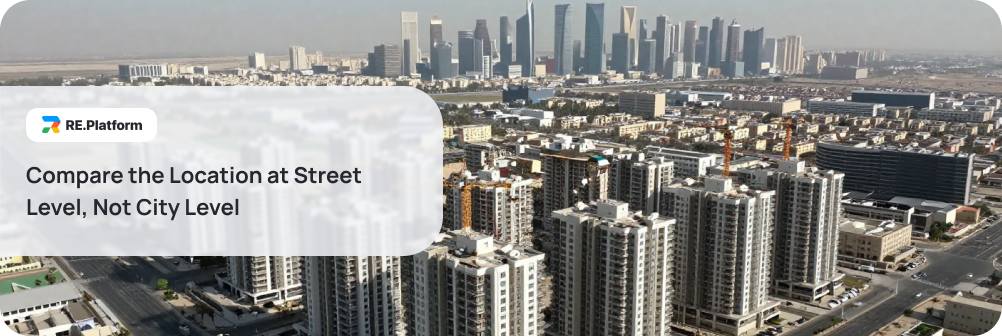
“Riyadh,” “Jeddah” and “Al Khobar” are not locations. They are markets. The real decision happens at district, street and access level.
In Riyadh, two projects can both be marketed as being in the north of the city, yet their investment cases can be completely different. A project near established demand in Al Malqa, Al Narjis, Al Yasmin or Al Sahafa does not carry the same risk as a project in a less mature corridor where the main argument is future infrastructure. In Jeddah, a project with strong access to coastal lifestyle demand, family districts or business movement is not the same as a project that only uses the city name as a selling point. In the Eastern Province, proximity to Al Khobar, Dhahran, Dammam, Bahrain-linked movement and employment clusters can change the rental story entirely.
A good location comparison should look at four layers.
The first layer is current access. How long does it take to reach the main road? Is the project convenient for daily commuting? Does access depend on future roads, future intersections or future public infrastructure? A buyer should not pay today’s premium for infrastructure that may arrive later than expected.
The second layer is existing infrastructure. Are supermarkets, schools, clinics, mosques, gyms, cafes and daily services already nearby? Or is the sales story built around a future community that still needs several years to mature? A developing location can still be a good buy, but the price should reflect the waiting period.
The third layer is surrounding supply. If three similar apartment projects are being delivered in the same area at the same time, rental competition may be stronger. If a villa community is surrounded by limited family-oriented supply, the resale story may be healthier. Supply is not just about the number of units. It is about how similar those units are to yours.
The fourth layer is the buyer or tenant pool. A district driven by Saudi families behaves differently from a district driven by young professionals, corporate tenants or expat demand. A premium tower with beautiful amenities may underperform if the local demand is mainly price-sensitive family renters. A simple but efficient unit may outperform if it fits the dominant tenant profile.
A useful question is this: if the project were stripped of its branding and renders, would the location still make sense?
Do Not Compare Developers by Name Recognition Alone

In off-plan property, the developer is part of the asset.
A strong location can be weakened by a developer with poor execution. A promising payment plan can become a problem if construction slows. A beautiful design can lose value if handover quality, maintenance planning and common-area management are weak.
When comparing two real estate projects in Saudi Arabia, the developer should be assessed in three areas: legal standing, delivery history and post-handover reputation.
For off-plan projects, buyers should check whether the project is properly licensed through the official off-plan framework. Wafi is central here because it grants licenses for selling off-plan real estate units and registers real estate development companies. If a project is being sold off-plan, the buyer should not rely only on a sales presentation. The official project details, developer registration, license information and escrow arrangements should be reviewed before money is transferred.
Delivery history matters just as much. Has the developer completed similar projects before? Were they delivered close to the promised timeline? Did the quality match the marketing? How did the project look one year after handover, once residents moved in and maintenance became real?
Post-handover reputation is often ignored. It should not be. A residential project is not finished when keys are delivered. Common areas, elevators, parking, landscaping, security, waste management, amenities and service charges all affect long-term value. A developer that understands operations can protect resale appeal. A developer that treats handover as the finish line may leave owners with a weaker asset.
The biggest developer is not automatically the safest choice. A smaller developer with clean documentation, realistic timelines and a strong track record in the same product type can be a better option than a louder brand selling lifestyle at a premium.
Check Wafi, Escrow and Contract Terms Before Discussing Discounts

A discount should never be the first serious point in an off-plan negotiation. Documentation should.
A buyer comparing two off-plan projects should ask for the official project license, the legal name of the selling entity, developer registration details, escrow account information and the draft sale agreement. These documents tell you more than the brochure.
The escrow account is especially important because off-plan buyers usually pay in installments before the unit exists as a completed property. A proper escrow structure helps separate project funds from ordinary developer cash flow and ties buyer money to the licensed project.
The sale agreement should also be specific. It should show the payment schedule, handover date, consequences of late buyer payments, remedies or procedures in case of developer delay, unit specifications, shared-area rights, parking details and termination rules.
A weak contract often hides behind friendly language. Sales teams may say “this is standard,” “handover is expected,” or “everyone signs the same document.” That may be true, but the buyer still needs to understand what the document actually says.
| Document or detail | Why it matters |
| Wafi project license | Confirms the project is licensed for off-plan sale. |
| Developer registration | Shows whether the developer is officially registered. |
| Escrow account information | Helps verify where buyer installments are paid. |
| Draft sale agreement | Defines payment, handover, rights and obligations. |
| Unit specification sheet | Reduces ambiguity around finishing and materials. |
| Parking allocation | Affects daily use, rentability and resale value. |
| Common-area and service provisions | Helps estimate long-term ownership costs. |
| Assignment or resale rules | Important if you may exit before handover. |
If Project A provides clean documentation and Project B gives vague answers, Project A should score higher even if Project B looks cheaper.
Compare the Real Price, Not the Advertised Price
The price on the sales sheet is not the full cost of buying property in Saudi Arabia.
A buyer needs to calculate the acquisition cost, not only the unit price. This includes Real Estate Transaction Tax, brokerage commission where applicable, valuation or legal review costs, mortgage-related fees if financing is used, furnishing, service charges, maintenance expectations and potential fit-out costs after handover.
The most common mistake is to compare two units only by price per square meter. That number is useful, but it is not enough.
A SAR 1.2 million apartment of 100 square meters may look better than a SAR 1.1 million apartment of 82 square meters. But if the 82-square-meter unit has a cleaner layout, better parking, less wasted corridor space, lower service charges and stronger tenant demand, it may be the better asset.
Saudi buyers and international buyers should compare usable value.
| Pricing factor | What to check |
| Total unit price | Determines financing need and resale ticket size. |
| Price per sqm | Helps compare against nearby projects. |
| Usable layout | Shows whether the space actually works. |
| Balcony or terrace treatment | Outdoor space can add value or inflate area. |
| Parking | Strongly affects convenience and resale. |
| Service charges | Reduces net rental return and affects owner cost. |
| Finishing quality | Impacts post-handover spending. |
| Furnishing cost | Important for rental investors. |
| Transaction costs | Changes the real entry price. |
A project that is 3% cheaper on paper may not be cheaper after all costs are included. A project that looks expensive may be fairly priced if it has better location, better layout, lower risk and stronger liquidity.
The question is not “Which project has the lower price?” The better question is: “Which project gives more durable value for every riyal invested?”
Treat the Payment Plan as a Risk Profile
A flexible payment plan can be useful. It can also hide risk.
Developers often promote payment plans as if lower upfront cash automatically makes a project more attractive. In reality, a payment plan should be tested against construction progress, escrow structure, financing availability and the buyer’s own liquidity.
A 10/90 plan may look comfortable because most of the payment is due at handover. But that final 90% can become a problem if your mortgage is delayed, valuation comes in lower than expected or market conditions change. A 30/40/30 plan may look heavier, but if payments are linked to clear construction milestones and the developer is credible, it may be more balanced. A post-handover plan may support cash flow, but the convenience may already be priced into the unit.
When comparing two real estate projects, model the payment plan month by month.
| Payment plan point | What to ask |
| Booking amount | Is it refundable? Under what exact conditions? |
| Down payment | When is it due and what does it secure? |
| Construction installments | Are they calendar-based or milestone-based? |
| Escrow payment | Are installments paid into the project account? |
| Handover payment | Can you fund or finance it comfortably? |
| Late payment penalty | What happens if the buyer is late? |
| Developer delay | What happens if the project is delayed? |
| Pre-handover resale | Can you assign the contract or sell before completion? |
The strongest payment plan is not the one with the smallest first payment. It is the one that matches the buyer’s cash flow and does not transfer hidden risk onto the buyer.
If the sales team cannot explain the payment plan clearly, that is a warning sign. If they can explain it only verbally but not in the contract, that is a bigger warning sign.
Compare Floor Plans Like a Future Tenant or Buyer
A beautiful lobby does not rent your apartment. A practical floor plan does.
In Saudi Arabia’s major cities, the best-performing units are often not the largest. They are the units that match a clear user profile. A compact apartment with a smart layout can rent faster than a larger apartment with wasted space. A villa with privacy, storage and parking can hold value better than a visually attractive home that does not fit family life.
For a one-bedroom apartment, check whether the layout works for a single professional or a couple. Is there proper storage? Is the kitchen practical? Is the bedroom separated from the living area? Is there space for laundry? Does the bathroom placement make sense for guests?
For a two-bedroom apartment, ask whether it can serve a small family, two professionals sharing, or an expat couple needing a home office. In many cases, the difference between a strong two-bedroom and a weak two-bedroom is not size. It is proportion.
For villas and townhouses, the questions change. Privacy, parking, driver’s room, maid’s room, outdoor space, kitchen flow, family living areas and storage become more important. In Saudi Arabia, family lifestyle is not a secondary detail. It can define demand.
A good rule is simple: if the floor plan needs a long explanation, it may be harder to rent and harder to resell.
Amenities Should Be Compared by Value, Not Quantity
Amenities are designed to sell emotion. Buyers should translate them into cost and demand.
Pools, gyms, lounges, landscaped areas, co-working rooms, children’s zones and retail space can all support value. But they also need management, maintenance and funding. A project with more amenities may carry higher service charges. A project with fewer amenities may be more financially efficient if the location already provides lifestyle infrastructure.
The right question is not “Which project has more amenities?” It is “Which amenities will the target buyer or tenant actually use?”
A family-oriented community benefits from shaded outdoor space, safe internal movement, children’s play areas and proximity to schools. A professional apartment building may benefit more from parking, security, gym access, elevators, fast road access and efficient unit layouts. A premium project needs strong management because luxury fades quickly when common areas are poorly maintained.
Project A may have fewer amenities but better long-term cost control. Project B may look more exciting in the brochure but become expensive to own. The comparison should include service charges, management quality and the likely resident profile.
Rental Demand: Use Conservative Numbers, Not Sales Brochure Numbers
Rental yield is easy to overstate.
A sales agent may show the highest possible annual rent for a similar unit and call it “expected income.” That is not a conservative investment case. A serious buyer should check asking rents, comparable units, Ejar-based market signals where available, vacancy risk, tenant profile and furnishing requirements.
In Riyadh, rental analysis requires extra discipline after the regulatory changes introduced in September 2025. Residential and commercial rent increases within Riyadh’s urban boundaries were suspended for five years, and vacant properties that were previously leased are tied to their last registered Ejar contract value. For investors, this does not make Riyadh unattractive. It changes how assumptions should be built.
A Riyadh investor should not rely on aggressive annual rent growth. The model should focus on entry price, realistic first-year rent, tenant quality, vacancy risk, resale potential and the long-term appeal of the district.
| Rental metric | Project A | Project B |
| Expected annual rent | ||
| Conservative annual rent | ||
| Furnishing cost | ||
| Service charges | ||
| Estimated vacancy period | ||
| Gross yield | ||
| Net yield after costs | ||
| Likely tenant profile | ||
| Ease of re-leasing |
The project with the higher gross yield is not automatically better. A lower-yielding project in a more liquid location with stronger tenant stability can be a better risk-adjusted investment.
A good rental comparison should answer one practical question: if the unit is vacant tomorrow, how easy will it be to lease again at a realistic price?
Resale Liquidity Matters Even If You Plan to Hold
Every buyer should think like a future seller.
You may plan to hold the property for ten years. That does not mean liquidity is irrelevant. Jobs change. Family needs change. Financing conditions change. Market cycles change. A property that is hard to sell gives the owner fewer options.
Resale liquidity usually improves when the project has a recognized location, a clear buyer pool, practical layouts, transparent legal status, reasonable ticket size and limited direct competition. Liquidity weakens when the unit is too unusual, too large for the local buyer base, too dependent on luxury positioning, or located in an area where too many similar units are delivered at once.
For off-plan projects, buyers should also check assignment rules. Can you sell your contract before handover? Does the developer allow it? Are there fees? Are there restrictions until a certain percentage of the price is paid?
This matters because some buyers enter off-plan deals expecting flexibility. Then they discover the exit is more complicated than the entry.
When comparing two projects, do not ask only, “Will the price go up?” Ask, “Who will buy this from me, and why?”
Non-Saudi Buyers Need a Separate Legal Filter
Foreign buyers should not compare projects only on price and location. Eligibility comes first.
Saudi Arabia’s non-Saudi real estate ownership framework is tied to geographic zones, permitted rights, ownership percentages, regulations and buyer categories. For international buyers, this means the question is not simply whether Saudi Arabia allows foreign property ownership. The real question is whether a specific buyer can acquire a specific right in a specific project in a specific location.
A non-Saudi buyer comparing two projects should confirm whether the project is in an eligible area, what type of real right is being offered, whether the unit can be registered, whether financing is available, whether resale to another non-Saudi buyer is possible and whether the property supports any broader objective such as residency planning.
| Foreign buyer check | Why it matters |
| Geographic eligibility | Some rules depend on approved ownership zones. |
| Type of ownership right | Full ownership and other real rights are not the same. |
| Registration process | The asset must be legally transferable and documented. |
| Financing access | Some buyers may need bank support or alternative structuring. |
| Resale buyer pool | Exit liquidity depends on who can legally buy later. |
| Residency objective | Not every property automatically supports residency goals. |
A discount cannot compensate for unclear ownership eligibility. If Project A is legally straightforward and Project B depends on “we will confirm later,” Project A is the safer option.
Ready Property vs Off-Plan: Compare Different Risks
A ready property and an off-plan property should not be compared as if they carry the same risk.
A ready unit gives the buyer something tangible. You can inspect the building, test the access, see the finishing, understand the surrounding area and estimate rent more confidently. The trade-off is that the price may already reflect much of the location’s current value.
An off-plan project offers earlier entry, staged payments and potential capital growth before completion. The trade-off is delivery risk, specification risk, timing risk and liquidity risk before handover.
| Factor | Ready property | Off-plan property |
| Inspection | You can see the actual unit. | You rely on plans, specifications and developer record. |
| Rental timing | Income can start sooner. | Income starts after handover. |
| Payment | Usually requires larger upfront funding. | Payments may be staged. |
| Risk | Lower construction risk. | Higher delivery and timing risk. |
| Upside | Often more priced-in. | Potential upside if bought early and delivered well. |
| Legal check | Title and registration clarity are central. | Wafi, escrow and contract terms are central. |
Neither is automatically better. A ready apartment in a weak building may be riskier than a well-licensed off-plan project by a reliable developer. An off-plan project in a speculative location may be riskier than a ready unit in an established district. The point is to compare the right risks.
A Practical Scorecard for Comparing Two Projects
The best way to avoid emotional decision-making is to score both projects with weighted criteria.
This does not remove judgment, but it makes the decision more honest. It also exposes whether one project is winning only because of one attractive feature, such as a discount or a better-looking render.
| Factor | Weight | Project A score | Project B score |
| Location and access | 20% | ||
| Developer credibility | 15% | ||
| Legal clarity and licensing | 15% | ||
| Price versus comparable projects | 15% | ||
| Floor plan efficiency | 10% | ||
| Payment plan safety | 10% | ||
| Rental demand | 10% | ||
| Resale liquidity | 5% |
Score each factor from 1 to 10, then multiply it by the weight.
A project with a weaker location but a lower price may still win if the discount is meaningful. A project with a premium price may still be justified if it scores strongly on location, developer, legal clarity and liquidity. The value of the scorecard is not mathematical perfection. It forces the buyer to explain the decision.
If the only reason to choose a project is “the sales team offered a better deal,” that is usually not enough.
Example: Two Apartment Projects in North Riyadh
Imagine a buyer comparing two off-plan apartment projects in Riyadh.
Project A is in a more established northern district. It has direct access to main roads, existing retail nearby, a clear tenant pool and a developer with completed projects. It is not the cheapest option, and the amenities are not the most dramatic, but the documentation is clean and the layouts are efficient.
Project B is cheaper and has a more flexible payment plan. The renders look more impressive, the lobby is larger, and the sales story is built around future infrastructure. But the district is less mature, the developer has limited delivery history, and several similar apartment projects are expected in the area.
For an end-user planning to live there, Project A may be the better decision because daily convenience is already visible. For an investor with higher risk tolerance, Project B may be interesting only if the entry price is low enough to compensate for location maturity, delivery and future supply risk.
The mistake would be choosing Project B simply because it is cheaper. A lower price is not automatically value. It becomes value only when the risk is understood and priced correctly.
Example: Riyadh Apartment vs Jeddah Coastal Project
A buyer may also compare projects across cities.
A Riyadh apartment may offer strong corporate tenant demand, deeper liquidity and exposure to the capital’s long-term growth. But prime districts can be expensive, and rental assumptions must be realistic under the current regulatory environment.
A Jeddah project may offer stronger lifestyle appeal, coastal demand and a different buyer profile. But performance depends heavily on district quality, access, project positioning and whether the unit appeals to local families, lifestyle buyers or investors.
The better project is not decided by the city name. It is decided by the exact unit, price, legal status, buyer pool and resale story.
Riyadh may be stronger for corporate-driven demand. Jeddah may be stronger for lifestyle-led demand. Al Khobar and Dammam may offer practical stability for buyers focused on the Eastern Province. But in every case, the project must be judged on its own economics.
Red Flags Buyers Should Not Ignore
Some warning signs appear early if the buyer knows where to look.
A project deserves caution if the sales team pushes urgency before documentation. The same applies if the developer cannot provide clear licensing information, if the payment plan is explained differently by different agents, or if the contract avoids specific handover dates and buyer remedies.
Another red flag is a project that depends entirely on future promises. Future infrastructure can create value, but it should not be the only reason to buy. If the current location is weak and the price already assumes a future transformation, the buyer may be taking the development risk without being properly compensated.
Be careful with projects where the floor plan looks large but feels inefficient. Wasted corridors, awkward bedroom proportions, poor storage, weak parking arrangements and impractical kitchens can all affect daily use, rental demand and resale.
Also be careful when projected rental yields look too smooth. Real properties have vacancy, maintenance, furnishing, service charges and tenant turnover. A yield table without costs is not an investment model. It is a sales tool.
The Best Project Is Usually the One With the Clearest Downside
Buyers naturally look for upside. Experienced buyers start with downside.
What can go wrong? Can the project be delayed? Can the area take longer to mature? Can rents be lower than expected? Can service charges reduce net yield? Can resale be slower than planned? Can legal eligibility become an issue for the buyer profile?
A good project does not eliminate all risk. No real estate investment does. But it should make the risks visible.
The strongest project is often the one where you can clearly understand the location, developer, contract, cost structure, rental demand and exit path. The weakest project is often the one where everything depends on optimism.
Before buying, a buyer should be able to answer these questions without relying on verbal promises:
- Can I legally buy this property?
- Is the project properly licensed?
- Is the developer credible?
- Where does my money go during construction?
- What happens if delivery is delayed?
- Is the price reasonable compared with alternatives?
- Will this layout rent or resell easily?
- Who is the future buyer or tenant?
- Can I afford the payment plan under a conservative scenario?
- Does the location work today, not only in the future?
If one project gives clear answers and the other gives polished uncertainty, the clearer project is usually the better buy.
Final Project Comparison Checklist
Before paying a booking amount or signing a sale agreement, compare both projects through the same lens.
| Category | What to confirm |
| Purchase goal | Home, rental income, capital growth, residency planning or family use |
| Location | Access, daily services, schools, roads, traffic, surrounding supply |
| Developer | Registration, previous projects, handover quality, post-handover reputation |
| Legal status | Title, ownership rights, Wafi status, Real Estate Registry details where applicable |
| Contract | Payment schedule, handover date, delay clauses, termination terms |
| Escrow | Project account, bank details, payment process |
| Price | Total cost, price per sqm, comparable projects, transaction costs |
| Unit layout | Usable area, parking, storage, privacy, tenant or buyer appeal |
| Amenities | Real demand value, service charges, maintenance burden |
| Rental case | Conservative rent, Ejar logic, vacancy risk, furnishing cost |
| Resale | Buyer pool, ticket size, assignment rules, liquidity |
| Non-Saudi eligibility | Geographic zone, ownership right, registration and resale possibility |
A buyer who completes this checklist will avoid many of the most expensive mistakes in the Saudi property market.
The point is not to find the perfect project. The point is to avoid buying a project for the wrong reason.